The World Bank raised its growth forecast for East Asia and the Pacific to 4.5 percent in 2026, three-tenths of a point above the figure it published in April. The region, 23 economies including China, Vietnam, Indonesia, Malaysia, and Thailand, is then expected to slow to 4.4 percent in 2027 and 4.3 percent in 2028. Vietnam got the largest upgrade among the major economies, 1.1 points, to 7.4 percent.
The upgrade sits on a narrow base. The bank says the region's strength depends on AI-related manufacturing and exports, and that a reversal in global tech spending would leave it exposed. Major central banks are raising rates for the first time since 2023, which the report treats as a tightening of the liquidity that has fed the boom. Vietnam's 7.4 percent is the sharpest single-country revision. The 4.4 percent and 4.3 percent figures are the bank's path for 2027 and 2028 if that export mix holds.
CNBC's reading of Tuesday's report says the extra growth is sitting on AI-related exports. Trade in everything else has been weak or negative. Those AI goods accounted for more than half of export growth in most of the region's economies, and more than 70 percent in Malaysia, the Philippines, Thailand, and Vietnam. China, Indonesia, Malaysia, the Philippines, Thailand, and Vietnam shipped $1.4 trillion of AI-related goods in the twelve months through April.
The spending boom is being compared with 2000
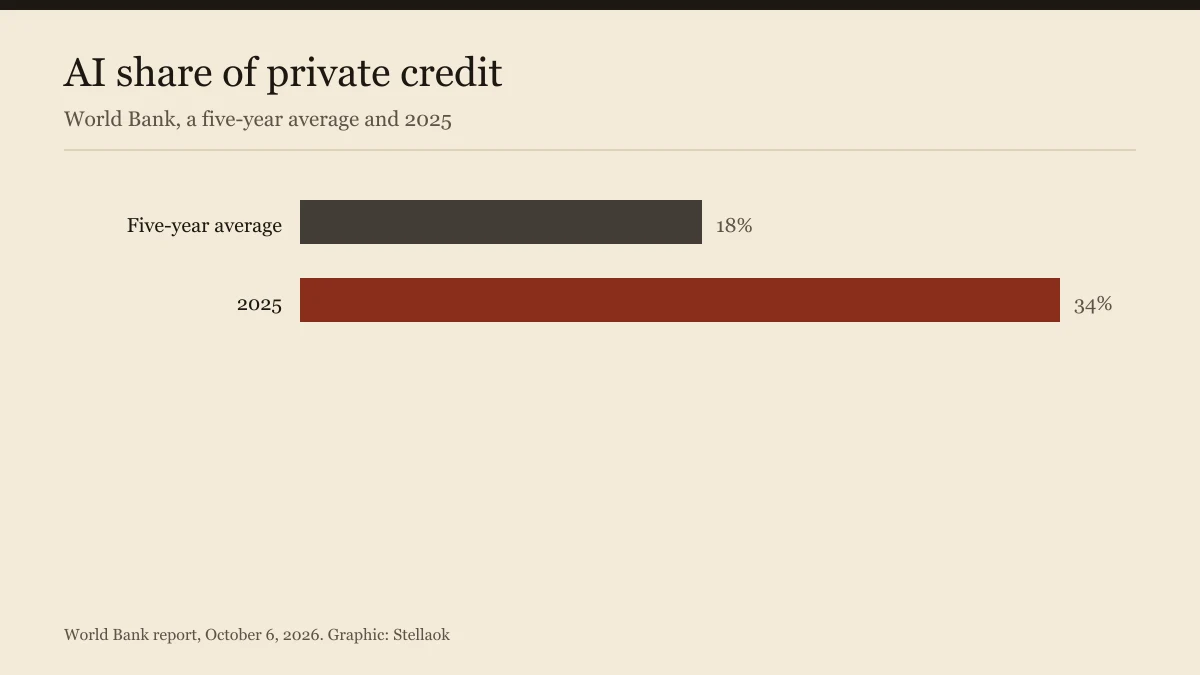
AI-related capital spending has reached about 6 percent of U.S. GDP, a level the bank sets next to the 2000 peak in information-technology investment. This cycle has risen faster than either previous one, and it is still speeding up. Of $2.9 trillion in AI capital spending planned for 2025 through 2028, $800 billion is expected from private credit. AI-related lending was 34 percent of private-credit activity in 2025, against an 18 percent average over the prior five years. Europe has already counted about $42 billion in delayed or cancelled data centers. The bank's worry is the financing, not the factory count.
Private-credit portfolios have seen markdowns, outflows, and defaults this year. The bank calls those markets less visible, and untested by a severe downturn. The Bank for International Settlements, in its June annual report, had already compared the boom's scale and pace to the dot-com years and to other manias. A correction, the World Bank says, would mean investment had run ahead of realized demand. It would not, on the bank's wording, automatically end the cycle.
Korea's chip share is the concentrated version
South Korea's exports grew 83.5 percent in September 2026, to a record $120.9 billion, and chips were half of that. Samsung and SK Hynix together were 43 percent of the Kospi's value at the end of April, the date the bank used. Taiwan's statistics bureau recently lifted its 2026 growth forecast to 11 percent from 9.6 percent on AI demand, and warned in June that a high-tech slowdown would hit the local economy harder than people expect. Micron's last quarter is what that chip demand did to one memory maker's profit.
A U.S. slowdown lands harder on investment
A one-point slowdown in U.S. growth cuts other emerging-market growth by an estimated 0.6 point, and the hit to investment is about twice as large. The bank says a slowdown concentrated in AI would matter more in East Asia because of the region's place in the supply chain. Foreign-currency liabilities of banks were 29.2 percent of GDP in Malaysia and 20.7 percent in the Philippines. Towns have already blocked $68 billion of data-center projects in a single quarter. The Fed raised rates last month, its first increase in more than three years, and signaled one more hike this year. The bank treats that tightening as one way the boom, which has been fed by abundant liquidity, could slow.