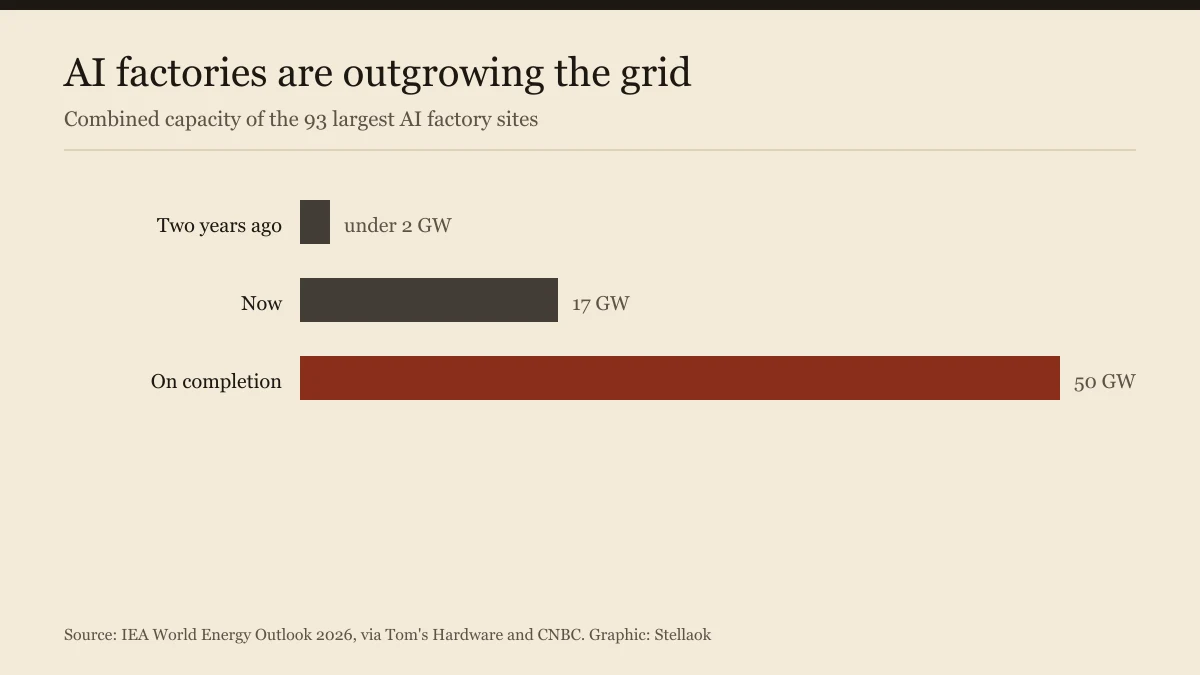
The International Energy Agency's World Energy Outlook 2026 puts numbers on the AI power boom, and they compound fast. Global data centers currently hold about 120 gigawatts of capacity, with another 120 gigawatts due by the end of the decade, three quarters of it dedicated to artificial intelligence. On top of that, the agency's satellite imagery tracks 93 large AI factories under construction or expansion, sites whose combined capacity grew from under 2 gigawatts to 17 gigawatts in two years and should reach 50 gigawatts when complete.
The scale, in units you can feel
Fifty gigawatts of AI factories alone equals adding a second Great Britain to world power demand. The aggregate picture is larger still: CNBC's summary of the same report has data centers consuming around 1,000 terawatt-hours a year by 2030, roughly double today's draw, in a scenario built only on measures governments have already put forward. The agency counts project pipelines in Texas, Virginia, Finland and the UK where data centers waiting to connect already exceed the local grid's entire peak demand.
Investment follows the same curve. Capital going into AI data centers is projected to reach $32 trillion by 2050, a figure larger than railways, electrification and the internet combined. Some operators are not waiting for utilities at all: the report notes projects like Elon Musk's Colossus 2 site in Southaven, Mississippi, generating their own power, with about 180 gigawatts planned or under construction across the United States.
Who pays for the wires
Community opposition to data centers usually centers on utility bills, and the IEA's finding is that both camps can be right. Its analysis "does not yet show a clear relationship between growth in data center capacity and increases in electricity prices." A center that uses existing capacity and pays its share of costs can spread fixed charges across more customers and lower bills, which is one way the hundreds of existing hyperscale sites have mostly avoided triggering bill shocks so far. A center that forces a grid upgrade can push those construction costs onto everyone's monthly statement. Which outcome arrives depends on local grid headroom, and the report projects peak demand rising 40 to 50 percent by 2035 against grids that need 26 million kilometers of new lines by then, with 16 million kilometers more refurbished and copper and transformer supplies already tight.
The generation mix behind the boom is also less green than the contracts look. Renewables dominate power purchase agreements at nearly half, but actual delivered power leans on coal and natural gas for about 60 percent, because reliability still requires fossil backup when the wind and sun do not cooperate. The agency expects coal and gas emissions from data centers to rise 70 percent by 2030.
The bottleneck is concrete, not silicon
The report's core warning is about construction time, not chip supply. Renewable plants take one to five years to build, roughly the same span as a large data center project without delays, while transmission lines take three to five times longer than the plants they serve. That mismatch explains why hyperscalers are putting jet engines beside their server halls, and why turbine blades, like transformers, are now scarce goods.
For an economy that one economist already calls balanced on a single AI leg, the grid, not the GPU, is emerging as the binding constraint on how fast the boom can grow. The IEA's framing is that the wires decide: where grids expand on time, the factories hum; where they lag, the projects wait in queue behind everyone else.