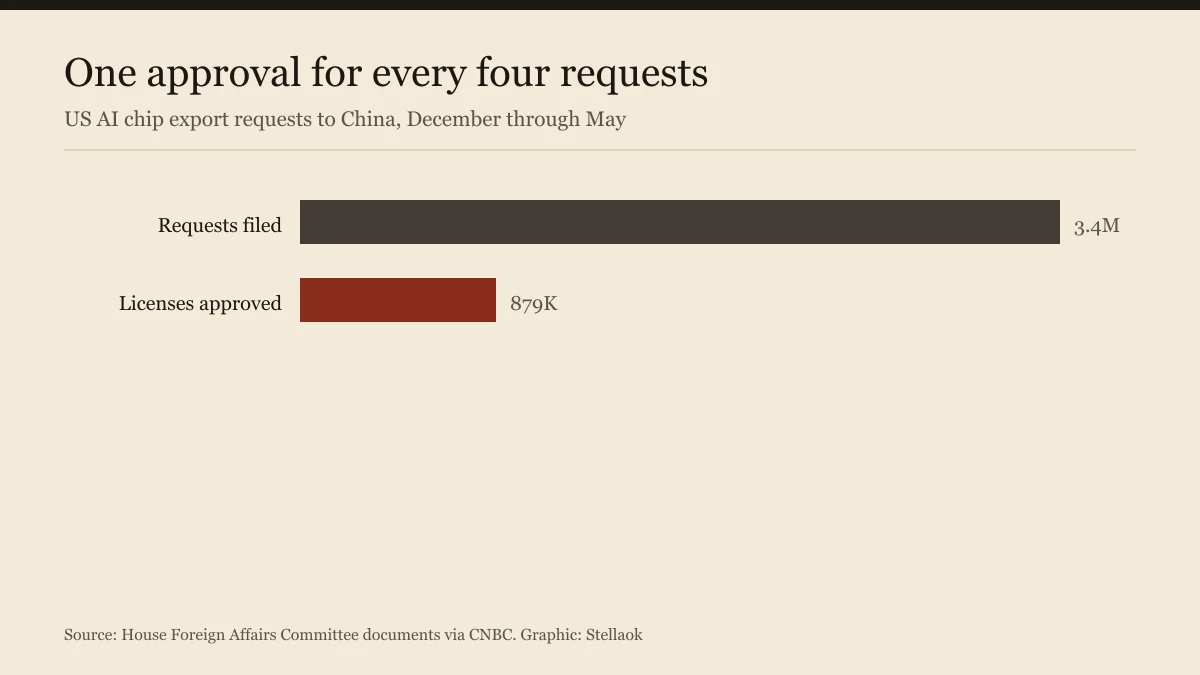
The Bureau of Industry and Security approved the sale of more than 879,000 AI chips to Chinese companies, including Alibaba and Tencent, as of May 2026, according to license records the House Foreign Affairs Committee voted Thursday to declassify. Some of those approvals covered companies the Department of Defense designates as Chinese Military Companies. Between December and May, requests filed for sales of US AI chips to China totaled 3.4 million, meaning roughly one approval went out for every four asks.
What the documents show
The released license requests name buyers including ByteDance, Tesla's Shanghai operation, and Baidu. The committee cited the Export Control Reform Act, which lets it declassify export data when withholding it runs against the national interest. "The license information we are disclosing today will help inform the American public about how BIS has handled licenses for Nvidia H200 and equivalent AMD chips to China," said Representative Gregory Meeks of New York, the committee's top Democrat. "The public has the right to know how these decisions were made."
Representative Brian Mast, the committee chair, flagged two applicants in Nvidia's paperwork, Maginfra and New Matrix, as suspected smuggling fronts, pointing to New York Times reporting that both companies had empty offices and ties to sanctioned firms. "Both are fake companies. If BIS approved the sale of these chips to these firms, obviously that is of tremendous concern to us," Mast said at the meeting.
The companies answer
Nvidia and AMD both said they comply with export law. A Nvidia spokesperson, John Rizzo, said the licensing review "spanned more than half a year, with approvals subject to strict conditions and limited volumes," and noted the company has since stopped shipping H200s to China altogether, a halt it announced as controls tightened earlier this month. A BIS spokesperson said licensing decisions are "the product of deliberation and consultation among multiple US Government agencies."
The approved volumes were small relative to demand, analysts said. Bernstein's Stacy Rasgon told CNBC the 879,000 figure is "not that many" and that the four-to-one rejection rate shows "a process in place." Beijing compounded the squeeze by declining to approve large-scale imports, which kept Nvidia's H200 shipments below 1 percent of data center revenue in the quarter ended July. This week's earnings report put quarterly H200 and related China revenue at $2.4 billion, with China and Hong Kong at about 9.5 percent of total sales.
The scandal behind the hearing
The release lands in the middle of a congressional inquiry into Nvidia's ousted leadership. Jensen Huang resigned after reporting surfaced of extramarital affairs, including one with a suspected Chinese agent, and lawmakers have since questioned whether chips could have been diverted through people close to the company. Huang is scheduled for a closed-door interview with three committees on December 1, general counsel Tim Teter appears December 2, and Senate Banking Committee chair Tim Scott said Huang and Commerce Secretary Howard Lutnick have also agreed to testify. Lutnick has drawn fire over his ties to Huang and over inaction on Megaspeed, the Singapore firm where Alice Huang was an executive until 2025 and which investigators suspect of diverting chips to China.
Congress has not limited itself to hearings. The Commerce Department issued an interim final rule Monday closing the loophole that let Chinese companies lease Nvidia compute from third-country data centers, an extension of export rules to rented compute that BIS said was written at the direction of Treasury and the National Security Council. Lawmakers in both parties are drafting bills to impose stricter controls on advanced AI chips sold to China and other adversaries.
AMD's exposure grew Thursday too. Its shares fell after Hunterbrook Media reported that IEIT Systems, a Chinese server maker on the entity list, kept receiving newer AMD firmware that allows AMD chips to run in servers. AMD said it maintains rigorous compliance processes across its global operations.