The 403 largest data centers in the United States consumed about 82 terawatt-hours of electricity between May 2024 and April 2025, roughly 1.8 percent of everything the country used, and produced 25.7 million metric tons of carbon dioxide doing it. The figures come from a paper published Monday in Nature Sustainability by a Harvard team that built the dataset from satellite imagery because operators do not report it.
For scale, 82 terawatt-hours is more than the annual consumption of about 148 countries on their own, a comparison run by John Sterman of MIT's Sloan Sustainability Initiative, who was not involved in the study. The emissions figure is close to Denmark's national total, and Sterman puts it above the combined output of about 113 countries. About 54 percent of the electricity those facilities drew came from gas and coal.
How they counted what nobody discloses
Lead author Gianluca Guidi, a postdoctoral fellow in biostatistics at Harvard T.H. Chan School of Public Health, started from 675 candidate sites and verified 403 of them against satellite images, then estimated each facility's annual draw from its electrical capacity and matched it to the local grid's fuel mix using Environmental Protection Agency data. The toughest part of the project, he told CNET, was preparing and validating that data, because individual data centers treat their power use as proprietary.
The method has a floor and a ceiling. CNET reports the range as 68 to 99 terawatt-hours depending on assumptions, which is why the headline number should be read as an estimate rather than a meter reading. What the paper does establish is the size of the fleet: an average facility in the dataset runs at 40 megawatts, and 403 of those add up to a demand that utilities now plan around.
Location is the variable that moves the number
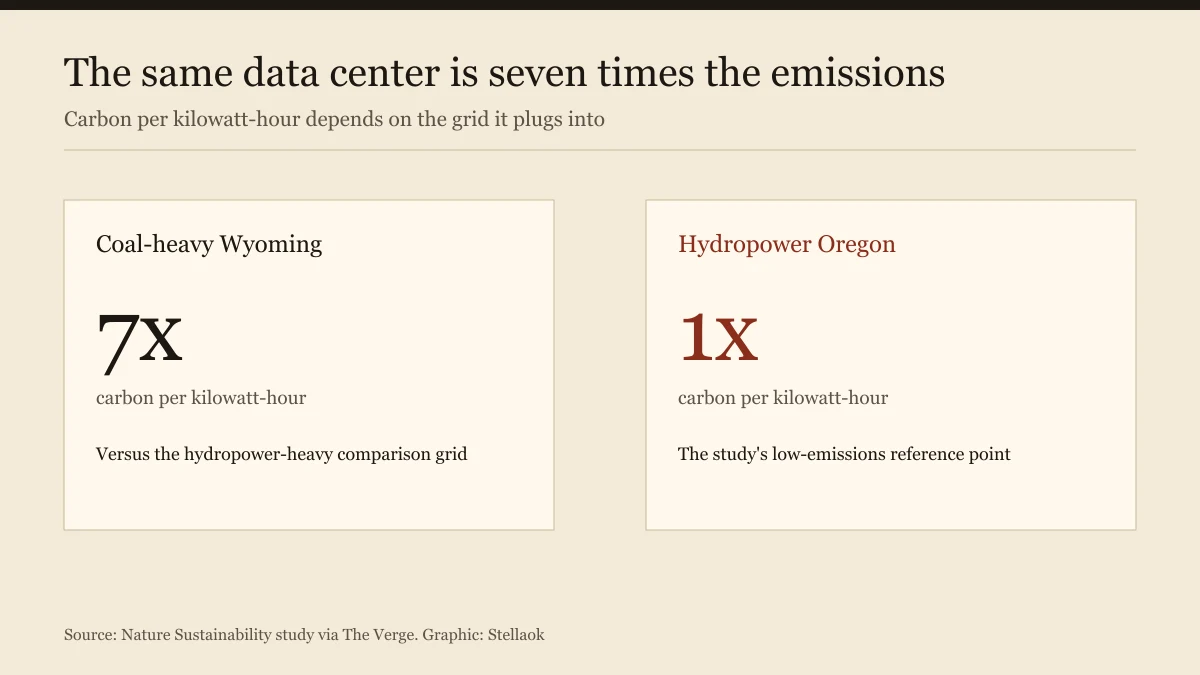
The same building plugged into two different grids produces very different emissions. Data centers in Wyoming, where coal still carries the load, emitted roughly seven times more carbon per kilowatt-hour than ones in hydropower-heavy Oregon. Four states, Virginia, Oregon, Ohio and Iowa, accounted for more than half the electricity use in the study, and northern Virginia's concentration is the reason its grid operator has become a planning case study for the whole country.
Divided out, 82 terawatt-hours across 403 facilities is a little over 200 gigawatt-hours a year each, which is what a town of roughly 20,000 homes uses. That per-site figure is the one that matters for local politics, because it is the number a county board sees when a developer files for a conditional use permit on farmland.
The gap between pledges and fuel mix
Most of the operators in the dataset have signed corporate renewable pledges, and the study finds that the physical supply has not caught up with the paper. Fengqi You, an energy systems engineer at Cornell who reviewed the paper, calls the result carbon lock-in: a gas plant built to serve a campus that comes online in 2027 will still be running in 2050, so the decisions made in this permitting cycle set emissions for decades.
Behind-the-meter generation is the part the study cannot see, and it is growing fast. Wired reports that as many as 189 gigawatts of on-site power are in the development queue earmarked for data centers, much of it gas turbines, and that BloombergNEF estimated last week that building all of it would raise total US emissions by about 10 percent. Guidi's paper excludes those plants, along with the local air pollution they create, which means the national picture it draws is a floor rather than a full accounting.
What would make the next study easier
Two things are changing. The Energy Information Administration has finished three pilot surveys of data center power use across 10 states and is now designing a voluntary sector survey, an agency spokesperson told Wired. And a bipartisan bill in Congress would require disclosure of electricity use at the facility level. Guidi's team is also building a public site that tracks individual data centers, so that a county can look up the building down the road instead of waiting for a peer-reviewed paper.
Until one of those lands, the numbers will keep being reconstructed after the fact by academics working from orbit. US data center construction is already running at an $85 billion annual pace, operators have started planting wetlands around new campuses, and one startup wants to move the whole argument offshore by floating its halls on ocean heat while the disclosure fight grinds on. Gina McCarthy, the former EPA administrator, said in a statement distributed by the authors that communities need independent data on what these facilities mean for air and health. The paper supplies a year of it, and the year it covers ended 19 months before today's construction pipeline.