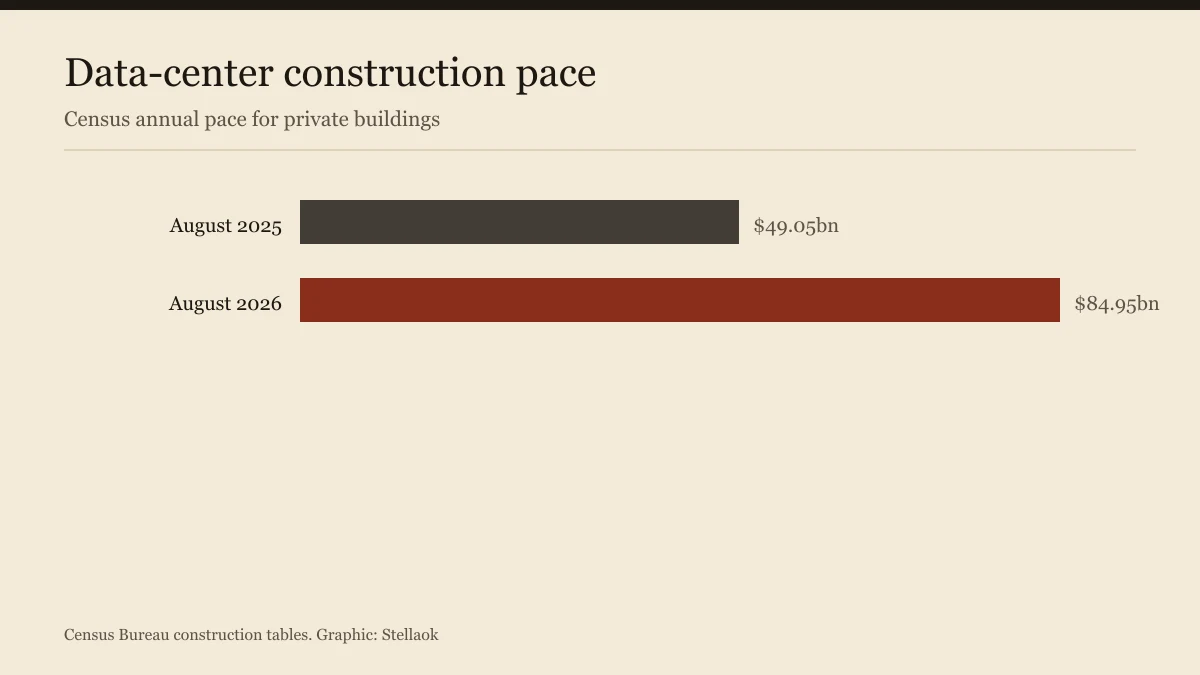
Private data-center construction in the United States is running at an $84.95 billion annual pace, up from $49.05 billion a year earlier. Tom's Hardware, reading the Census Bureau's August 2026 construction tables, calls that a rise of more than 73 percent and the fastest growth since April 2025, when the same series rose 88.2 percent. The report came out last week.
A full year at August's pace is how Census turns one month of put-in-place spending into the $84.95 billion figure. The $49.05 billion is the same calculation a year earlier. General office, at $45.8 billion, has been falling since January 2023, down 34.8 percent over that stretch and 9.7 percent over the latest year. Manufacturing construction is down 19.8 percent year over year. Power construction is up 9.7 percent, and Basu tied that rise to the electricity these buildings need. The $5.9 billion data-center share of an $8.0 billion monthly increase is 74 percent of the gain. Private nonresidential spending as a whole is down 1 percent, to $773 billion, and down 5.9 percent if the data centers are removed, to $688.1 billion.
Census has published this cut of construction spending since January 2014. Data centers became the majority of private office only recently, and the September 2025 crossover is the month Tom's Hardware says they started beating general office every month. Growth has sped up for four straight months in the piece's reading. April 2025's 88.2 percent jump is the faster comparison the August pace does not beat. Basu's September 1 note is the contractors' version of the same split: without these buildings, July's nonresidential gain disappears. November 2 is when the September tables are due, and the piece says they may keep the streak.
The Tom's Hardware account is careful about what the dollars buy. Census measures the value of construction put in place, then scales a month into a full-year pace. Data centers, in that definition, are buildings that hold the hardware for storing, processing, and transmitting digital information. They are a slice of private office. Racks and servers are not in the number. Power plants and transmission lines built for those buildings sit in a separate power category.
The office category flipped
Data-center construction is about 63 percent of all private office construction, against 47 percent a year earlier. It has beaten general office spending every month since September 2025. General office is at $45.8 billion, down 9.7 percent from a year earlier and 34.8 percent since January 2023. The gap between the two, $39.1 billion, is the widest since the Census series begins in January 2014. Data-center construction is more than nine times its January 2021 level of $9.26 billion. Amazon has said it stopped using nondisclosure agreements on these projects. The buildings are no longer the quiet line inside office construction.
Power plants are counted somewhere else
Private nonresidential construction was $773.0 billion, down 1.0 percent from a year earlier. Strip data centers out and the rest was $688.1 billion, down 5.9 percent. Of an $8.0 billion monthly rise in private nonresidential spending, $5.9 billion, or 74 percent, was data centers. Manufacturing construction is down 19.8 percent from a year earlier. Power construction is up 9.7 percent. Associated Builders and Contractors chief economist Anirban Basu said on September 1 that July's nonresidential gain was entirely due to data centers, and that power's growth was boosted by their electricity demand.
Four months of faster growth, then November 2
Tom's Hardware's own reading of the recent months is May at 36.3 percent year over year, June at 55.2 percent, July at 65.3 percent, and then the August pace. September's tables are due November 2. The Senate killed a bill that would have told regulators to look at who pays for the grid upgrades. The Census number is the shells. The chips that go inside them are a different invoice, and this series does not try to guess why the shells got more expensive.