Microsoft is reshaping the land around more than 20 data-center sites with restored wetlands and native gardens. The company says the approach is now part of every new U.S. project. The stated aim is to blend the buildings into the surroundings in the United States and Germany. Public Citizen's Texas director, Adrian Shelley, called it "basically lipstick on a pig," after a 20-year deal Microsoft signed in June to buy power from a planned Chevron gas plant in West Texas.
Tom's Hardware, citing The Verge, names the person running the land work. Kaitlin Chuzi, director of global land strategy, says the fixes are local: restore what was lost, and use plants to quiet the hum and cut the view from nearby houses. A tool called Ecosystem Intelligence, running on Azure, scores water quality, biodiversity, and noise. Named places include Mecklenburg County, Virginia; Mount Pleasant, Wisconsin; East Point, Georgia; Bedburg, Germany; plus Ohio, North Carolina, and Wyoming.
Mount Pleasant put 100 acres back into prairie
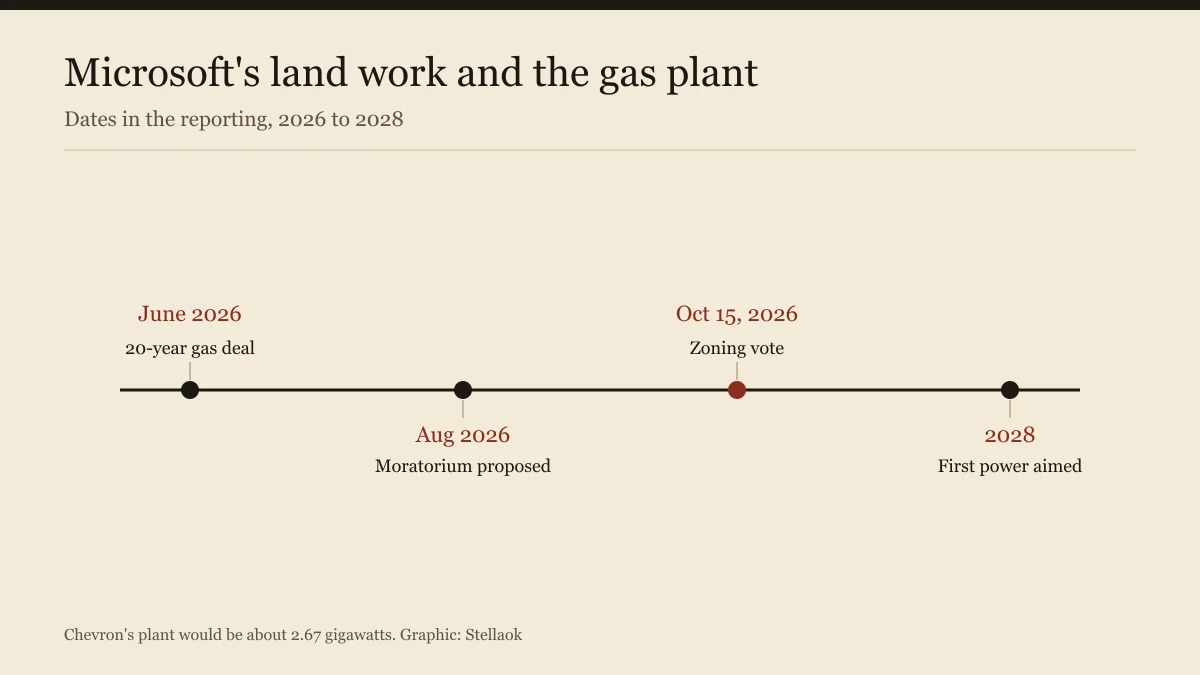
Fairwater, which Microsoft calls the world's most powerful AI data center, sits at Mount Pleasant. The restoration there is 100 acres of prairie and forest along Lamparek Creek, with the Root-Pike Watershed Initiative Network. Executive director Dave Giordano said Microsoft built stormwater ponds with forebays to hold sediment. "Not all data center companies are the same," he told the outlet. In San Antonio, District 6 councilmember Ric Galvan counts more than a dozen centers in his district, with more proposed. A 2022 approval let Microsoft remove 2,642 trees from a 33-acre tract. Spokesperson Jennifer Lyons said the company is putting money into more than 400 acres of woodland and pollinator prairie in the city, and intends to leave the land more productive than it received it. Galvan said covering bases is fine if residents are actually answered. He proposed a moratorium in August. The council refused a blanket pause and is weighing zoning instead.
The council votes on October 15, 2026
That zoning vote is scheduled for October 15, 2026. Shelley' s objection is the neighbor the gardens do not change: a gas plant. Chevron says the plant would provide about 2.67 gigawatts if it is built, with first power anticipated in 2028. "I cannot really see any level of biomimicry investment that makes a gas plant a desirable neighbor," Shelley said. Governor Greg Abbott has paused grid connections for data centers until regulators audit them, and in September he barred the state environmental agency from issuing new data-center permits until that audit is done. The Houston Advanced Research Center put data-center water use at about 0.4% of Texas's total in 2025, and projects 0.5% to 2.7% by 2030.
Microsoft's own 2026 sustainability report, out in July, says emissions rose 25% in fiscal 2025, driven primarily by data-center expansion and by the company stopping its use of unbundled renewable-energy certificates. The 2030 goals are carbon negative and water positive. Microsoft says it met the water goal in fiscal 2025 by its own measure. Holly Alpine, who led restoration work near the centers until she left in 2024, still sees a gap between the build and those goals. Local opposition has already blocked $68 billion of projects in one quarter. The gardens are Microsoft's answer on the parcel. The gas contract is the answer on the wire.
First power, if the plant is built, is 2028
First power from the Chevron plant, if the plan holds, is 2028. The San Antonio zoning vote is October 15, 2026. The wetlands are the part already in the ground at Mount Pleasant. Welder and pipefitter ads have already jumped on the buildings these gardens are meant to hide.