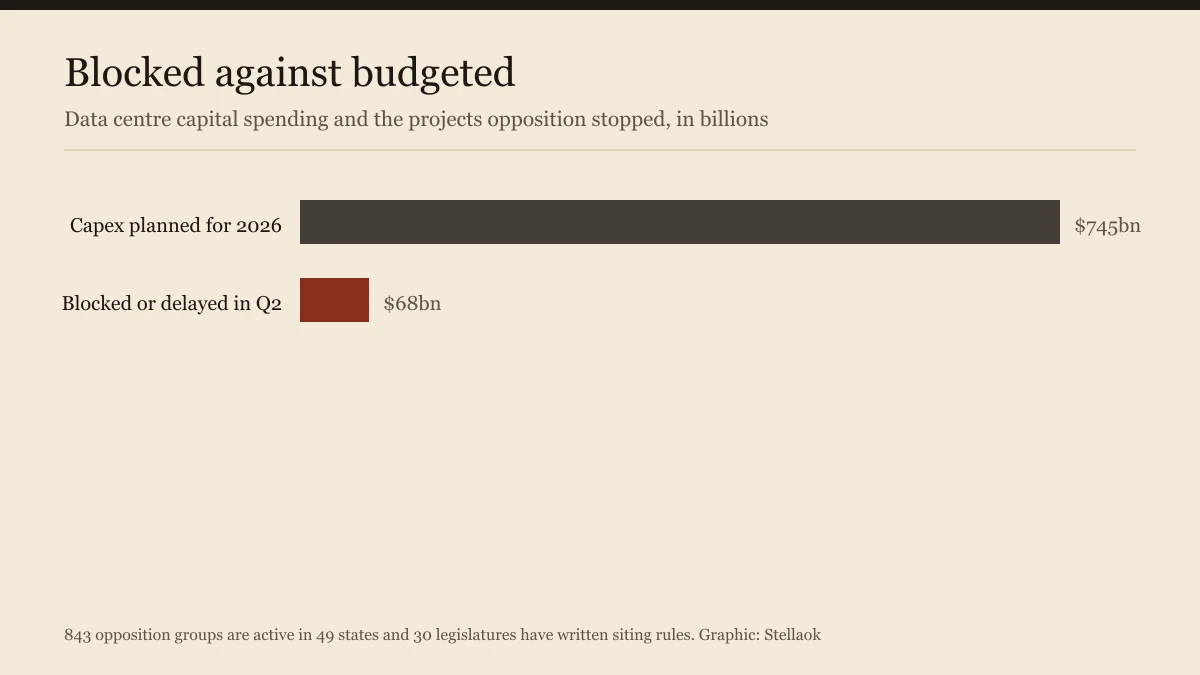
Local opposition blocked or delayed $68 billion of data centre projects between April and June this year. That figure comes from Data Center Watch via a Bloomberg report, and Tom's Hardware set it against the spending it is pushing back on: hyperscalers have committed more than $1 trillion to data infrastructure since 2023, with another $745 billion of capital expenditure expected in 2026 alone.
So the resistance is stopping about 9% of one year's planned spending. That is not a rounding error and it is not a halt.
The organisation is the news, not the sentiment
Opposition to data centres has been reported as a mood for two years. The numbers now describe something structural.
Thirty state legislatures have implemented rules on where data centres can be sited and how much water and power they may draw. Data Center Watch counts 843 opposition groups across every US state except Hawaii. In July, 142 separate protests ran across 42 states in a single weekend, which requires coordination rather than coincidence.
The tactic has also shifted. Communities are pursuing moratoriums on construction before developers file for permits, which moves the fight from the planning hearing to the statute. A developer can win a permit argument. It cannot easily win against a rule that says no applications will be accepted.
The density is what makes this hard to route around. Spread 843 groups across 49 states and the average state has 17 of them, which means a developer scouting a site is not choosing between a hostile county and a friendly one so much as choosing which organised opposition it prefers to negotiate with. Thirty states having already legislated means more than half the country now has statutory language a project has to satisfy, rather than a planning board to persuade.
The stated concerns are land use, noise, electricity and water. Water is the one with the largest number attached: AI is projected to consume up to 600 billion gallons by 2030, because hundreds of thousands of accelerators have to be cooled. Hyperscalers argue the issue is being overstated.
Texas moved, and Texas is the test case
Governor Greg Abbott ordered a halt on data centre permits weeks after issuing them, which is the most consequential single development in this story. Texas has been the default destination for projects that ran into resistance elsewhere, on the strength of cheap land, a separate grid and a permissive regulator.
If Texas is prepared to pause, the geographic escape route narrows considerably. That is a different problem from any individual project being blocked, because the industry's operating assumption has been that opposition in one county simply relocates the build rather than preventing it.
President Trump's position, quoted in the reporting, is that communities opposing these projects "want to end up being backwards and poor." That framing tells you the federal preference, and it does not settle a state permit or a municipal moratorium, which is where the decisions are actually made.
The money still expects to win
Set against all of it, the long-range forecast has not moved. Data centre investment is still described as on track to reach $3.2 trillion by 2050.
The reconciliation between that number and 843 opposition groups is timing and location rather than volume. Capital this size does not get cancelled by local politics, it gets slower and more expensive, and it moves to places that will take it. The cost shows up as delay, as concessions on water recycling and noise abatement, and as higher payments to the communities that say yes.
Which means the investable question is not whether the buildout happens. It is who absorbs the friction cost, and the honest answer so far is ratepayers and developers in roughly unknown proportions.
The politics are hardening on both sides. The Congressional Black Caucus spent last week on this, with its vice chair claiming 60 of its 62 members would vote for AI guardrails while Meta briefed the same conference on what data centres do for local economies. The grid operators caught in between have their own view of the risk, which is less about the models than the people running them. And in jurisdictions where the politics are easier, the projects keep getting larger, as with the plan to quadruple a Saskatchewan AI data centre into the largest private investment in the province's history.