Vietnam is the largest electric car market in Southeast Asia. Sales more than doubled in 2025 and electric vehicles now account for almost 40% of new car sales, according to International Energy Agency data released in May. That is a higher EV share than almost anywhere outside China and Norway.
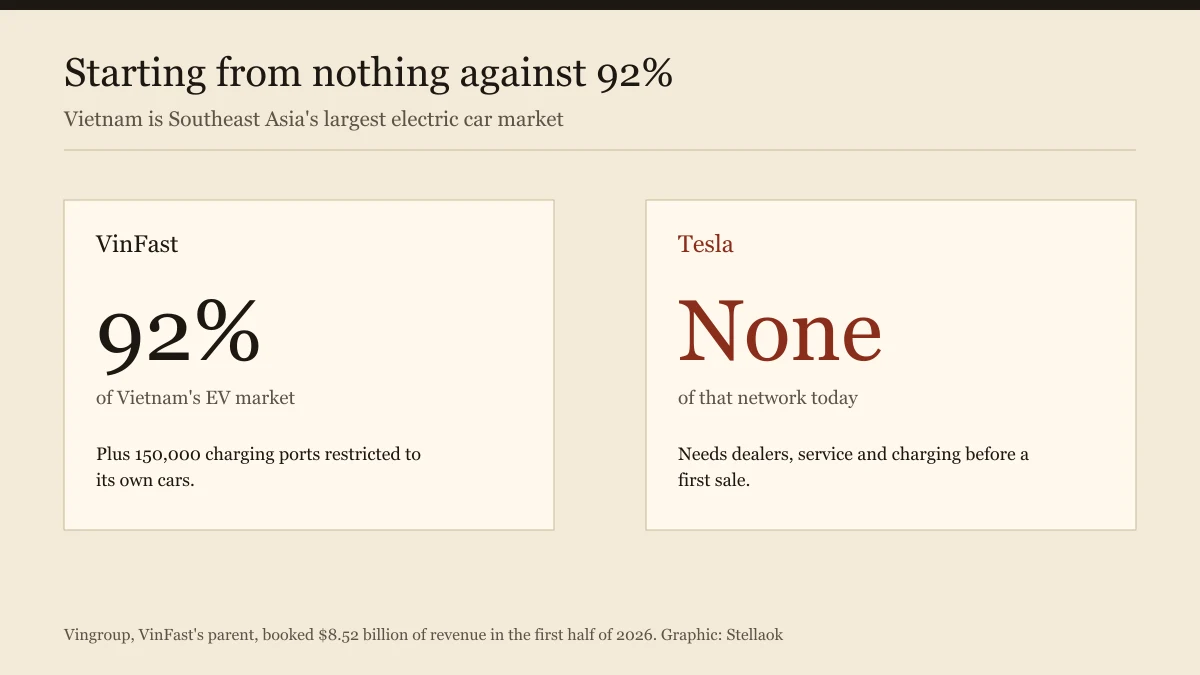
Tesla is moving in, and one company already has 92% of it. CNBC's report puts VinFast's domestic share at that level, citing HSC research, with no timing yet public for a Tesla entry.
VinFast's advantage is not the car
The Nasdaq-listed manufacturer is backed by Vingroup, one of Vietnam's largest private conglomerates, founded by billionaire Pham Nhat Vuong. Vingroup booked 221.97 trillion dong, about $8.52 billion, in revenue in the first half of 2026.
What that buys is an ecosystem rather than a product line. Koketso Tsoai, senior automobiles analyst at BMI, a Fitch Solutions unit, lists local brand recognition, Vingroup's wider consumer businesses, and constant street-level visibility through an affiliated electric taxi fleet. The charging and after-sales network reduces what he calls perceived ownership risk, which for a first-time EV buyer is most of the purchase decision.
His conclusion is blunt. "It would be difficult for Tesla to compete with VinFast in Vietnam because VinFast has advantages that go well beyond product availability."
The charging number is the barrier
Here is the figure that defines the problem. VinFast operates a proprietary network of more than 150,000 charging ports, restricted to its own vehicles, according to Supparoek Sawangwong, ASEAN analyst at Mobility Global.
Restricted is the operative word. A buyer choosing any other brand is choosing a smaller charging network by an enormous margin, and that calculation happens before anyone compares range or software. Sawangwong notes the same infrastructure position has already made Vietnam difficult for BYD, which is not a company that usually struggles on price or distribution in Asia.
Tesla's normal playbook does not obviously answer this. Its Supercharger network is a competitive asset in markets it entered early, and in Vietnam it would be starting from nothing against an incumbent with six figures of installed ports. Building distribution and service coverage is the other requirement Tsoai identifies, in a market where buyers are, in his description, highly sensitive to price and practicality.
There is a version of this that works, and it runs through opening the network. Tesla has spent the last few years letting other manufacturers onto Superchargers in North America and Europe, turning a moat into a toll road. Vietnam inverts the problem: Tesla would be the brand asking for access, and VinFast has no commercial reason to grant it while its own share sits at 92%.
What Tesla is actually buying into
The case for going anyway is the market's growth rate rather than its current structure. Doubling sales in a year and reaching 40% EV share means the addressable customer base in 2028 will be much larger than today's, and a distant second position in a fast-growing market can be a decent business even when the leader is entrenched.
Price is where it gets difficult. Vietnam's buyers are sensitive to it, VinFast makes vehicles designed for local incomes, and Tesla's cheapest models are not priced for that segment. Competing on practicality means solving charging, which means capital expenditure in a market where the incumbent's network is already built and closed.
None of which has a date attached. Tesla has signalled interest and disclosed nothing about timing, which for a company that has previously announced market entries years ahead of delivery is worth holding lightly.
The wider regional picture is that Southeast Asian governments are all trying to attract this manufacturing rather than just the sales, and the credibility of the policy varies by country. Indonesia's new finance minister inherited exactly that kind of test. The economics also depend on what the alternative costs to run, and fuel prices have been doing the EV case a favour, with diesel at record levels that transport firms called science fiction.