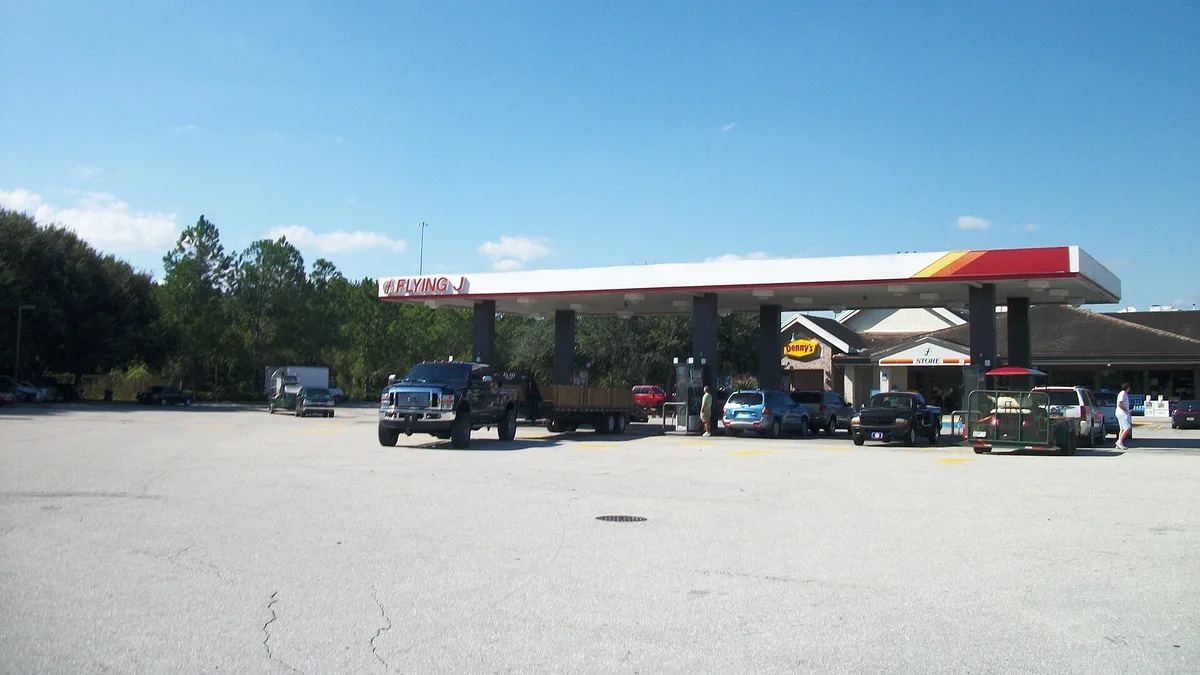
Diesel, the fuel that powers trucks and trains, reached an all-time high of $6.31 a gallon on Wednesday. Transport companies said that level belongs in "science fiction." They are not describing a rounding error. They are describing a planning break.
Carriers that move freight by road and rail are the first buyers of those gallons. At $6.31, every loaded mile costs more. Firms that call themselves the backbone of the economy are warning that the price is unworkable.
$6.31 is a cash cost, not a metaphor
The record print is a spot figure for Wednesday. Operators say it does not read as a brief spike they can absorb. They are treating it as an alarm. CNBC Markets put $6.31 on the board and carried the "science fiction" line with it, which is how a truck-stop number becomes a market-wide headline.
Diesel sets the cash cost of trucking and a large share of rail haulage. When that cost hits a high, freight rates and delivery times tend to follow. That is why the sector is speaking first. The rest of the economy buys the same fuel indirectly, through shipping bills.
Waiting for a recession print is how you miss the surcharge round. Surcharges will try to push $6.31 downstream this month. Where contracts lag, margins take it. Where surcharges stick, grocers and manufacturers inherit it. Households inherit it after inventories turn.
The companion explainer on how record diesel rips from freight into the broader economy is the pass-through map. This piece is the price. Keep both. A record without a map is just a scare. A map without $6.31 is a lecture.
Trucks and trains buy this fuel in the morning
U.S. retail diesel's last crisis chapter was 2022, after Russia's invasion of Ukraine tightened global distillate. National averages ran to then-record levels and stayed elevated longer than crude bulls wanted. Gasoline grabbed the ads. Diesel grabbed the invoices. That split has not changed.
Trucking moves most U.S. freight by tonnage. Class 8 tractors fill up at truck stops, not at the neighborhood station that sets the political temperature. Freight railroads run diesel-electric locomotives on the vast majority of their networks. Electrified rail is a passenger-city story here, not a transcontinental freight story. When diesel prints a record, both modes feel it the same morning.
The Energy Information Administration's weekly retail survey is the public tape. Carriers have their own rack prices and hedges. They still use the national number to explain a surcharge to a customer who thinks fuel is cheap. A $6.31 handle ends that argument for this week.
U.S. natural gas slipping as European prices hit a one-week low is a reminder that fuel complexes can fade on one continent while another stays on fire. Distillate is the fire. Bulk shippers, including names such as Teck sitting on chart support, will see it in delivered cost even if their product is ore rather than oranges.
Iran is in the oil backdrop for this print. Few fleet managers are treating Wednesday as weather. If crude stays geopolitically bid, diesel does not get a gentle mean-reversion just because someone wants one.
If surcharges fail, service fails
The next EIA weekly print will show whether $6.31 was a spike high or a new floor. One Wednesday is a record. Two or three weeks in that neighborhood is a planning assumption, and planning assumptions get built into rates.
Watch crude and the diesel crack together. An oil shock that keeps distillate tight will not let this fade just because a crude contract had a down day. Product inventories and refinery runs are the plumbing.
Fleet managers who can delay a purchase of new tractors will delay. That is how a fuel spike becomes a Class 8 order-book story, which then becomes a manufacturing story. You do not need a new number beyond $6.31 to see the channel. You need the print to last.
Earnings-season language from trucking, rail, and large shippers is the tell after the pump. If "science fiction" becomes a quantified surcharge, the alarm has moved to the P&L. If management teams say they cannot recover it, the alarm has moved to capacity. That second outcome is worse for the real economy than an ugly fuel line.
The backbone sector has already spoken. Either the price comes down, or the rest of the economy starts speaking too. There is not a third option that leaves $6.31 as a curiosity.