The University of Michigan consumer sentiment index hit record lows this year. It fell 13% year over year in September, with almost 8% of that coming from August alone. Output growth and equity markets tell a different story, and economists have spent the entire post-pandemic period arguing about which one to believe.
Goldman Sachs economist Joseph Briggs offered clients an answer this week that is uncomfortable for anyone who trades on the number. "Low reported economic sentiment likely reflects a more fundamental, downbeat assessment of the state of the world rather than the economy," he wrote.
The happiness data he is pointing at
Briggs builds the case on the University of Chicago's General Social Survey, which has been asking Americans the same questions for decades and shows a decline that never reversed after the pandemic.
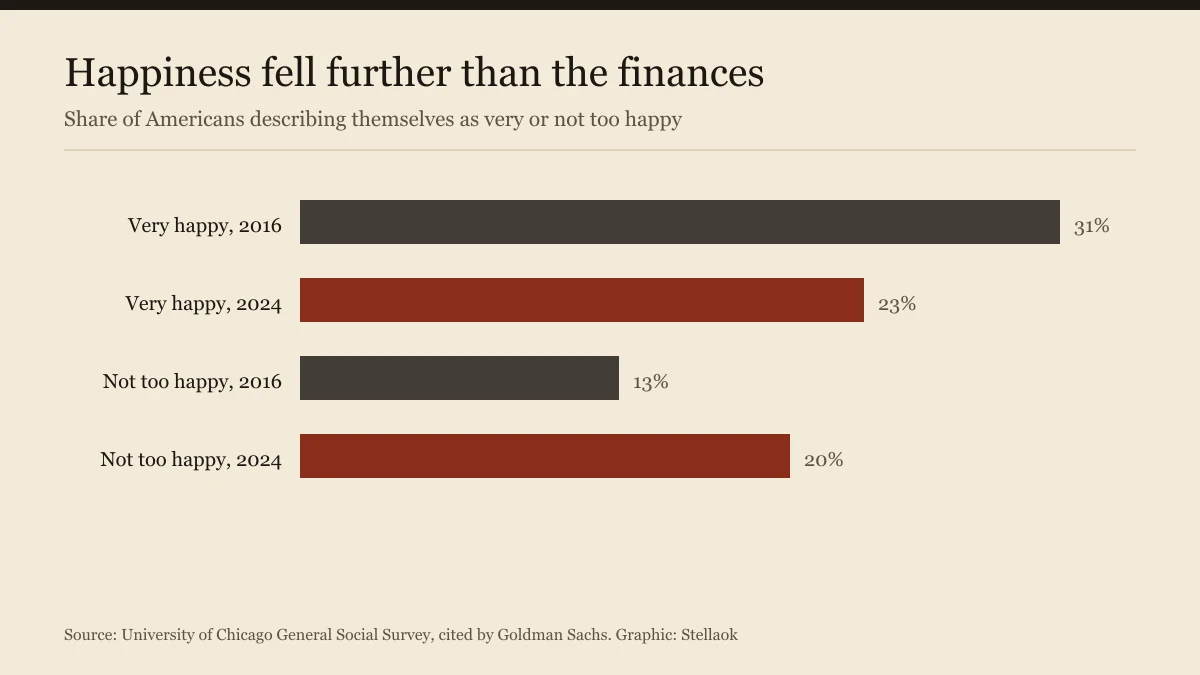
The share of respondents describing themselves as very happy fell to 23% in 2024 from 31% in 2016. Those saying they were not too happy rose from 13% to 20% across the same period. In Briggs's reading of the data, overall happiness dropped further than the financial satisfaction measure tracked in the same survey, which is the detail that separates his argument from a simple cost-of-living story.
He also finds trust doing much of the work. Declining confidence in public institutions accounts for what he calls a disproportionate amount of the fall in net happiness in recent years. Joanne Hsu, who directs the Michigan survey, told CNBC earlier this year that her own readings track alongside both falling happiness and falling institutional trust.
Prices are still in the mix
Briggs is careful not to claim mood explains everything, and inflation remains part of his answer. That caveat matters, because the household arithmetic has been genuinely bad even when the aggregates looked fine.
Real pay has been the sharper complaint. When inflation at 3.4% outruns wage growth at 3.1%, a household loses ground every month regardless of what GDP does, and the loss compounds quietly. Separate confidence measures have moved the same way, with the consumer outlook index falling to 47.8 as inflation expectations worsened. A story that attributes all of that to general malaise is doing the survey respondents a disservice.
The more defensible version of Briggs's point is narrower: price levels explain a lot of the decline, and something else explains the residual that has refused to close for five years.
What breaks if he is right
The consequence Briggs draws is the one markets should care about. If sentiment is anchored to non-economic variables, it may not recover even if the economy keeps performing, and it becomes a weaker predictor of what households will actually do.
That is a real problem for anyone using the series as an input. Consumer sentiment earned its place in forecasting models because it led spending. A measure that now reflects institutional trust as much as economic conditions will keep generating signals that never show up in the retail data, and forecasters who keep treating a low print as a warning will keep being wrong in the same direction.
It also cuts the other way politically. If sentiment no longer responds to output, then no amount of good macro data fixes it, and the gap between reported conditions and reported feelings becomes permanent rather than a lag. Policymakers who have spent years waiting for sentiment to catch up to the numbers are waiting for something that may not be coming.
The practical response is to stop reading the index as a single thing. The financial satisfaction component still tracks the economy. The headline increasingly tracks the country's mood about itself, and those are different series wearing the same name.