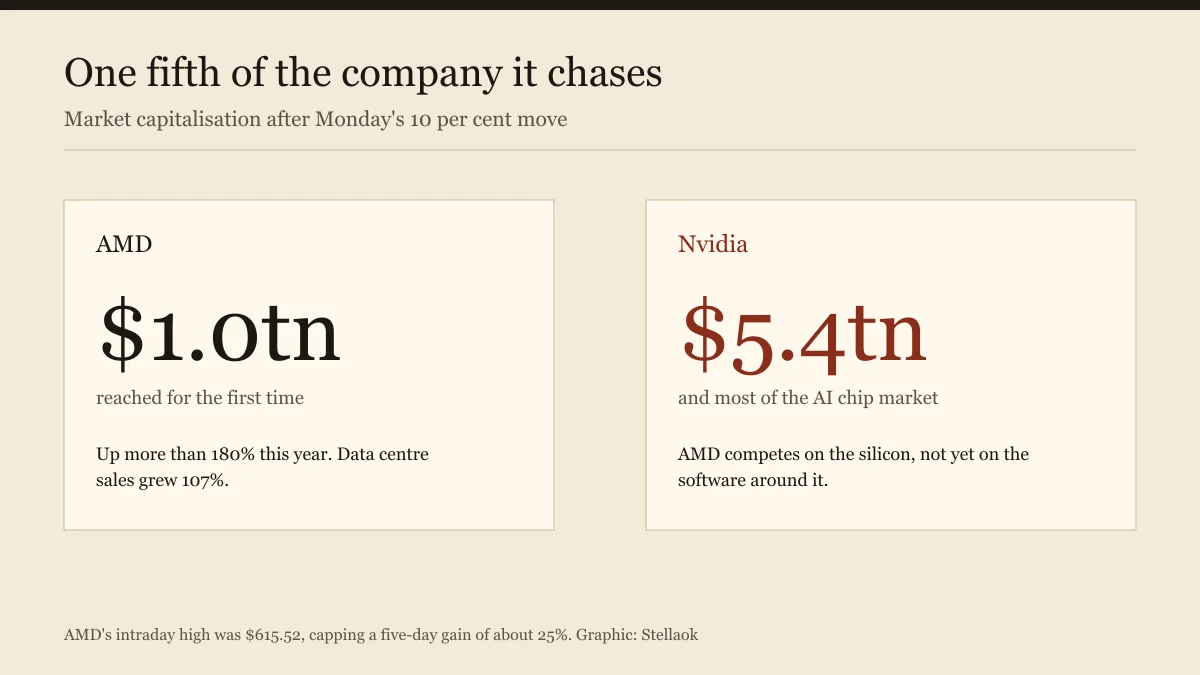
AMD shares rose 10% on Monday to an intraday high of $615.52, pushing the company past a $1 trillion valuation for the first time. That capped a five-day run worth about 25%, and it comes in a year where the stock is up more than 180%.
It is a genuine milestone and it needs the other number next to it. CNBC put them side by side: Nvidia is worth roughly $5.4 trillion and holds the majority of the market for AI data centre chips. AMD has just reached one fifth of its rival's size, in the business they are both in.
The growth is real and it is concentrated
Look at the last quarter and the rally makes sense. AMD reported revenue of $11.54 billion, up 50% from $7.69 billion a year earlier. The Data Center unit did $6.7 billion of that, up 107%.
Doubling a segment year on year is not a story about market sentiment. That is customers signing orders. And it tells you where the whole company now lives: at $6.7 billion of $11.54 billion, data centre work is 58% of revenue, which means AMD's valuation is a bet on AI infrastructure spending continuing, in the same way Nvidia's is.
It also sets the multiple. Annualise that quarter and AMD is running at roughly $46 billion of revenue, so a trillion-dollar valuation is about 22 times sales. That is a number that only works if the data centre line keeps compounding, because the rest of the business is not growing fast enough to justify it on its own. Every percentage point of deceleration in that segment costs more of the valuation than an equivalent slowdown anywhere else in the company.
Which is also the risk. A company whose growth is that concentrated in one demand cycle has its valuation set by the capital expenditure plans of a handful of buyers. Those plans are currently enormous, and they are announcements rather than deliveries.
The stock fell a month ago for a reason worth remembering
AMD dropped last month after reporting second-quarter earnings that beat expectations. The problem was the forecast, which came in short of what some investors had priced.
That is the shape of this market. Beating on the quarter is not enough when the multiple assumes acceleration, and a guidance number slightly below the most optimistic models is enough to take the stock down. The same mechanism works in reverse, which is what a 25% five-day move without a fresh earnings report looks like.
Anyone buying at a trillion dollars is buying into that volatility rather than around it. The 180% year is the reason to be interested and the reason to be careful about the entry.
What the gap to Nvidia actually represents
Five times the market capitalisation is not five times the silicon. Nvidia's advantage is the software layer, the installed base of developers trained on its tools, and supply agreements signed years out. AMD competes on the chips and has been closing on raw performance for several generations. Closing on the ecosystem is a longer job and the market is pricing it that way.
There is a second reading of the gap that favours AMD. If AI infrastructure spending keeps growing at the rate the hyperscalers' own numbers imply, the constraint stops being who has the best part and becomes who can supply anything at all. A distant second supplier in a capacity-constrained market captures demand it could not win on merit, and 107% data centre growth is consistent with exactly that.
Nvidia's chief executive has said chip sales will double next year, which is the forecast underwriting both valuations. The spending behind it is visible in customer disclosures, including OpenAI's own projection of $856 billion on compute and a $278 billion cash shortfall through 2030. Memory is the other bottleneck nobody priced in, with suppliers like Micron pushing 512GB DDR5-9200 modules at the high end while memory costs distort the price of everything downstream.
The AI buildout driving all of it is showing few signs of slowing, and it is doing so against rising public resistance to data centres and unresolved questions about whether the models are safe to deploy at this scale. Neither of those has shown up in a chip price yet.