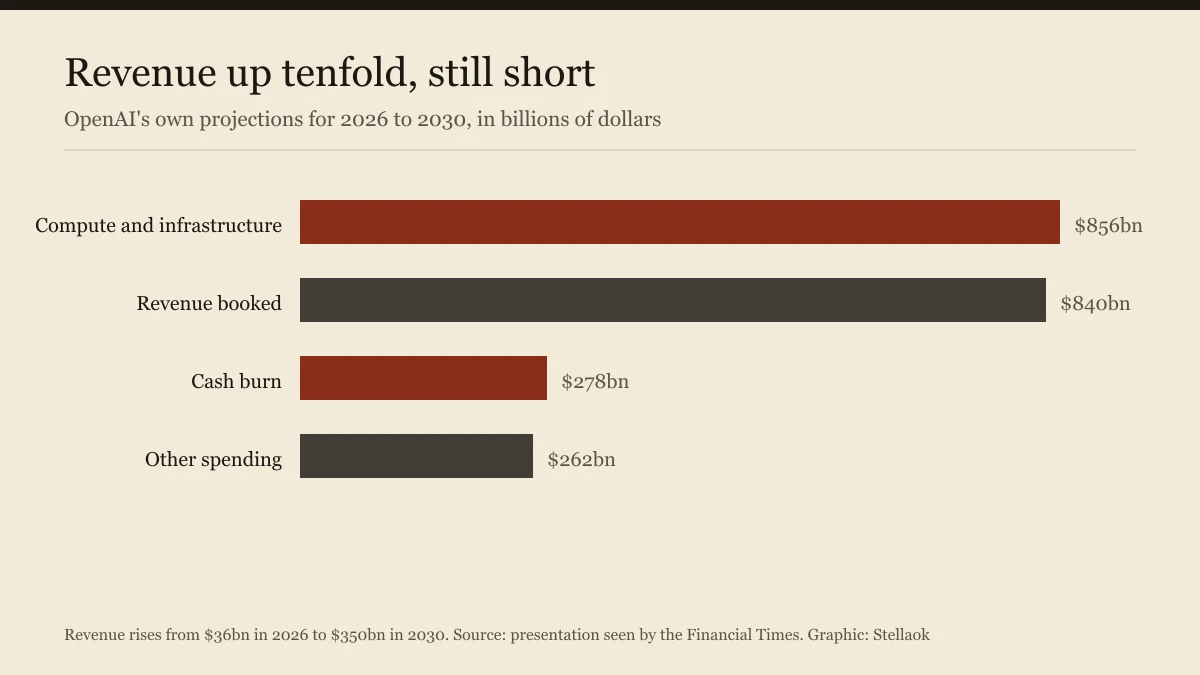
OpenAI expects to spend $278 billion more than it takes in between 2026 and 2030. That figure comes from the company's own investor presentation, seen by the Financial Times, and it sits alongside a revenue forecast that is genuinely spectacular.
Both things are true at once, which is the interesting part. Tom's Hardware laid out the arithmetic: revenue climbing from $36 billion in 2026 to $350 billion in 2030, $840 billion booked across the whole period, and $856 billion spent on computing and infrastructure in the same window. Add another $262 billion of other spending and the cumulative free cash flow comes out at negative $278 billion.
Growing tenfold is not enough
Read the two lines against each other and the story stops being about demand. Revenue rising almost tenfold in four years would be one of the fastest ramps in corporate history. It still does not cover the compute bill.
That is a structural point rather than an execution problem. Every additional user needs additional inference capacity, and the capacity has to be bought and powered before the revenue arrives. The spending curve leads the revenue curve by design, and at this scale the gap between them is measured in hundreds of billions.
There is one sign the trajectory is improving. The same model projected negative $305 billion in May, so the company has trimmed $27 billion off its expected shortfall in four months. Whether that reflects cheaper compute, better utilisation or simply a later start on some projects, the presentation does not say.
For scale, $278 billion lands just under the Austrian government's $286 billion of spending in 2024, and above the annual government expenditure of both Indonesia and Norway according to IMF figures. A more useful comparison, given who pays it: the gap equals four years of $20 monthly subscriptions from roughly 290 million people. As of early 2026 the company had more than 50 million consumer subscribers, over 9 million paying business seats, and more than 900 million weekly active users. The free tier is most of the audience and none of the revenue.
The funding clock is the real deadline
OpenAI raised $122 billion in March. Its own financial model shows that money running out in 2028, which is the date that actually governs the company's behaviour.
Talks about the next round are already underway. Prospective investors have approached at a $1.2 trillion valuation against the $852 billion the company was recently worth, and someone close to the company says it wants more than that. Raising at a higher mark while publishing a $278 billion burn is a specific bet: that capital markets will keep funding the gap because the revenue line eventually crosses the spending line.
The IPO timing tells you how confident they are about making that case in public. An autumn 2026 listing was planned, documents went to the SEC confidentially in June, and then the process was postponed. The stated reason was rising public concern about the risks of fast-advancing AI systems. Some observers read it differently, as nervousness about how public markets would price a company losing more per year than several national governments spend. Anthropic, meanwhile, is expected to go out this autumn in what could be the largest listing ever, which would hand investors a direct comparison OpenAI has so far avoided offering.
What it means if you are watching the rest of the chain
For anyone holding the suppliers rather than the model builders, this presentation is a demand forecast. An $856 billion compute commitment is an order book, and it lands on the companies selling accelerators, memory, power and buildings. Nvidia's chief executive has already said chip sales will double next year, and numbers like OpenAI's are where that confidence comes from.
The risk runs the same direction. A funding round that prices lower than $852 billion, or arrives later than 2028 needs it to, forces the spending curve down first, because compute is the one line big enough to cut. That is the scenario worth watching, and it would show up in supplier guidance long before it showed up in a press release.
The relationship with the largest backer is not simple either. Court filings have shown Microsoft privately describing OpenAI's data scraping as theft, which is an unusual position for a partner underwriting this much infrastructure. Investors reading the $278 billion figure should read that alongside it.