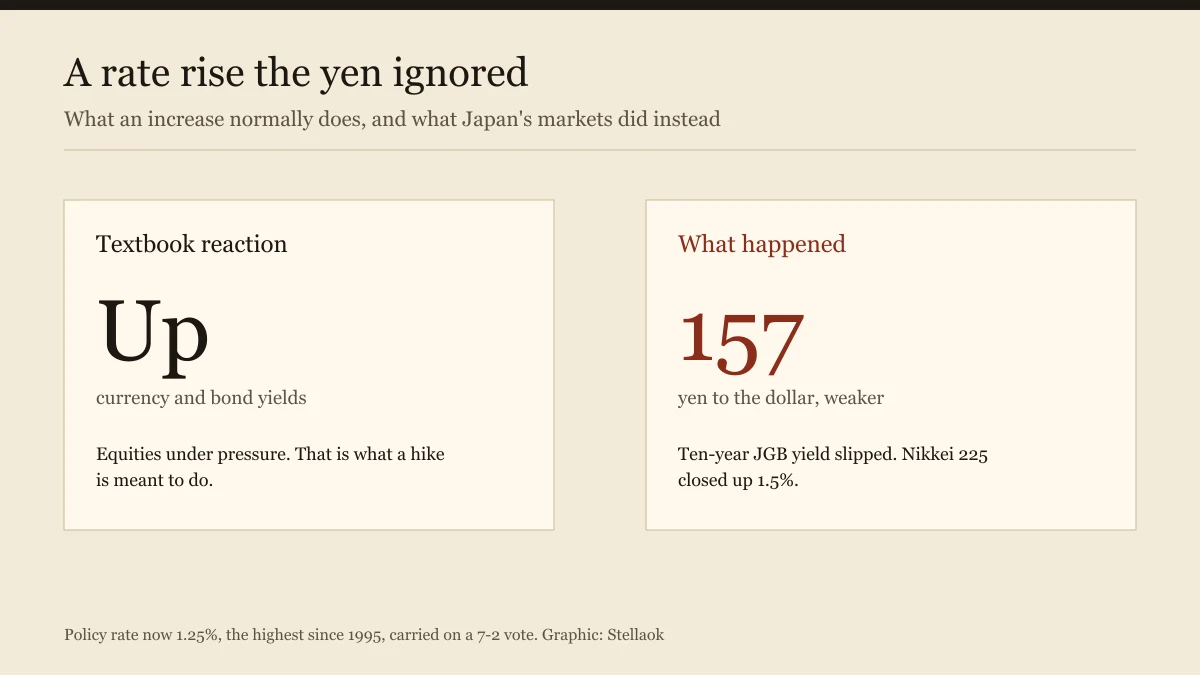
Textbook monetary policy says a rate increase lifts the currency, lifts bond yields and weighs on equities. Japan just delivered a rate increase and got the exact opposite on all three counts.
The Bank of Japan took its policy rate to 1.25%, the highest since 1995, and the yen promptly weakened past 157 against the dollar. The yield on the 10-year Japanese Government Bond slipped. The Nikkei 225 closed up 1.5%. CNBC reported the reaction as counterintuitive, which it is only if you stop reading at the headline number.
The vote mattered more than the rate
What traders actually priced was the split. The board went 7-2, with Toichiro Asada and Ayano Sato both arguing for no change at all. That is two dissents at a meeting the market had expected to be a comfortable consensus.
"The two dissenting votes in favor of keeping rates unchanged came as a surprise," said Hirofumi Suzuki, chief FX strategist at Sumitomo Mitsui Banking Corporation.
Asada's stated reason is the one worth holding onto. Core inflation ran at 1.7% in August, down from 1.8% in July, which puts it below the 2% target the bank keeps pointing at. If you are hiking into decelerating inflation, the case for hiking again three months later gets thinner, not thicker. Sato's objection was similar: nothing in recent price or activity data looked meaningfully faster than before.
There was a second, quieter signal. This hike arrived without an updated outlook report, which stripped the bank of the tool it normally uses to sound hawkish, according to Masahiko Loo, senior fixed income strategist at State Street Investment Management. No revised forecasts means no upgraded inflation path to justify the next move. Shigeto Nagai, head of Japan economics at Oxford Economics, read the statement the same way and noted the language barely moved from July's.
Put those together and the market conclusion is reasonable. The Bank of Japan raised rates because it had to and said as little as possible about what comes next.
The political read underneath the economics
Nagai added a detail that explains some of the caution. He told CNBC the two dissents signaled that Prime Minister Sanae Takaichi had not been persuaded to accept the United States' request for faster and larger increases.
That request is on the record. Reuters reported that Treasury Secretary Scott Bessent pressed the case for higher Bank of Japan rates in a May meeting with Finance Minister Satsuki Katayama. A central bank that moves too obediently on a foreign government's timetable has a credibility problem at home, and a board that splits 7-2 is a board demonstrating it is not taking orders.
This is the second increase in three months, following the split-vote hike that took rates to a 31-year high. The pattern of small moves with visible internal disagreement is now the house style.
What to watch, and what it costs you
December is the consensus for the next one. Sam Jochim, economist at EFG International, expects roughly quarterly increases as underlying inflation approaches 2%, with a peak somewhere between 1.75% and 2% in 2027. Stefan Angrick, head of Asia-Pacific economics at Moody's Analytics, also sees a move around the turn of the year but thinks weak demand-driven inflation and disappointing real wage growth cap what follows.
Governor Kazuo Ueda will keep insisting every meeting is live, per Loo. The framing that matters is Loo's other line: "The debate is no longer whether the BOJ hikes, but how far rates ultimately go."
For anyone holding yen exposure, the practical takeaway is that Japanese rate increases have stopped being yen-positive events. A 1.25% policy rate against a dollar still yielding far more leaves the carry trade intact, and a central bank that will not commit to a terminal rate gives currency traders nothing to reprice. The yen at 157 after a 31-year-high policy rate is the market saying the gap is not closing fast enough to matter.
The bank did flag one genuine risk to its own path. It expects growth to slow because of high oil prices tied to the Middle East conflict, which is the kind of supply-side inflation a central bank cannot fix by raising rates and usually chooses to look through. That tension, not the 1.25% headline, is what will decide December. The Federal Reserve is working through its own version of the same problem, with equity markets similarly declining to behave as the models suggest.