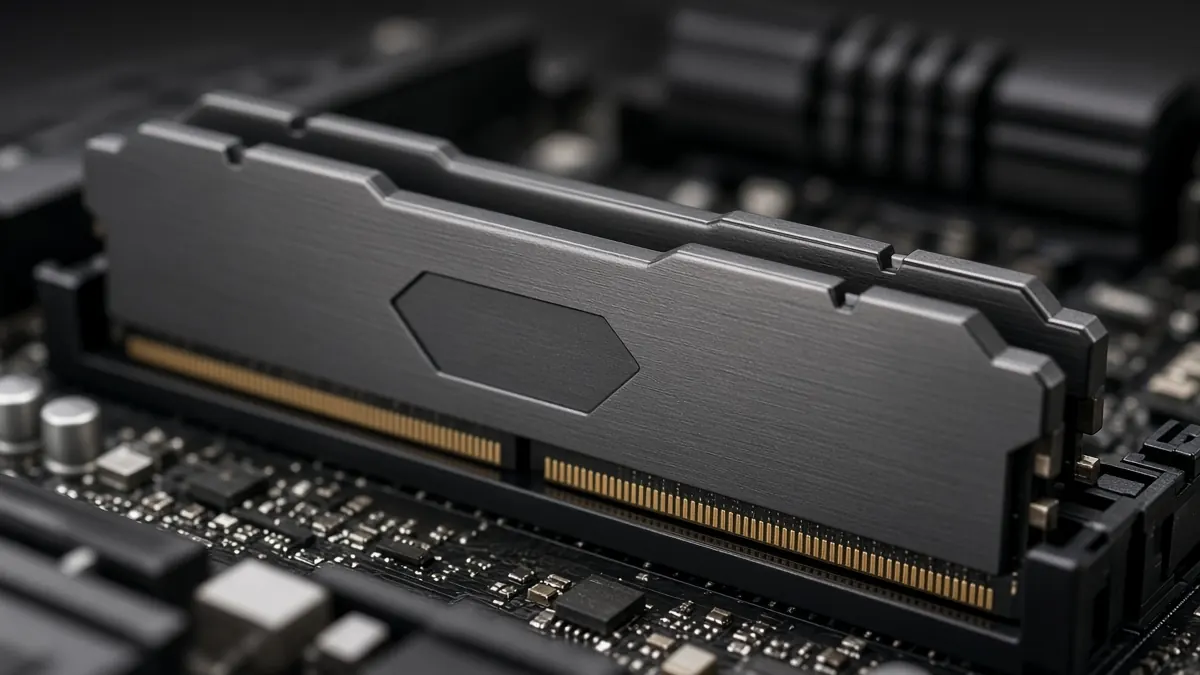
Micron has announced 512GB DDR5 memory modules rated up to 9,200 MT/s, the first direct rival in five years to Samsung's 512GB DDR5 parts. Each module draws 16 watts, the company said. A server can take up to 12TB.
The energy claim is the other number Micron wants in the slide: 60 percent less energy-intensive than a set of four 128GB modules. AMD and Intel have already tested the parts. Supply, Micron indicated, will follow demand.
Samsung had this class to itself
DDR5 started showing up in PCs around 2021. Capacity at the very top of the server catalog moved slower. Samsung sat on 512GB DDR5 modules for half a decade without a like-for-like Micron part in the same conversation. That kind of monopoly is rare in a market usually split among Samsung, SK Hynix, and Micron.
AI training clusters ate the story in 2024 and 2025 by pulling high-bandwidth memory onto GPU boards. Ordinary DDR5 did not disappear. It got more expensive, and the dense stuff got reserved for people who could wait and pay. A 512GB stick is not a gamer DIMM. It is a way to put terabytes in a chassis without filling every slot with four smaller modules.
Tom's Hardware flagged the obvious risk: prices could be way too high even for hyperscalers. Capacity this dense is useful. It is not useful if it blows the memory budget.
Consumer gadgets feel the same squeeze from the other direction. Valve's Steam Frame team already said a global memory and storage crunch shaped a headset and its price. Micron is selling the dense end of that crunch as a feature.
How the company wants buyers to do the math
Twelve terabytes in one box is the density pitch. Sixteen watts per module is the power pitch. Put those next to four smaller 128GB DIMMs and the 60 percent energy claim is the arithmetic Micron prefers. Speed bins up to 9,200 MT/s are the extra flex for platforms that can run them.
Do the slot math without inventing a price. 12TB from 512GB modules implies a fully stuffed server, not a workstation under a desk. The customer is a cloud buyer or a lab that already argues about watts per rack. Idle power on memory is not a hobbyist complaint. It is a utility line.
AMD and Intel validation matters because server memory that is not on a qualified list does not ship. "Already tested" is how Micron says the modules are not a paper product. "Supply will depend on demand" is how it says they will not sit in Newegg aisles. Someone big has to pull a purchase order.
Hyperscalers have spent two years writing checks for GPUs. Memory sitting next to those GPUs is supposed to be the boring part. A module that is both huge and allegedly stingy on watts is Micron trying to make it interesting again, at a price the same buyers might still reject.
If you cannot get an allocation, this is not your part
Practical question for a smaller OEM: you probably cannot buy these, and you should not design a board around a rumor of supply. Practical question for a cloud planner: ask for a quote, then ask what four 128GB modules cost on the same day, then ask whether 9,200 MT/s is a bin you will actually run.
Waymo-scale operators are the kind of customer that can wait for a specialized part. A restaurant-tech oven company is not. Tovala's hardware competes for ordinary components in a nasty market. These 512GB modules are the opposite product.
I would not bet a bill of materials on Micron flooding the channel. I would bet that Samsung's lonely 512GB SKU just got a comparison slide, and that the comparison will be about watts until someone leaks a price.
A public hyperscaler design win would make this real. List prices would make it comparable. Empty 9,200 MT/s bins in AMD and Intel memory population guides would mean the announcement was a marker, not a shipment.
Five years is a long time to be the only company in a catalog row. Samsung's 512GB DDR5 parts became a default for anyone who needed density and could tolerate a single-source risk. Micron showing up with 16 watts and a 60 percent claim is how a second source starts: not with a discount, with a slide that says you can pull four DIMMs out of the board.
Do not retrofit a workstation around this. If you needed 512GB in 2024, you already know the purchasing channel, and it was not a retail kit. If you did not, you still do not. The news is that the channel now has two logos to play against each other, once anyone quotes a number.