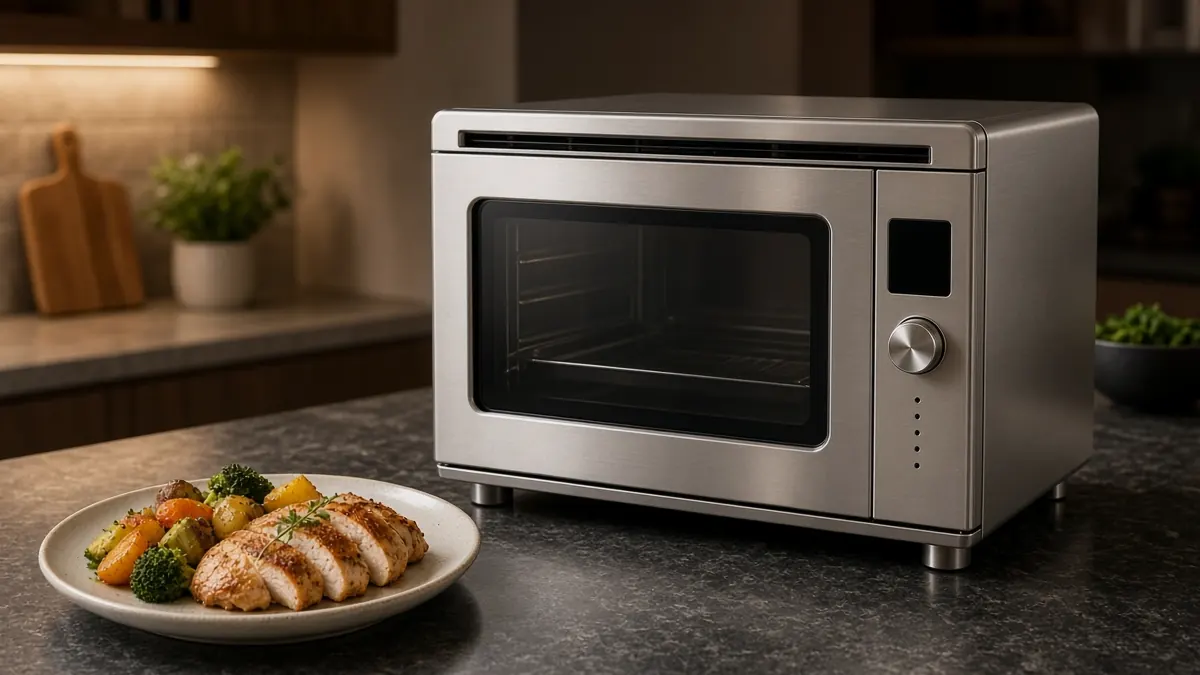
Scan the code. That is the entire Tovala pitch. The company sells a connected countertop oven and a meal-delivery service that are meant to work as a pair. Each meal arrives with a QR code. You scan it in the app, and the oven runs the cooking program on its own.
You are not setting a temperature. You are telling the appliance which box you just opened. TechCrunch ran a two-week trial framed as a test of whether that loop beats takeout. The hardware only makes sense if you also want the food.
A Keurig for dinner, not a chef's oven
Most smart-kitchen pitches try to replace every recipe you already make. Tovala is trying to beat delivery on nights when you would rather not think. That is a smaller claim, and a more honest one. Without those codes, it is another oven on a crowded counter, competing with a toaster that already works.
Households that already pay for HelloFresh-style kits are the obvious audience. They already accepted boxed food. Tovala is asking them to accept a dedicated appliance as the cooker. People who like to cook from a fridge full of ingredients are not the customer. The company is not really pretending they are.
Meal kits already had their crash
Tovala came out of Chicago in the mid-2010s, during the same boom that minted Blue Apron and HelloFresh. The twist was never the recipes. It was the oven: a countertop box that could steam and bake, tied to an app, sold as the reason the food would come out right without you watching it.
That period was brutal for kits. Blue Apron went public and then spent years shrinking. Grocery delivery and restaurant apps ate the I don't want to cook budget. Dedicated cooking gadgets had their own graveyard. June Oven promised a camera and software. Anova and Brava sold precision and steam to people who already owned too many devices. Most kitchens kept a microwave and a sheet pan.
Tovala's bet was that combining the two failures might work if neither had to stand alone. The food gives the oven a job every week. The oven makes the food look like a product instead of a bag of ingredients. Whether that is a household habit or a three-month novelty has always been the question hanging over the company.
The rest of the connected kitchen moved toward voice timers and air-fryer presets. Tovala stayed on rails: scan, walk away, eat. That is closer to a Keurig than to a range. It is also the only version of smart that a tired person will use twice on a worknight.
Two weeks is not a habit
A two-week window is long enough to learn whether the food is tolerable and whether the scan-and-wait routine saves time. It is not long enough to know if you will keep paying for meals once the novelty is gone, or whether the oven earns its footprint when the subscription lapses. The write-up does not hand you a score or a price. Treat any "beats takeout" claim as marketing until you have cooked the food yourself.
You are not building a custom roast. You are launching a program. That is a feature if you hate fiddling. It is a limitation if you wanted a general-purpose steam oven that also happens to read barcodes. Anova-style cookers sell the general-purpose story and treat meal partnerships as extras. Tovala sells the meal and treats the oven as the playback device.
Other gadgets sell a device that is empty without a feed. Roku is stacking more than 30 streaming bundles, including HBO Max and Starz, so the player has something to play. Tovala is the kitchen version of that bundle logic.
Valve is still explaining how Steam Frame splits streaming and a standalone mode. Waymo will not charge for Singapore rides until 2028 even though the cars show up much earlier. The oven you cannot really use without a QR code belongs in that group: announced hardware, delayed value.
Buy the box only if you like the menu
Skip the oven if you already cook. Skip it if you will cancel the meals in a month. Consider it if you already live on kits and hate watching a sheet pan. Check the current menu rotation before you give the appliance a permanent spot. A gadget oven that depends on a grocery SKU has to keep that SKU interesting.
Watch how Tovala talks about the hardware when it is not attached to a menu drop. If the next revision is sold as a general steam oven that happens to scan, the company is hedging. If it doubles down on exclusive recipes that only run from a code, it is staying a meal company with a dongle. The oven is already on the counter. The open question is whether the next box of codes is too.