Postings for welders and pipefitters are up 164% year over year, and the reason is data centre construction. That figure comes from ZipRecruiter labour economist Nicole Bachaud, and it is the sharpest number in CNBC's account of who the AI buildout is actually employing.
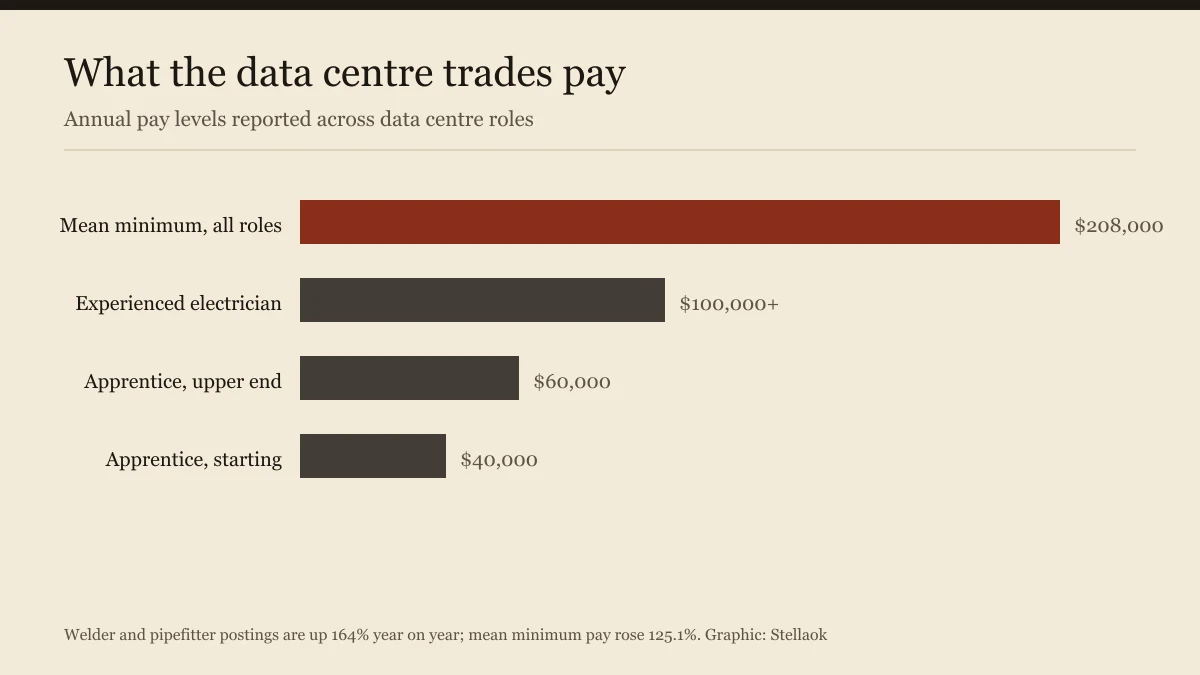
The same data shows the mean minimum salary for data centre jobs rising 125.1% year over year to nearly $208,000. Bachaud's own caveat on that one is the important part: "This is suggesting that highly specialized, top-tier engineering roles are pulling the overall average up drastically." A mean that doubles in a year is describing a change in the mix of jobs, not a doubling of anyone's pay.
What the trades are actually earning
The honest range sits well below that average. Maria Flynn, president and chief executive of the nonprofit Jobs for the Future, puts an apprentice-level technician at $40,000 to $60,000, with experienced electricians commanding north of $100,000.
That is a good living and it is a long way from $208,000. Both numbers are true and they describe different people: the first is the job a school leaver can start, the second is what a specialised engineer negotiates when four projects are bidding for them at once.
Flynn's broader point is that the demand is not only about the buildings. "These are occupations that are becoming increasingly important to the AI economy," she said, listing HVAC technicians, construction workers, line workers and pipefitters. Data centres get the coverage, but they require transportation upgrades and a modernised energy grid alongside them. "We are seeing major sources of demand that are converging at the same time."
Converging is the operative word. Grid work, road work and data centre construction all draw on the same pool of licensed trades, and that pool does not expand on a two-year notice period. Wage growth at the specialised end is what a shortage looks like before anyone calls it one.
The two percentages are worth reading against each other. Postings up 164% against a mean minimum salary up 125.1% means demand is outrunning pay, but not by a wide margin, and both are growing far faster than any training pipeline can respond to. An electrical apprenticeship runs four to five years. A data centre takes eighteen months to two years to build. The arithmetic of those two timelines is the reason specialised engineering salaries are near $208,000 while the apprentice band starts at $40,000: employers are bidding for people who finished training before this demand existed.
The geography is the whole story
Houston and Birmingham have seen the strongest growth, and Bachaud explains why in terms that connect this directly to the permitting fight.
"Places with more land to expand and build, which are often places where building regulations make development easier, cheaper, and faster, will likely be where expansion continues, versus coastal hubs that have higher costs and more regulatory burdens," she said. Her summary: an electrician or pipefitter in Birmingham will probably have more of a buyer's market than one in Boston.
Set that against what happened to permitting last quarter. Local opposition blocked or delayed $68 billion of data centre projects between April and June, 30 state legislatures have written siting rules, and 843 opposition groups are now active in 49 states. Texas, which had been the default destination for projects turned away elsewhere, ordered a halt on permits weeks after issuing them.
So the trades benefiting most are concentrated in exactly the jurisdictions where the political question is still open. The jobs follow the permits, and the permits are becoming the contested resource.
Why this changes the politics rather than settling them
A buildout that creates $100,000 electrician jobs in Birmingham is a much harder thing to oppose than one that raises residential power bills for no local benefit. That is the argument the industry has been looking for, and these numbers are the first version of it with wage data attached.
It is also why the fight is likely to get more local rather than less. A moratorium now costs identifiable jobs in an identifiable trade, which changes who turns up to the hearing. The Congressional Black Caucus spent last week on this exact tension, with its vice chair claiming 60 of its 62 members would vote for AI guardrails while a utility chief executive on the same panel talked about what the buildout does to constituents' bills.
For anyone weighing a trade apprenticeship against a degree, the practical read is that the demand is real, geographically uneven, and dependent on permitting decisions nobody can forecast past about two years. The skills transfer to grid and transport work either way, which is the part that does not depend on whether any particular data centre gets built.