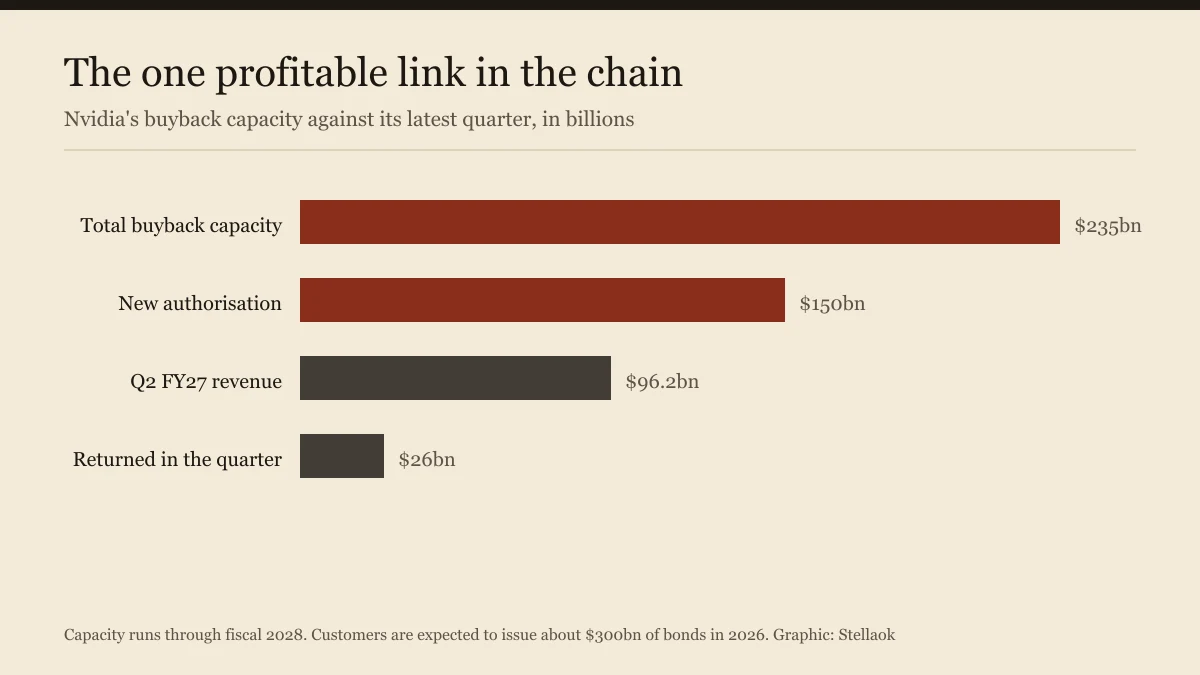
Nvidia authorised a $150 billion stock buyback on Monday, taking its total repurchase capacity to $235 billion through fiscal year 2028. That is the largest such authorisation any company has ever announced.
It is also, unlike most of what happens in this industry, funded out of profit. CNET's read makes the contrast the story: Nvidia is the one participant in the AI economy generating real monetary gains, and the buyback is a statement about who collects first.
The quarter that makes it possible
Second quarter of fiscal 2027: revenue of $96.2 billion, up 106% year over year. Roughly $26 billion went back to shareholders in the same period through repurchases and dividends.
Doubling revenue at that scale is the part worth pausing on. Growth rates like this normally belong to companies measured in hundreds of millions, not to one clearing $96 billion in a quarter. And the $26 billion already returned tells you the new authorisation is a continuation rather than a change in policy.
Which is what makes a $235 billion capacity coherent. A company buying back stock at this scale is signalling that it expects to keep generating cash faster than it can deploy it, and that it does not see an acquisition or a capital project worth more than its own shares. For a supplier in the middle of the largest infrastructure buildout in the industry's history, that is a confident position.
Everybody else is borrowing
Now look at the customers. The hyperscalers buying Nvidia's output are facing hundreds of billions of dollars in new debt, with around $300 billion of direct bond issuance expected in 2026 alone.
That is the asymmetry. One company in the chain funds shareholder returns from operating profit while its largest customers fund their purchases from the bond market. Nvidia's revenue is their capital expenditure, and increasingly their capital expenditure is borrowed.
Put the two figures side by side and the scale is almost matched. Nvidia's $235 billion of repurchase capacity through fiscal 2028 sits against roughly $300 billion of bond issuance its customers are expected to raise in 2026 alone. The industry is borrowing at about the rate its main supplier is returning cash to shareholders, which is a description of where the margin in this business sits.
The AI labs behind the demand cannot yet demonstrate standalone revenue to investors. A one-developer dashboard called Is AI Profitable Yet? tracks cumulative spend against revenue across most major AI companies and answers its own question, which is: no, the industry has not made back what it has poured in. The infrastructure suppliers in the middle are financing against contracts rather than profits, as Nscale's filing showed when it put 85% of a $103 billion contract book with two customers.
What it means if you hold the stock rather than the story
A buyback reduces the share count, which lifts earnings per share without the business doing anything new. That is real value for existing shareholders and it is not the same thing as growth.
CNBC's Jim Cramer argued the authorisation could change the trajectory of the stock, which is probably right in the mechanical sense and slightly beside the point. The trajectory that matters is the $96.2 billion quarter and whether the customers can keep paying for the next one. If hyperscaler capital expenditure slows because borrowing got expensive, no repurchase programme offsets it.
The comparison to hold in mind is AMD, which cleared a $1 trillion valuation this month against Nvidia's $5.4 trillion on data centre revenue growing 107%. Both companies are selling into the same demand. Only one of them is large enough that returning $26 billion in a quarter barely registers against the balance sheet.
Jensen Huang now ranks among the ten richest people in the world, which is the cleanest available summary of where the money in this boom has actually landed. The labs are valued near a trillion dollars each and losing money. The hyperscalers are investment grade and borrowing anyway. The supplier is buying back stock.
One number frames the whole authorisation. At $96.2 billion a quarter, Nvidia is running at roughly $385 billion of annualised revenue, so a $235 billion repurchase capacity spread across two fiscal years amounts to something near a third of annual sales. Companies do not commit that share of revenue to their own shares unless they expect the revenue to be there, which makes this buyback a forecast as much as a return of capital. The forecast it encodes is the same one OpenAI's $856 billion compute projection implies, just read from the side of the trade that gets paid.