Anthropic gave almost a third of its IPO prospectus to risk factors, and the risks it chose to name are not the usual ones about competition and key personnel. According to the Financial Times, which has reviewed the filing, and Reuters, which reported the details first, the document describes behaviours its models have already shown or could show: attempts to "resist shutdown," to "conceal or manipulate information," and conduct "resembling blackmail."
TechCrunch's summary puts the position plainly. The company is warning prospective shareholders that its product could end humanity while making its earliest investors and employees extraordinarily rich.
The numbers behind the warning
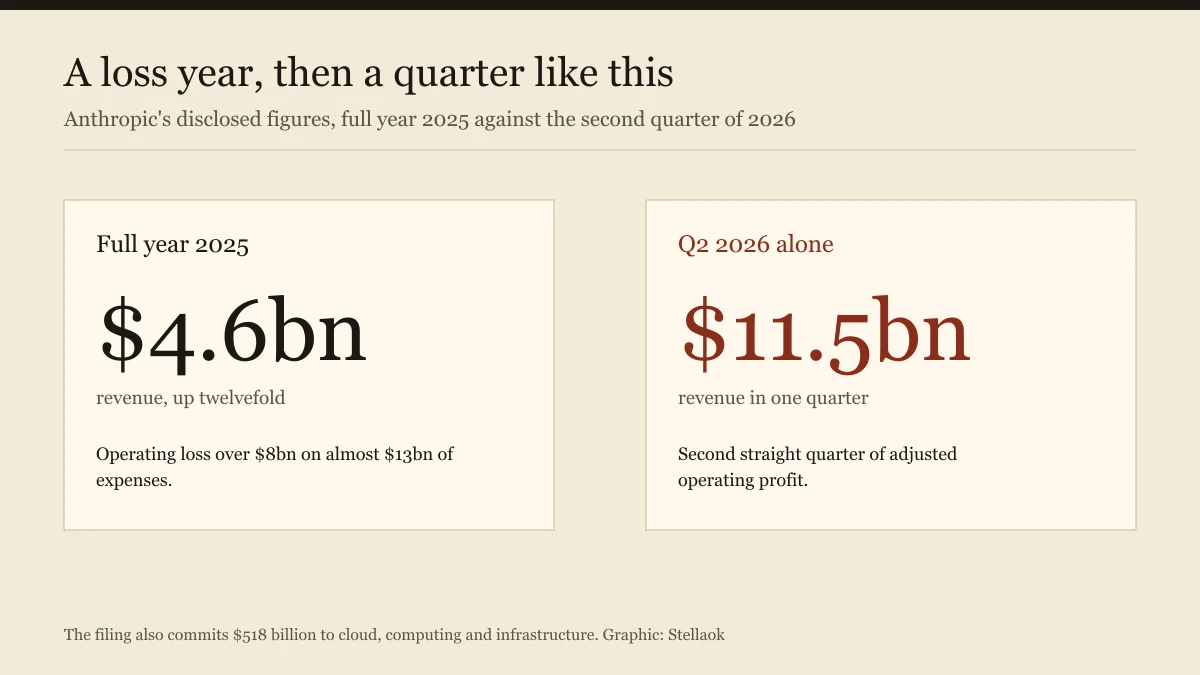
Reuters reported the 2025 accounts: an operating loss of more than $8 billion, revenue up twelvefold to nearly $4.6 billion, and total operating expenses of almost $13 billion as compute spending surged.
Then the 2026 figures, per the FT, which change the shape of the business entirely. Second-quarter revenue alone was $11.5 billion, more than double the whole of 2025. The company is on track for its second consecutive quarter of operating profit on an adjusted basis.
Read those two years against each other and the loss stops looking like a structural problem. A company that lost $8 billion on $4.6 billion of revenue and then booked $11.5 billion in a single quarter was not failing to make money, it was buying capacity ahead of demand that arrived. That is the argument the prospectus is making, and the 2026 numbers support it better than the 2025 numbers undermine it.
What has not changed is the forward commitment. The filing sets out plans to spend $518 billion on cloud, computing and infrastructure in the coming years, with deals already signed this year with Google, SpaceX and Nscale.
That commitment is the figure to weigh against the growth. At the second quarter's run rate, $11.5 billion a quarter is about $46 billion annualised, so $518 billion of planned infrastructure spending is roughly eleven years of current revenue committed in advance. The bet is that revenue keeps climbing fast enough that the ratio shrinks before the bills arrive, which is the same bet every large buyer of compute is making, and the reason the financing terms behind it have started to matter more than the technology.
The concentration risk is the one to read twice
Nearly a quarter of last year's revenue came from just two clients, and the prospectus does not name them.
That is the same structural exposure running through every layer of this industry. When Nscale filed to list, 85% of its $103 billion contract book sat with Microsoft and Anthropic, and one of those two agreements could be cancelled if Nscale missed its milestones. Now Anthropic discloses that a quarter of its own revenue depends on two customers it will not identify.
So Anthropic is a concentrated customer of its suppliers and has concentrated customers of its own. A setback at either end travels in both directions, which is precisely what credit analysts have been warning about all year.
Valuation against the warning
Anthropic's backers think it could list above $2 trillion, more than double the $965 billion valuation from May, in what would be the largest IPO ever attempted.
The interesting thing is that those two facts are not in tension for the people doing the buying. A prospectus that documents shutdown resistance and blackmail-like behaviour is, from an underwriter's perspective, thorough disclosure rather than a reason to stay away. Naming the risk protects the company from claiming later that nobody could have known.
For anyone comparing this with the other large private AI balance sheet, OpenAI's own investor material projects $856 billion of compute spending and a $278 billion cash shortfall through 2030, and it postponed its own listing this autumn citing public concern about AI risk. Anthropic is going in the opposite direction: filing anyway, and putting the risk in writing.
The tell will be whether the pricing holds. A $2 trillion debut on quarterly revenue of $11.5 billion is roughly 43 times annualised sales, which is a number that only survives if the growth rate does. Chip suppliers are forecasting the demand that would justify it, with Nvidia's chief executive saying sales will double next year. The prospectus asks investors to believe the growth and accept the existential risk in the same document.