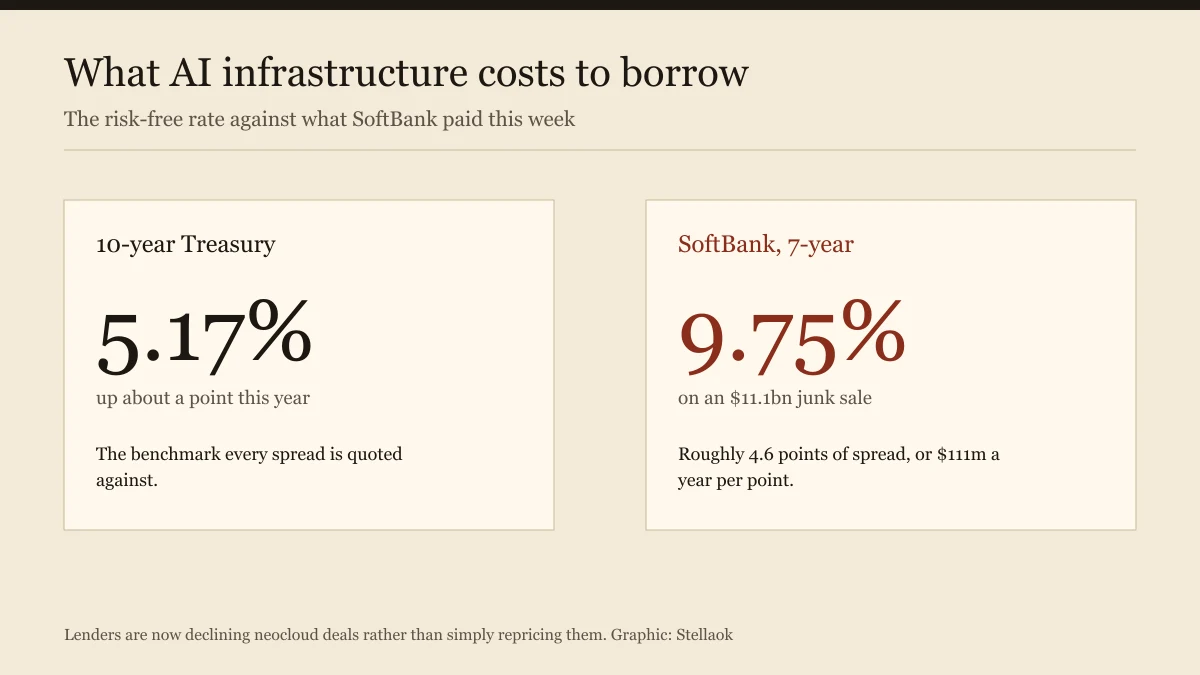
The ten-year Treasury yield sits near 5.17%, about a full percentage point higher than it started the year. That is the number that decides how much the AI buildout costs from here, because most of it is being financed with borrowed money.
SoftBank, one of the largest suppliers of capital to AI projects, raised $11.1 billion in a junk-bond sale this week. The seven-year tranche went out at yields as high as 9.75%. CNBC reported the raise alongside a warning from lenders that the terms are getting harder.
Price takers, by choice
Mark Malek, chief investment officer at Siebert Financial, described SoftBank's position without much sympathy. "They basically are price insensitive to that raise, which means they're price takers," he said. "In my view, a lot of these companies need to be price insensitive. They need to get as much capital as possible to compete."
Paying 9.75% for seven-year money is not a sign of financial distress. It is a sign that the borrower has decided the cost of not building is higher than the cost of the coupon. That is a defensible calculation while the demand forecast holds, and it becomes a very expensive mistake if the forecast slips, because the coupon is fixed and the revenue is not.
The split between who pays what is the part worth tracking. Amazon, Google, Meta and Microsoft have all committed hundreds of billions to capital expenditure this year with more expected in 2027, and they all carry investment grade credit ratings, which means cheap access to capital. Everyone else is borrowing at spreads set against a Treasury yield that has moved a point against them.
Lenders are now selecting, not just pricing
Two market participants told CNBC the same thing in different words, and it is the more consequential development.
A senior private credit investor, speaking anonymously to be candid, said neocloud deals will be harder to finance going forward because those companies have less cushion to absorb costs. Riley Thompson, a vice president at Mitsubishi HC Capital America, put it more sharply: lenders are getting pickier about which projects they will fund at all, even when the borrower agrees to pay a higher rate.
That is a meaningful shift. A market that demands a higher rate is still open. A market that declines the deal at any rate is closed, and it closes for the weakest borrowers first. The neoclouds are the weakest borrowers in this chain, and they are also the ones whose entire business model requires continuous capital to build capacity they have already promised to customers.
Nscale is the live test. Its IPO filing put 85% of a $103 billion contract book with two customers, and the larger of those two agreements is explicitly contingent on Nscale obtaining financing, with the customer free to walk if milestones slip. In a market where lenders are turning down deals, that clause stops being boilerplate.
The equity market has not agreed with itself
Nothing is in panic mode yet, and the share prices are contradicting each other.
CoreWeave, which carries a lot of debt, rose almost 8% this week. Oracle, which has leaned on the debt market to fund its AI expansion, fell 7% for the week and is down about 30% for the year. Same financing environment, same sector, opposite direction.
The most likely explanation is that investors are distinguishing between borrowers with contracted revenue behind the debt and borrowers who are spending ahead of it. Oracle's AI expansion is a bet on demand it is trying to win. CoreWeave's debt sits against signed agreements, even if those agreements are heavily concentrated.
The spread tells you what that distinction is worth right now. SoftBank's seven-year paper at 9.75% is about 4.6 percentage points above the 5.17% Treasury, which means the market is charging roughly double the risk-free rate to fund AI infrastructure through a holding company. For a borrower raising $11.1 billion, each point of spread is $111 million a year, so the gap between an investment grade rating and a junk rating in this sector now runs to hundreds of millions annually on a single deal. That is the cost the hyperscalers avoid and the neoclouds cannot.
Underneath it all are OpenAI and Anthropic, each valued near $1 trillion privately, generating the demand that justifies the borrowing. OpenAI's own numbers project $856 billion of compute spending and a $278 billion shortfall through 2030. Every dollar of that gap has to be financed by somebody, and this week the price of doing so went up. Chip suppliers are still forecasting the demand, with Nvidia's chief executive expecting sales to double next year, but a forecast does not pay a coupon.