Owen Lamont, a portfolio manager at Acadian Asset Management and a former finance professor at the University of Chicago, told Fortune in January that the US stock market was not in an AI bubble. He has changed his mind. "I think there is a 70% chance that as of November 2026 we are already in an AI bubble in the U.S. stock market," he said in an email. "I think a lot has changed this year."
What changed was the last of four conditions he tracks, which he calls the four horsemen of the bubble apocalypse: overvaluation, bubble beliefs, new issuance and inflows of new money. In January he counted three. The missing one was issuance, the act of companies selling shares to the public. At the time, US firms had bought back roughly $1 trillion of their own stock over the previous year, and Lamont treats executives as the informed seller whose behaviour is worth watching. They were buying, not selling.
From buybacks to a wave of stock
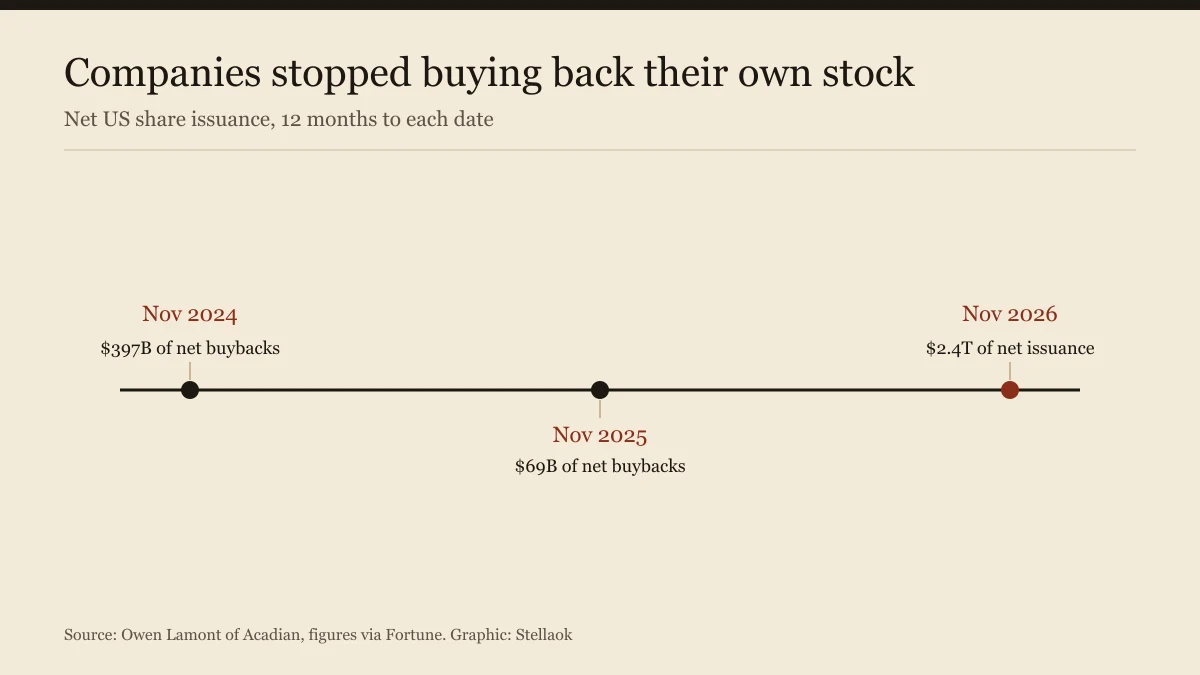
By his count, US companies issued a net $2.4 trillion of stock in the 12 months to November 12. In the 12 months to November 2025 they retired a net $69 billion, and in the year before that $397 billion. In a blog post on his Owenomics site he walked back the January headline directly: "Today, I would no longer write those words."
The $2.4 trillion carries a large qualifier. About $2.2 trillion of it comes from SpaceX's June IPO, which his method counts at full market value rather than at the amount raised. Remove that and net issuance is $192 billion. That is still a reversal from buybacks, and it includes the largest companies in the market. The Magnificent Seven went from net buybacks of $144 billion in the year to November 2024 to net issuance of $276 billion now, with Alphabet and Meta switching direction, Tesla increasing its issuance, and Meta announcing plans to raise nearly $98 billion in equity to fund AI spending.
Lamont is candid that one company carrying most of the number is awkward for his thesis. "I think one company is not enough to constitute a 'wave of issuance,'" he said. "On the other hand, we live in a world of concentrated stock markets where a handful of companies have huge market cap, so maybe we should expect waves of issuance that are also concentrated."
Professional investors are already trimming
The flows point the same way. Fund managers cut their net overweight position in technology to 12% from 37% in November, the largest one-month drop since June 2006, according to Bank of America's monthly survey. That is a positioning change rather than a verdict, but it removes the buyer that had been absorbing supply.
Why companies are selling is the question Lamont leaves open. His note offers two answers: the informed money believes the market is too expensive, or the firms need cash to build data centers. Asked which he favours, he said he is not sure and that it could be both. Strategists at TD Securities made a related point from the bond side this week, noting that Meta and Oracle have both issued equity and that financing AI capital spending with stock rather than debt would ease pressure on long-term Treasury yields, a link that others have disputed as the main driver of rates this year.
What would make him wrong
Lamont is not calling a top, and his own numbers explain why. Net issuance is running at about 3.1% of total market value, below the peaks of the dot-com bubble and the 2021 boom. Real long-term interest rates have risen about 100 basis points this year, which strengthens the overvaluation case without settling it. "It is not a slam dunk case: the market might be overvalued, but it is not absurdly overvalued," he said. "Net issuance has turned positive, but it's not strongly positive."
The week supplied its own evidence in both directions. Anthropic raised $81 billion in the largest offering on record, which is exactly the kind of supply Lamont is counting, and Nvidia's shares fell after an earnings beat. The IMF, meanwhile, has warned that the world economy is now standing on one AI leg. A 70% probability is a statement about odds, not a date, and Lamont's four conditions describe a market that can keep rising while the count against it grows. The fourth horseman, inflows, is the one that decides how long that can last: money arriving from index funds and retail accounts does not read the risk section.