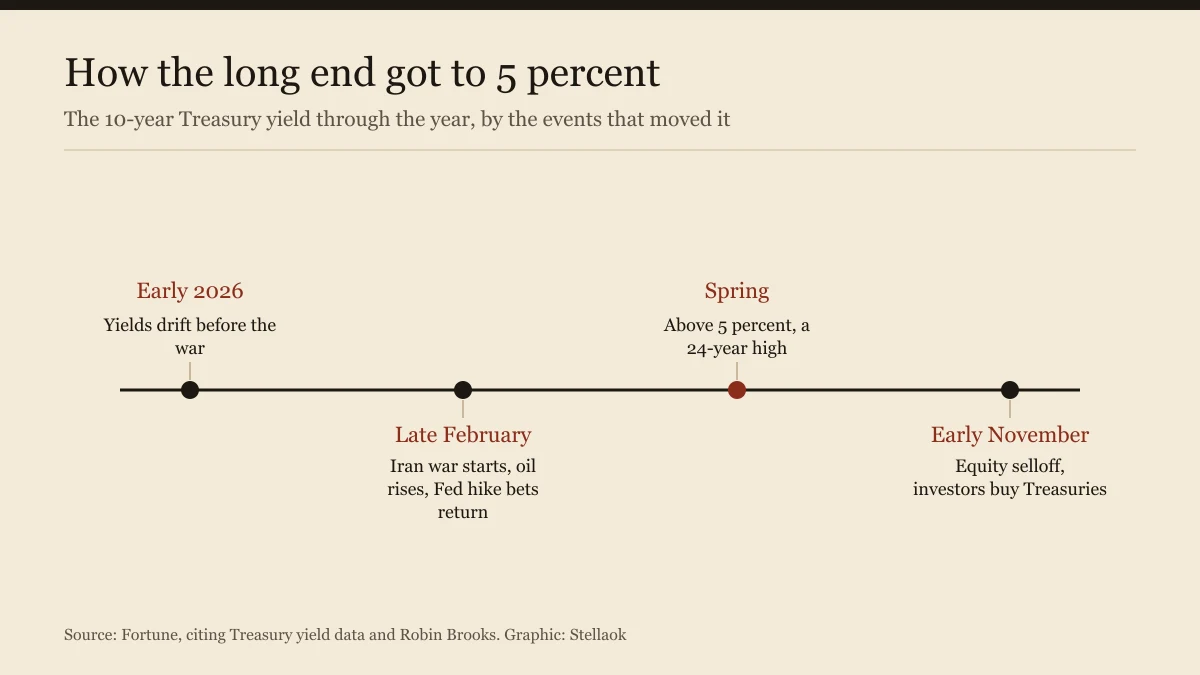
Treasury yields have spent the year explaining themselves, and Robin Brooks thinks last week's equity selloff settled the argument. The 10-year yield rose more than 100 basis points before its recent dip, climbing above 5 percent and at one point reaching a 24-year high. Two stories have competed to account for that move: one about federal borrowing, one about the debt that hyperscalers are issuing to build AI infrastructure. Brooks, a senior fellow at the Brookings Institution, argues the second story fails the test.
He laid out the case in a Substack post on Saturday, Fortune reported, framing the past week as a natural experiment. "On one end of the spectrum are people like me who think this is a rising fiscal risk premium as our public debt grows out of control," he wrote. "On the other end are folks who say it's hyperscaler debt issuance that's pushing up yields, so there's no sign fiscal policy's in trouble."
The yield run began after the Iran war started in late February, which sent oil prices up and raised expectations that the Federal Reserve would lift rates to fight resurgent inflation. At the same time, hyperscalers have been flooding the bond market to fund capital spending, and the Treasury has been borrowing to cover a $2 trillion budget deficit and to pay interest on $40 trillion of federal debt. All three borrowers have been competing for the same dollars.
The jobs report did not cooperate
Brooks points first at the bond market's reaction to the latest monthly payrolls report, which came in at more than double the consensus estimate. If growth and AI spending were driving yields, a hot labor print should have moved the front end in a way that matched the surprise. The two-year yield rose more than the growth data could account for, which he reads as evidence that investors were repricing the government's credit rather than the economy's momentum.
His second test is the market-implied yield on a 10-year security bought 10 years from now, a measure of the premium investors demand for holding Treasury duration. If an AI debt glut were pushing up long yields, that forward rate should have fallen along with the 10-year and the two-year. It did not.
"The midterm elections and the AI sell-off that's ensued have given us the perfect natural experiment to disentangle what's going on with long-term yields," Brooks wrote. "They're up because of mounting fiscal stress, not because of AI."
He also rejects the crowding-out story on size. Corporate borrowing is nowhere near the level of the early-2000s IT bubble, he argues, while public borrowing is historically high. The scale of AI issuance is real, and companies such as Nscale are raising billions against very few customers, but it is not large enough to explain the whole move on its own.
The numbers behind the argument
The fiscal year that ended in September makes the case easier to see. The deficit widened to $1.99 trillion, 12 percent worse than the $1.78 trillion gap a year earlier, according to the Treasury's final tally. Revenue rose 3 percent to $5.4 trillion while spending rose 6 percent to $7.4 trillion. Social Security and Medicare were the two largest line items. Interest on the national debt came third, ahead of defense and Medicaid.
Gross interest costs reached $1.36 trillion at an average rate of 3.53 percent, more than double the 2021 rate before the Fed began tightening. Net interest rose 8 percent to $1.05 trillion, faster than total spending, revenue or GDP. That works out to roughly $2.9 billion a day, and the Peter G. Peterson Foundation put the cost at 3.2 percent of GDP, above the previous record set in 1991.
The mechanism is the one bond investors have been describing for two years: higher interest requires more borrowing, and more borrowing requires higher rates. "Eventually, the whole thing could come crashing down," Maya MacGuineas, president of the Committee for a Responsible Federal Budget, said in September. "That's why Washington needs a fiscal intervention now, before it's too late."
Why the equity market cares
None of this is new information to the bond market, which is why the equity reaction is the interesting part. Last week's selloff followed a rally that had just been the best in 44 years, and the drop showed how quickly a market priced for falling rates reprices when the long end refuses to cooperate. Higher long yields raise the discount rate on every cash flow in the index, and they hit the longest-duration assets hardest, which in this market means the AI trade.
Brooks's conclusion is that the fiscal premium is now the binding constraint. If he is right, the debate about whether AI capital spending is a bubble is partly a distraction: the cost of money is being set by the government's borrowing, and every other borrower, including the hyperscalers, pays a spread on top of it. The next test arrives with the Treasury's refunding schedule and the next inflation print, whichever comes first.