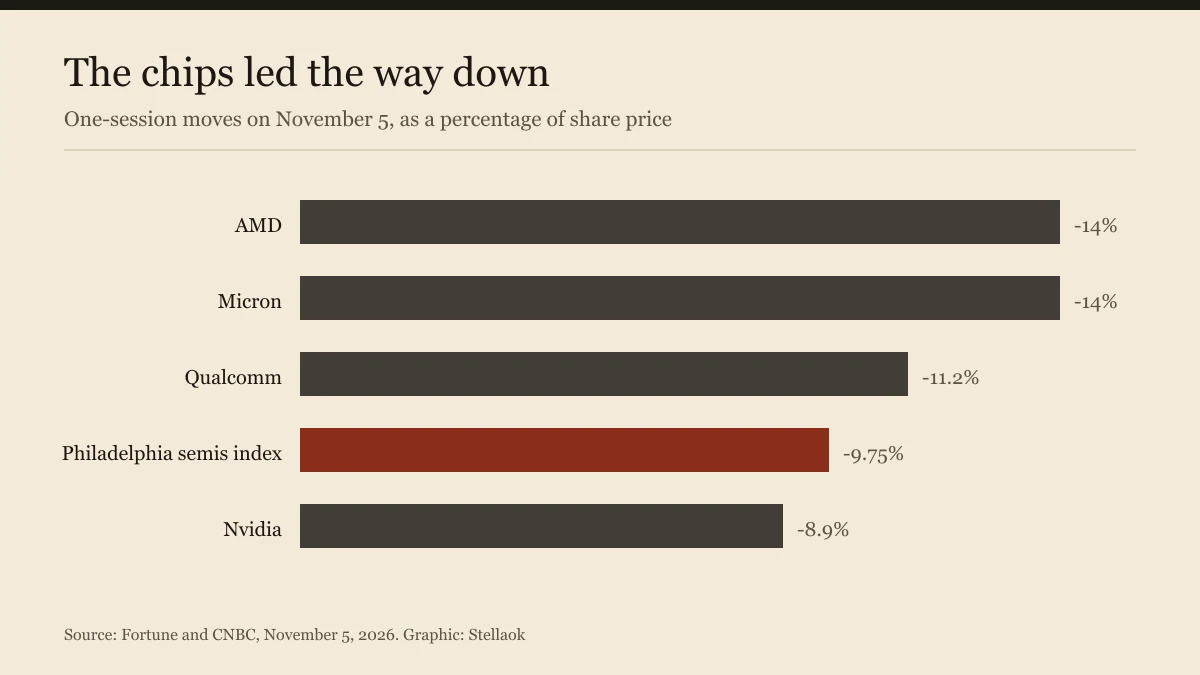
United States stocks shed roughly $3 trillion of market value on Thursday, one session after the Dow Jones Industrial Average posted its best post-midterm performance in 44 years. The Nasdaq fell about 5%, the S&P 500 nearly 4%, and the Philadelphia Semiconductor Index dropped as much as 11% before closing near a 9.75% loss, its steepest day since March 2020.
Wednesday had been the mirror image. The Dow rose 1,569 points, or 3%, the S&P 500 added 1.6% to 7,688.62, and oil fell more than 8% as traders bet a divided government would mean steadier policy. By Thursday afternoon the S&P 500 had traded as low as 7,394.49, below where it closed on election day.
Fortune traced the reversal and CNBC tied it to the chip sector specifically. The two accounts differ slightly on the size of the move, with Fortune putting the Nasdaq down 5.2% in midday trading and CNBC recording a 5.5% close, its worst day since April 2025.
The ballot box was the catalyst, not the earnings
Forty-one local measures in ten states asked voters to restrict data centre construction in some way. Voters sided against data centres on every one of them except a single measure in Harwood, North Dakota, according to Ballotpedia counts compiled by CNBC.
The state-level results pointed the same direction. In Texas, Democrat Gina Hinojosa, who campaigned on an immediate moratorium on new data centres, beat Republican governor Greg Abbott. Wells Fargo estimates that 27% of the data centre gigawatts planned in the United States sit in Texas. Democratic candidates also won governorships in Ohio and Georgia on similar platforms.
Abbott had already paused new data centre permits in September pending a grid audit, which means the moratorium Hinojosa promised may not require new legislation. That detail is the one that re-rated the sector, because a permit freeze is a nearer event than a bill.
The losses were concentrated in exactly the companies that had been priced for uninterrupted growth. AMD and Micron each fell roughly 15%, Nvidia dropped almost 9% and gave up about $450 billion of market capitalisation, Qualcomm lost 11.2% after a weak forecast and Arm fell 11%. The hyperscalers held up better: Meta fell 3.4%, Microsoft 2.8% and Alphabet 1.6%.
Capex arithmetic was already stretched before the vote
Dan Ives of Yorkville Ives told clients on Thursday that he now expects technology capital spending to peak next year rather than in 2028 or 2029. He estimates that at the low end 10% of the 800 to 1,000 AI-focused data centres planned in the United States will come off the roadmap, with as many as 20% facing a longer regulatory path.
Ives still expects hyperscaler capex to exceed $1 trillion in 2027. The distinction between the level and the second derivative is the whole argument: the spending continues, the acceleration stops, and equities that were valued on the acceleration lose most of their premium.
The financing side is where the stress shows first. Neocloud operators borrow against future capacity, so a permitting delay hits them before it hits the customers they serve. CoreWeave fell 9% on Thursday and 18% over two sessions, and its bonds already carried a yield that reflected scepticism about the buildout long before this week.
Memory added its own pressure. Micron, Samsung and SK Hynix had already been marked down when CXMT showed a new memory design, and the same shortage that lifts prices is now squeezing the consumer devices those chips go into. Qualcomm chief executive Cristiano Amon told CNBC the constraint is supply: "If I had more supply, I would probably be doing better."
The rotation was not a full risk-off
Four of the S&P 500's eleven sectors finished higher, with consumer staples up 1.5% and Berkshire Hathaway at an all-time high. Money did not leave the market. It left the part of the market that depends on permits.
Asia sold off first and hardest. South Korea's Kospi closed down 5.28% with trading halts during the session, Taiwan's main index fell 3.2% and the Nikkei 1.79%, which follows from the concentration of memory and packaging capacity in those two markets.
Software was caught in the same wash even where the business had nothing to do with data centres. Salesforce fell 3.6%, Snowflake 6.4%, and Figma extended a fall that began when it beat estimates and guided higher. That pattern, good numbers and a lower price, is what a de-rating looks like from the inside.
What the next two quarters will settle
Meta president Dina Powell McCormick said at a Wall Street Journal conference on Wednesday that building data centres in the United States is "going to be harder", and that every hyperscaler is now weighing whether to build outside the country. That sentence matters more than any single day's percentage, because it describes a change in where the money goes rather than how much of it there is.
Meta, Alphabet and Amazon have all now reported negative free cash flow in a recent quarter. CoreWeave's 2031 bonds yielding 15.78% is the price the credit market puts on that.
The next printed number is the October jobs report on Friday. The one that matters more arrives with third-quarter capex guidance in January, when the companies that pay for this buildout say whether the ballot results changed a budget line or only a headline.