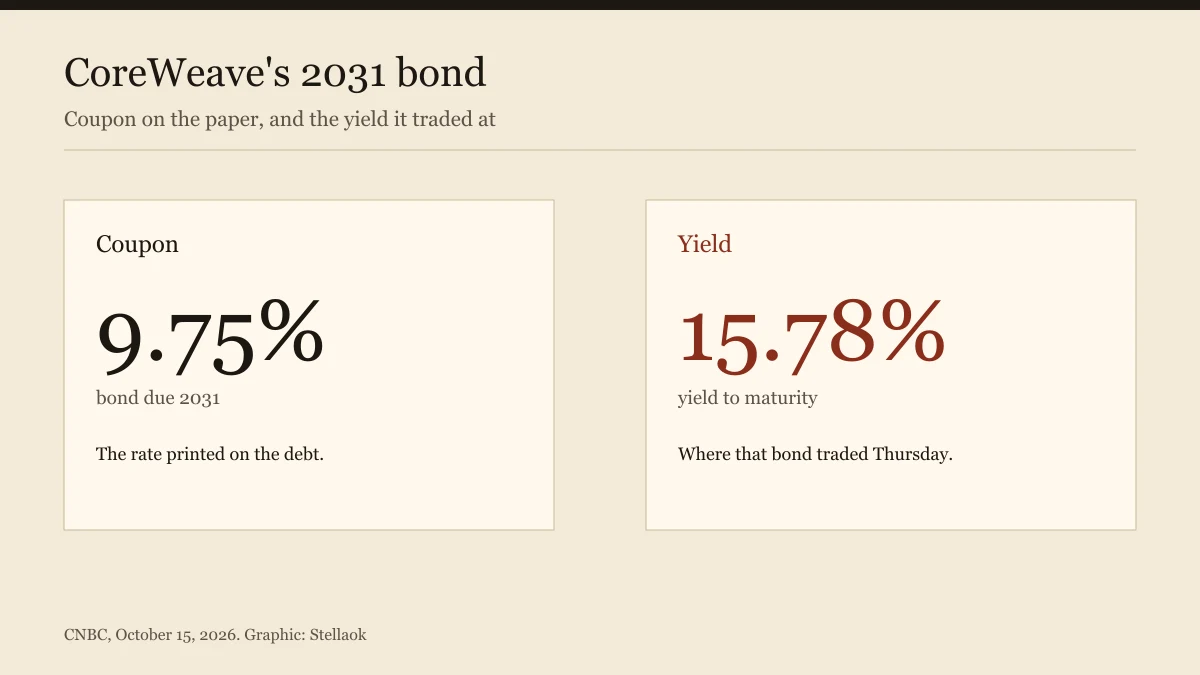
CoreWeave's five-year credit default swaps traded in distress territory on Thursday. The spread rose above 1,140 basis points during the session and was last near 1,038, up 16 percent from a week earlier and 164 percent from a year earlier. The yield to maturity on the company's 9.75 percent bond due in 2031 reached 15.78 percent. Bond yields move the other way from prices, so that yield is a cheaper bond, not a richer one.
CNBC's market report put CoreWeave's debt and other obligations above $51 billion, borrowed to build AI data centers and fill them with chips. CNBC calls CoreWeave a neocloud: it builds that infrastructure and rents the computing out. Thursday's move, in the piece, was a revolt by stock and bond investors inside a wider selloff of AI-related names. The investors it described have turned skittish about borrowers that buy chips, build the buildings, and depend on rental income to carry the debt. The share-price close did not replace the credit print. A credit default swap is insurance against a missed payment. Gavan Nolan, executive director of fixed income pricing at S&P Global Market Intelligence, said a spread of 1,000 basis points or more is the usual marker of credit distress. The Evercore ISI trading desk's line, quoted by CNBC, was that the market is saying "no mas" to AI debt that does not have operating cash flow behind it.
The stock bounced. The other neoclouds did not tell one story
CoreWeave shares fell during Thursday's session, then closed 5.94 percent higher. That followed a 15.5 percent drop on Wednesday. Nebius also sold off and finished up 1.29 percent. Iren closed down by less than 1 percent. The equity tape and the credit tape were not the same trade. Nolan said nobody is questioning whether demand for the computing is real, because CoreWeave has contracts with the large hyperscalers. The open question is whether the cash shows up in time to justify the capital spending. He called free cash flow heavily negative.
Micron closed up 1.87 percent and AMD fell 1.5 percent after a selloff in South Korean chip stocks. CNBC treated those moves as the same anxiety spreading from credit into the companies that sell the hardware. Nvidia guided the October quarter to $108 billion, up 89 percent. That guide is the chip bill operators like CoreWeave are borrowing to pay. Nvidia's $20 billion Groq deal is now a Delaware lawsuit, a separate argument about what those chips and that engineering are worth once the contract is signed.
The chief executive pointed at a backlog above $100 billion
Chief executive Mike Intrator dismissed Wednesday's drop in a memo CNBC obtained. He wrote that a new kind of technology company will have periods when the market misunderstands it and acts irrationally, and that the backlog more than supports all of the debt. Deutsche Bank, in a note Thursday, put that backlog above $100 billion, with around two-thirds of it at investment-grade customers including Microsoft, Meta, IBM, and Caterpillar. The bank repeated a buy rating and called the price move a buying opportunity.
Jim Reid, global head of macro and thematic research, told CNBC the risk is that this kind of worry becomes a self-fulfilling prophecy and spreads to other AI-related names. Oracle's five-year credit default swap also jumped this week, last quoted at 282 basis points, roughly 10 percent higher in a week. Reid said a downgrade from Oracle's BBB rating could push investment-grade-only investors into forced sales. That is a different issuer. It is the channel he named for the worry leaving CoreWeave's own bonds.
Cash that can be returned, and cash that has to be borrowed
Nvidia authorised $150 billion of buybacks. The seller of the chips has cash it can hand back. The buyer in this note is paying a distress spread to keep building. Nolan's condition for the debt is the one the contracts do not settle on their own: the cash flow has to arrive, because the capital spending is already happening.