Two former Groq engineers want a Delaware court to reopen Nvidia's $20 billion deal for the startup's inference technology. Joshua Rubin and Benjamin Serebrin filed on October 2, 2026, in the Court of Chancery. They call the price a lowball, and they say the board sold the company without the stockholder vote Delaware law requires.
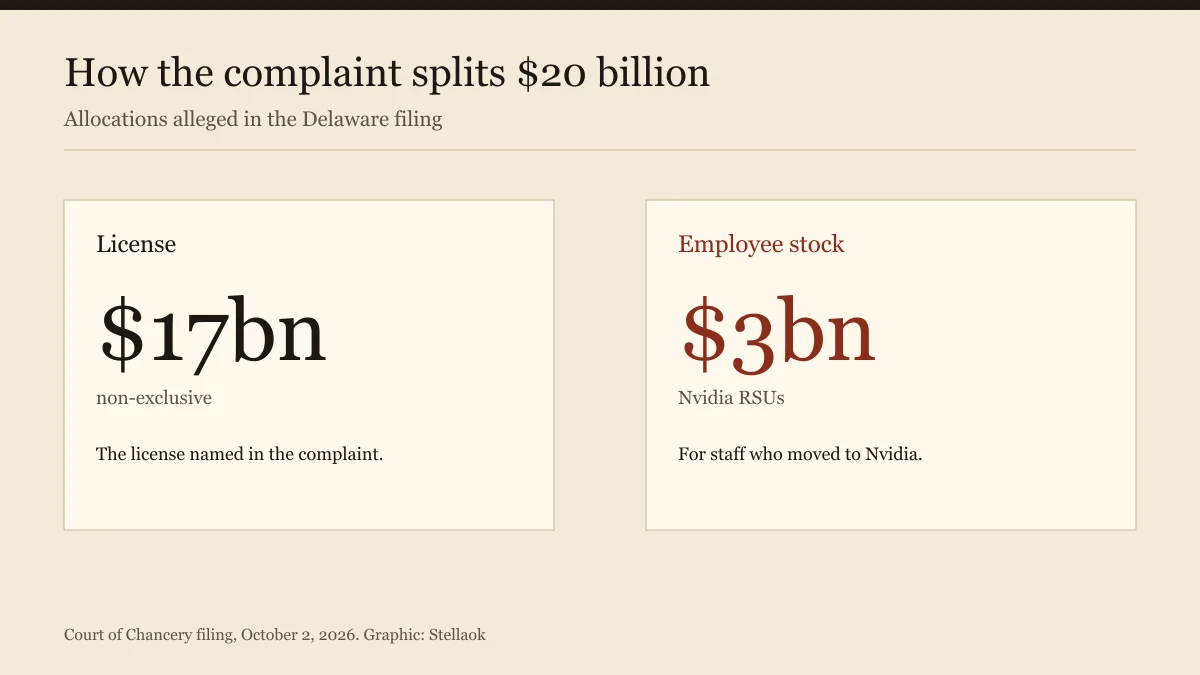
CNBC's account of the complaint puts the alleged split in one sentence. Nvidia allocated $17 billion to a license it labeled non-exclusive, and set aside another $3 billion of Nvidia restricted stock for the Groq employees who moved with the technology. About 150 to 200 engineers became Nvidia employees. Rubin and Serebrin had already left, and they say they still held stock.
The license was announced as a license
Groq said in December that it had signed a licensing agreement with Nvidia for its inference technology. Founder and chief executive Jonathan Ross and president Sunny Madra joined Nvidia, along with other senior leaders. Groq also said it would continue as an independent company. It has raised around $1 billion since June 2026, and Nvidia is among the investors.
Jensen Huang told employees, in an email CNBC obtained from around the announcement, that Nvidia planned to integrate Groq's low-latency processors into its AI factory architecture. He added a line the complaint is built to argue with: Nvidia was adding employees and licensing intellectual property, and it was not acquiring Groq as a company. Nvidia has room on its own balance sheet for a $150 billion buyback authorization. A $20 billion inference deal is a different check, written to a startup's stockholders.
The board is the target, not the chip
The complaint says a board majority was conflicted, and that investment funds which had designated board members were positioned for windfall returns from a later squeeze-out. It says the board did not run a process designed to test or maximize what Nvidia bought. The cost to stockholders, in the plaintiffs' words, was billions of dollars.
Groq says the cloud is still its own
The plaintiffs' phrase for the structure is a squeeze-out. They say the funds that had put people on Groq's board were set up to gain from it, and that stockholders who were not in that circle were not. About 150 to 200 engineers changed employers. Ross and Madra changed employers and titles. Groq's remaining corporate line is that it is independent, that it has raised about $1 billion since June 2026, and that Nvidia is one of the investors in that raise. A company can take money from the firm it just licensed and still tell a court it was not sold. That is the argument the spokesperson's "meritless" is defending.
Huang's email is more specific than the headline price. He told staff the agreement would expand Nvidia's capabilities, and that the plan was to put Groq's low-latency processors into the Nvidia AI factory architecture so the platform could cover a wider set of inference and real-time workloads. The complaint's answer is that a license labeled non-exclusive, plus stock for the people who moved, was a sale in substance. Rubin and Serebrin left before the announcement. Their LinkedIn profiles are what CNBC cites for that timing. The stock they say they still held is why they are in Chancery at all.
Groq's spokesperson told CNBC the licensing agreement delivered exceptional value for the company, its investors, and its employees. The lawsuit, the company said, is meritless, and it will defend itself. The operating line that followed is the one that treats the corporate form as still alive: Groq remains focused on customers and on building what it calls the world's leading AI inference cloud. Oracle's reported chip lease for Tencent is the other kind of $7 billion inference bill, rent rather than a license.
The Chancery filing is the document that turns Huang's "not acquiring" sentence into a claim about price. Ross and Madra are already inside Nvidia. The engineers who moved are on Nvidia stock. The two who sued are the ones who left first and kept the old shares.