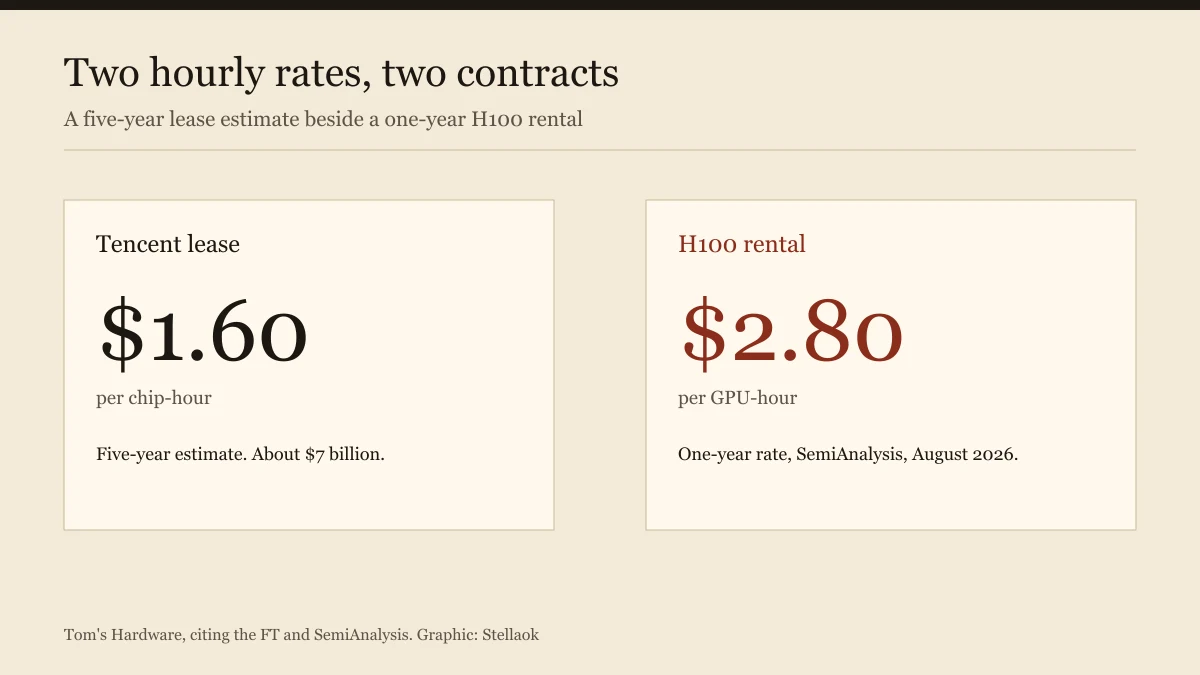
Oracle has reportedly agreed to lease Tencent about 100,000 advanced AI chips for five years, at data centers in Southeast Asia, for about $7 billion. Tom's Hardware, citing the Financial Times, puts that at about $1.60 per chip per hour, with about 30% paid upfront. Neither company has commented. The chips are described as unavailable in China. The FT says leases of this kind are legal under current U.S. rules.
The Tom's Hardware account sets the $1.60 figure against published rental rates. SemiAnalysis, in August 2026, had Nvidia's H100 at roughly $2.80 per GPU-hour on a one-year contract. A 2025 filing by the Japanese operator Datasection had an unnamed customer's three-year B200 contract at $3.09 per GPU-hour. The FT's estimate sits under both. No chip in the Tencent lease is named. The FT says such leases could reach Nvidia's top parts. Tom's Hardware says that sentence does not identify this contract as Nvidia hardware.
The hourly rate is an estimate, and the chip is unnamed
Tencent's chief strategy officer, James Mitchell, said on the August 12, 2026 earnings call that rental prices are still climbing. President Martin Lau, on the same call, said the company could sell existing orders at more than 30% profit versus what it paid a few months earlier. Countries, sites, and a start date for the Oracle lease are not in the report. Oracle has two cloud regions in Singapore and has announced one in Malaysia. The FT says ByteDance and Alibaba are the largest clients of Southeast Asian centers, and that Chinese firms use the capacity for training that domestic chips cannot yet do. Tencent already signed a deal worth more than $1.2 billion for Datasection Blackwell rentals in Japan and Australia, the FT reported in December 2025.
Oracle's own filings are the cash context, and they do not name Tencent. From March to May the company added $67 billion of AI contracts. From June through August it received $11.4 billion of customer prepayments that included a significant financing component. Deferred revenue rose from $15.4 billion to $30.8 billion in the quarter. On the September 10 call, GPU utilization was 97.9%, and renewals on GPUs four years or older carried a 20% average premium. Nvidia has authorized $150 billion of buybacks on the chips everyone is trying to rent.
A House bill would cover the remote login
The Remote Access Security Act passed the House 369 to 22 in January 2026 and sits in the Senate Banking Committee. It would let Washington regulate remote cloud access to sensitive technology for any foreign person, not a named country. Export rules have covered shipments of advanced AI chips to China-headquartered companies abroad since November 2023. Cloud rentals were left out. The Commerce Department, according to The Information, is drafting a rule to block Chinese firms from renting compute in third countries such as Thailand and Singapore. A Baker McKenzie attorney told The Information that rule cannot be enforced under current law. China has cleared Tencent to buy Nvidia's H200, and has let in only about 10,000 of them so far, the FT reported in August 2026. Micron's last quarter is what the memory on those rented boards is earning.
Investor Day is October 28, 2026
Oracle's Investor Day is October 28, 2026, inside Oracle AI World at the Venetian in Las Vegas from October 25 to 28. Tencent's third-quarter results are expected the month after. Trump and Xi met in Washington late last month, extended a trade truce by two months, and set up a channel for AI incidents. The next meeting is APEC in Shenzhen in November 2026. Nothing on chip controls was announced. Tom's Hardware also runs the hardware math the FT did not: Datasection bought servers with 5,000 B200s for $272 million in 2025, and scaling that receipt to 100,000 chips is $5.44 billion, about 78% of the reported $7 billion lease, before buildings, power, networking, and financing. The piece says that sum fits a guess about older or non-Nvidia hardware better than a stress story about Oracle. It is the writer's scaling of someone else's purchase, not a line in the contract. The contract, as reported, still does not name the chip.