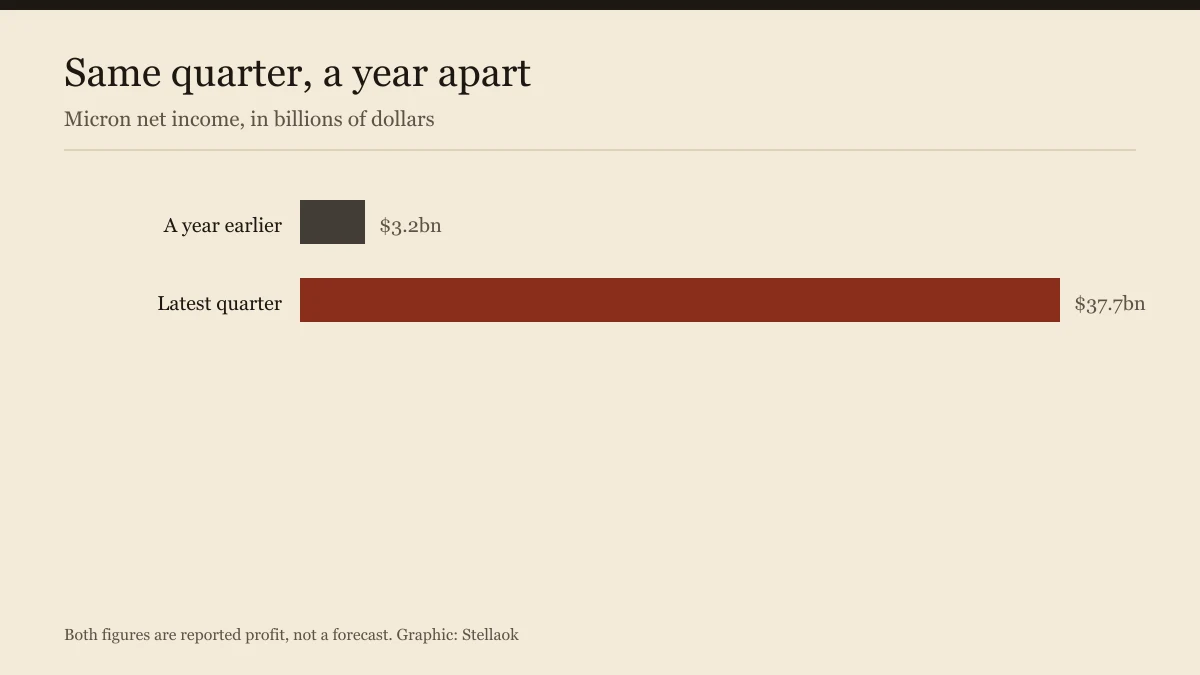
Micron's net income in the latest quarter was $37.7 billion, or $32.87 a share. A year earlier the same quarter produced $3.2 billion, or $2.83 a share.
CNBC is reporting the company's statement. Divide 37.7 by 3.2 and the result is 11.8. Both inputs are reported profit for one fiscal quarter, twelve months apart, so the multiple is a like-for-like change. It is not a forecast divided by a result. Per-share earnings moved from $2.83 to $32.87, or 11.6 times, on that same pair of quarters.
$39.8 billion of DRAM implies a total only if 73 percent is exact
Fourth-quarter DRAM revenue rose 343 percent from a year ago, to $39.8 billion, "representing 73 percent of total sales." Take 73 percent as exact and $39.8 billion divided by 0.73 is about $54.5 billion of sales. If 73 is rounded, that total moves. It is an implication, not a figure Micron printed next to the DRAM line. Revenue "almost quadrupled" from $11.32 billion a year earlier. "Almost" means the new revenue is not four times $11.32 billion, and the story does not state the precise revenue total beside that sentence.
Micron is the only US maker of high-bandwidth memory. Sanjay Mehrotra, the chief executive, said the company has a "strong roadmap for future HBM products" and is working with Nvidia on the industry's "first custom HBM implementation." Micron still has the smallest HBM share of the three suppliers. Its market value has topped $1.2 trillion. "Topped" is a floor on the valuation, not a close. The shares are up more than 500 percent over the past year. That year and this quarter are different windows. They do not divide.
The build attached to the profit is $250 billion for two new HBM campuses. The larger one broke ground in Clay, New York, in January. The first new fab in Boise, Idaho, is due online next year. Nvidia's $150 billion buyback is another company's cash going out. AMD at $1 trillion and Nvidia near $5.4 trillion is the scale Micron just joined by clearing $1.2 trillion.
Even the low end of the guide beats $35.40
Next quarter Micron expects about $61.5 billion of revenue and adjusted earnings of $38.15 a share. Analysts polled by LSEG had looked for $57 billion and $35.40. "About" $61.5 billion is roughly $4.5 billion above $57 billion. The word "about" means the gap is not exact to the dollar.
Tom's Hardware reprints the margin path. A gross margin of 86.25 percent on $61.5 billion is $53.04 billion, which is what the outlet calls more than $53 billion of gross profit. After an estimated $2.06 billion of operating costs and a tax rate around 15.5 percent, earnings per share are $38.15 plus or minus $1. The bottom of that band is $37.15, still $1.75 above the $35.40 consensus. The guide beats the Street without using the top of the range. Share count in that walk-through is about 1.15 billion.
He will not date the end of the shortage
Mehrotra said most of next year's capacity is already sold, and that customers will pay more than they did in 2026. Demand exceeds supply in calendar 2027 and 2028, and "we see greater tightness in the industry in 2027 and in 2028 versus 2026." He has no "line of sight to when supply and demand will return to balance." NAND and DRAM shipments are expected to grow in the low-to-mid 20s percent for two years. That phrase is a range. It is not 23 percent. HBM is expected to grow faster than ordinary DRAM. New plants take years before the first wafer.
Pay went up for every Micron employee in fiscal 2026, he said. Hundreds of workers in Taiwan threatened to strike. At SK Hynix and Samsung, similar fights have ended in bonuses upwards of $500,000. That "upwards of" is a floor on other companies' bonuses, not a Micron cheque.
He joined a Trump meeting on AI rules on Tuesday, days after a White House dinner with Xi Jinping on Xi's first US visit in more than a decade. The shortage has no end date in his remarks. The figure that does is the next quarter's earnings band, a dollar wide, centered on $38.15.