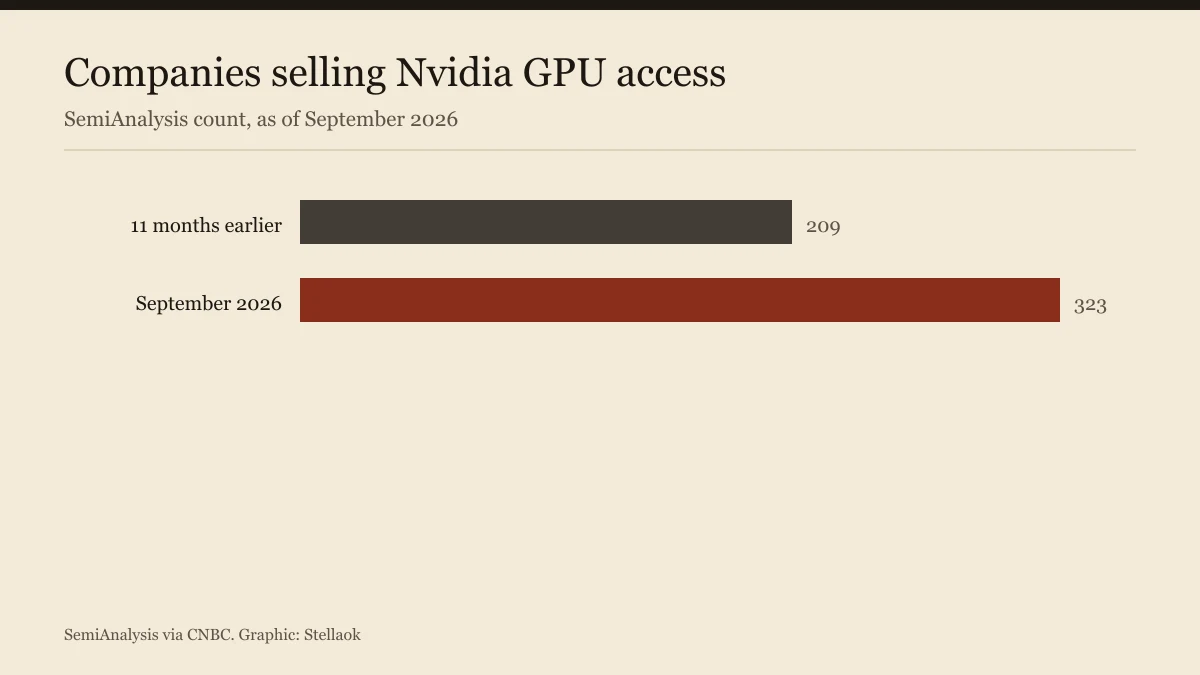
Nvidia's management anticipates $108 billion of revenue in the October quarter, an 89 percent increase from a year earlier. The company's market value sits close to $6 trillion. Customers can rent the chips from Amazon, Microsoft, and Google, from specialists such as CoreWeave, from online marketplaces, or they can buy the hardware. SemiAnalysis counted 323 companies selling access to Nvidia GPUs as of September, up from 209 less than 11 months earlier.
CNBC's account says the customer list is widening even while cloud providers remain at the top of it. A filing showed five clients each accounting for at least 10 percent of accounts receivable in the July quarter, up from three in January. Jensen Huang, speaking at a Goldman Sachs technology conference in San Francisco last month, said a new crop of these specialists would carry hundreds of billions of dollars of backlog among them. Nvidia has authorized $150 billion of buybacks. The October guide is the revenue line those buybacks sit beside.
Labs have pledged over $500 billion to two clouds
In the past year Anthropic and OpenAI have committed to spending over $500 billion between Amazon and Microsoft. Those two companies controlled 59 percent of the cloud infrastructure market in 2025, Gartner says. Hardeep Singh, a Gartner analyst, said the hyperscalers can show enterprises a decade of full-stack operations, and that they still run short of the GPUs some customers want. Andy Jassy, Amazon's chief executive, told analysts in July that Amazon will be unable to serve all the demand it foresees this year. He said he expects the same in 2027.
Large buyers already spend tens of millions of dollars a year across Amazon, Google, and Microsoft, a mix that widened after ChatGPT launched in 2022. Bindu Reddy, chief executive of the AI assistant startup Abacus, told CNBC that an enterprise sale is easier when the subprocessor is Microsoft's Azure. Micron's last quarter lifted profit from $3.2 billion to $37.7 billion. Memory is one input. The chip the labs are reserving is the other.
CoreWeave says the near-term stock is sold out
Modal, which runs sandboxes for AI agents, left the hyperscalers for the specialists and now uses 25 of them. Chief executive Erik Bernhardsson said the company needed well beyond a few hundred GPUs, or a thousand. Google and Microsoft have themselves started buying capacity from CoreWeave while competing with it. Marc Boroditsky, chief revenue officer of Nebius, a Netherlands-based specialist with U.S. operations, said some hyperscalers have asked Nebius to take customers they cannot serve on time.
Alberto Taiuti, chief executive of the video startup Reactor, uses both Nebius and the big clouds because the videos have to appear quickly, and the location of the data center is part of that. The named specialists often want money up front, and the chips can take months to come online, because the provider raises funds against contracts and then installs the equipment, Bernhardsson said. Chen Goldberg, an executive vice president at CoreWeave, said handing 10,000 GPUs to a new customer on a day's notice would be difficult. On the August earnings call, chief executive Mike Intrator said near-term capacity is essentially sold out.
Oracle will host chips the client already bought
Oracle is letting clients bring their own GPUs. It carries more debt than Amazon or Microsoft, and a lower credit rating, which leaves less room to buy the hardware itself. Chief financial officer Hilary Maxson told analysts in June that bring-your-own-hardware holds the margin and produces a higher return on invested capital. John DiFucci, a Guggenheim analyst who recommends Oracle shares, said AMD and Nvidia would be logical clients for that lane. The company has kept the names off the record. OpenAI's commitment to Oracle is a separate figure, over $300 billion across five years. Zhen Lu, chief executive of Runpod, said capacity is tight and that who supplies a firm like his is treated as a secret. Sunny Smith, co-founder of Massed Compute, said buyers will reserve capacity when they think the price is about to rise. SpaceX has arranged to pass spare GPU capacity to Google and to the startup Reflection.