Figma reported third-quarter results that beat expectations, raised its full-year forecast, and watched its shares fall 7 percent in extended trading. Revenue grew about 43 percent year over year and the adjusted operating margin came in at 12 percent against a 6.1 percent consensus among analysts polled by StreetAccount, CNBC reported. The net loss narrowed to $81.3 million, or 15 cents a share, from $1.10 billion, or $2.72, a year earlier.
Guidance went up rather than down. Figma now expects an operating margin of 11 percent for the year, from 9 percent in August, and revenue of $1.497 billion to $1.499 billion, against a prior range of $1.463 billion to $1.467 billion. The LSEG consensus was $1.471 billion.
A beat that reads as a warning
The fourth-quarter number explains the reaction. Figma told investors to expect revenue growth of about 33 percent, which is above the 28 percent analysts had modelled and still a steep deceleration from the 43 percent just reported. A company that guides above consensus and still slows by ten points in a quarter is being read as one that is buying growth.
That is close to what management described. Figma gave clients more AI credits during the quarter while holding prices, which is a discount in everything but name. Chief financial officer Praveer Melwani told CNBC the trade was deliberate: give up near-term revenue, invest in customers, and grow durably later. Investors marked the stock down by the amount of revenue that moved off the current quarter and into a future one.
The usage figures behind the decision are decent. Weekly users at organisations spending more than $10,000 on Figma who used AI credits rose almost 50 percent in the quarter, the share of work performed by the company's own model doubled, and the rate at which people undo AI-generated work fell. All three point the same way: the features are being adopted and the output is improving.
Why the stock is down 41 percent this year
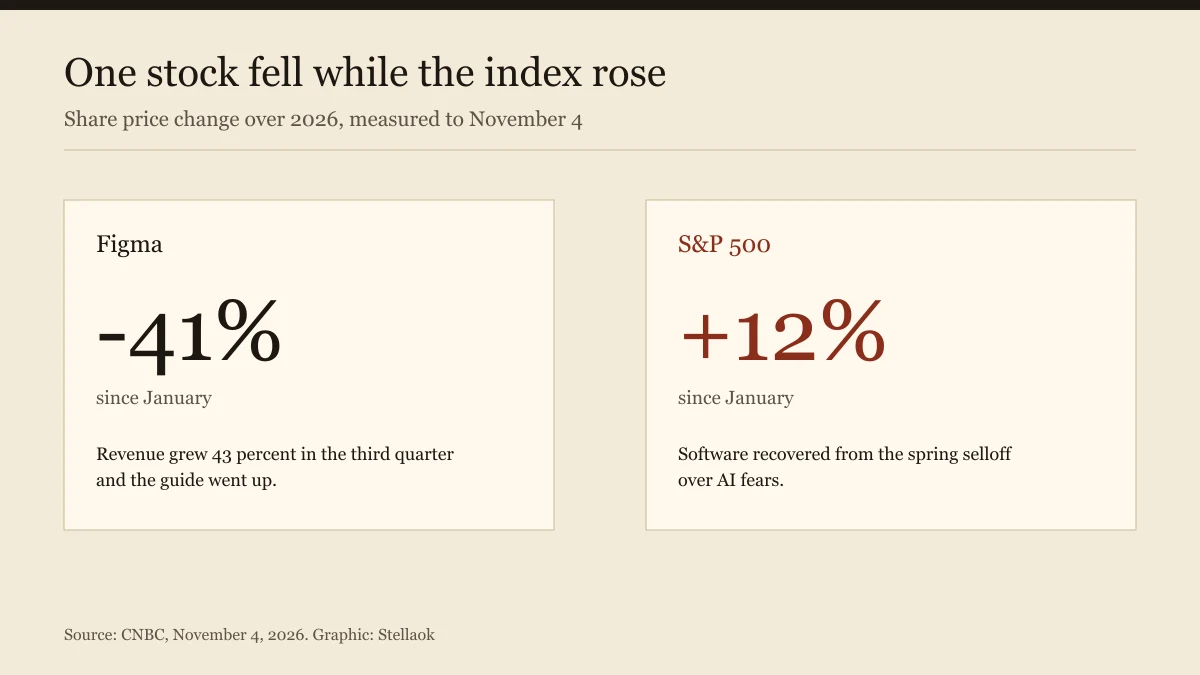
Figma has lost about 41 percent in 2026 while the S&P 500 gained 12 percent, a gap of more than 50 percentage points. The selloff started earlier this year on the fear that AI models would make design software cheap to replicate, and the fear has not been retired by three quarters of growth.
The comparison inside the sector is instructive. Canva, the design startup with the largest private valuation in the category, said a day earlier that it would cut 22 percent of its staff. One company is trading margin for adoption and the other is cutting cost, and both are responding to the same shift in what customers expect to pay for design tools.
There is also a competitive question Figma cannot answer with its own numbers. Character AI filed for bankruptcy and lined up a sale after failing to convert usage into revenue, which is the failure mode investors are pricing when they discount AI features. Oura delayed its IPO as smart glasses drew privacy scrutiny for a different reason, but both cases show how quickly a narrative about a product category can reset a valuation that revenue cannot defend in a single quarter.
The company is also spending attention on security. Chief executive Dylan Field said clients are not asking Figma to become a security vendor, but that the company has to scrutinise the security of all its vendors, after AI agents got into systems at Hugging Face and elsewhere. That is a new cost line that did not exist when the IPO was priced.
What to watch in the fourth quarter is whether the credit giveaway shows up as retention. If the customers who took extra credits renew at higher seats, the trade worked and the 33 percent guide is a floor. If they use the credits and leave, Figma will have paid for growth it did not keep, and the 41 percent decline will look like the market getting there first.