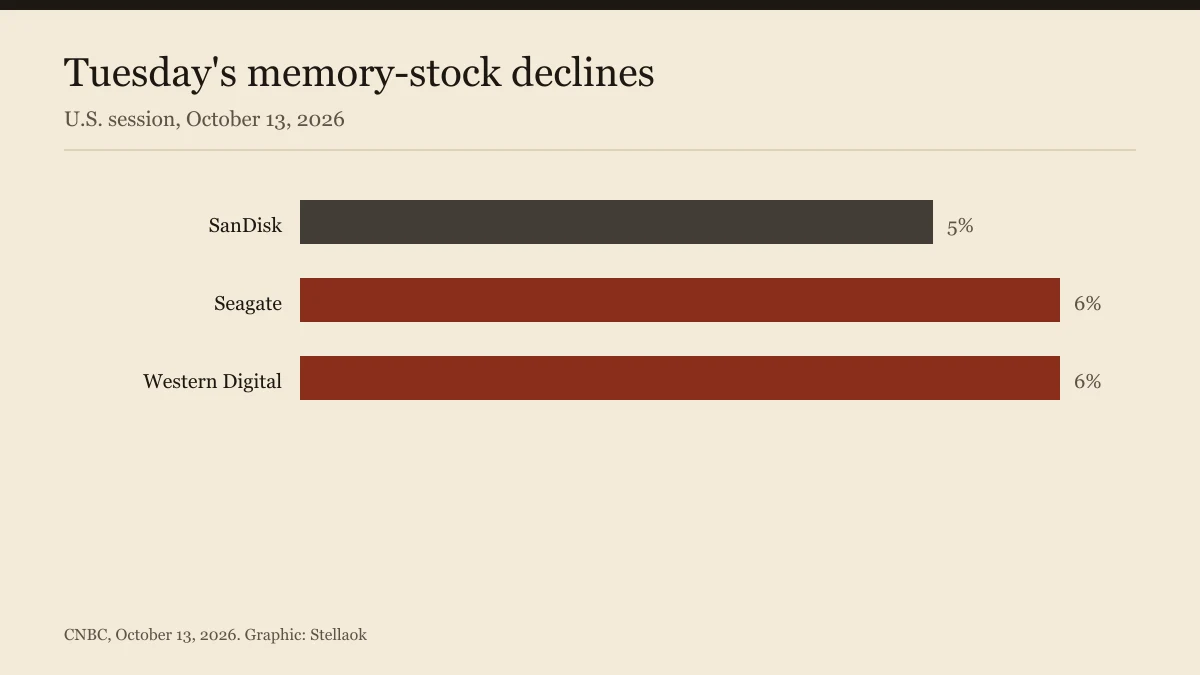
Memory and storage stocks fell on Tuesday after ChangXin Memory Technologies said over the weekend it had made progress on a denser chip design. In the later session Micron slipped about 5 percent, SanDisk fell 5 percent, and Seagate and Western Digital each dropped 6 percent. SK Hynix's Seoul shares closed more than 10 percent lower, and Samsung Electronics fell 7.4 percent. Both Korean names hit their lowest levels since August.
CNBC's piece on CXMT had Micron down 3.7 percent in premarket trading, before the cash session deepened. The later market story is the one with the 5, 6, and 10 percent moves. Hynix's U.S.-listed stock was down around 5 percent in premarket. SoftBank fell 8.5 percent in Tokyo. Tokyo Electron dropped 7.2 percent, Advantest 2.9 percent, Lasertec more than 5 percent, Disco 4.7 percent, and Renesas 5.9 percent. In Europe, ASML was down 3.3 percent, STMicroelectronics and Infineon each about 5 percent, and BE Semiconductor and ASM International around 4 percent at the open. The Nasdaq Composite had fallen 0.44 percent on Monday, when Micron slid 3.9 percent.
The design is a denser cell, aimed at servers
CXMT, based in Hefei and founded in 2016, said the new architecture packs more data into a smaller space. It reportedly plans a server-memory product on the design by the end of 2026. The cell is described as "4F square." SK Hynix presented a roadmap for the same class of design in 2025. Analysts still treat CXMT as behind Micron, Samsung, and Hynix at the frontier, especially in high-bandwidth memory, the stacks used in AI systems. An HSBC note on Thursday put CXMT's share of the global DRAM market at about 10 percent, up from about 4 percent a year earlier.
The company still cannot buy ASML's extreme ultraviolet scanners. A Washington count put 343 immersion DUV tools in China. Those are the machines CXMT can still try to use. Citi analysts wrote in August that Washington is unlikely to allow Chinese-made memory into the United States, and that sales to data centers in Europe could still reach Micron's customers indirectly. The Financial Times reported in July that Apple had started testing CXMT DRAM for phones sold inside China and was lobbying the U.S. government for broader permission. Apple was approached for comment.
July's listing made the rival visible
CXMT's Shanghai STAR Market debut in July rose nearly 466 percent and, that day, made it the most valuable China-listed company. The IPO price was 49 yuan a share. The stock has since fallen 4 percent from that first-day price. The market value cited Tuesday was 3.46 trillion yuan, about $520 billion, against Tencent's 3.87 trillion yuan. Micron's last reported quarter was the profit spike. Tuesday's move was about a Chinese rival's cell design, not about Micron's earnings line.
Traders treated a lab result like a supply shift
Vey-Sern Ling, senior equity advisor at UBP, said investors are looking for excuses to take profit in AI names that have already run, especially memory. He said Chinese makers can become a threat to the global balance over time, and that in the short run they still face hurdles on advanced memory such as HBM. Phillip Wool, chief market strategist at Rayliant Global Advisors, called the CXMT step a milestone for getting around equipment restrictions, and said the price move looked large next to a firm that has not shown large-scale production of the new part. Elon Musk wrote on Monday that once China works out how to manufacture a product, its ability to scale is often greater than the rest of the world combined. The server chip CXMT described is still scheduled for the end of 2026.