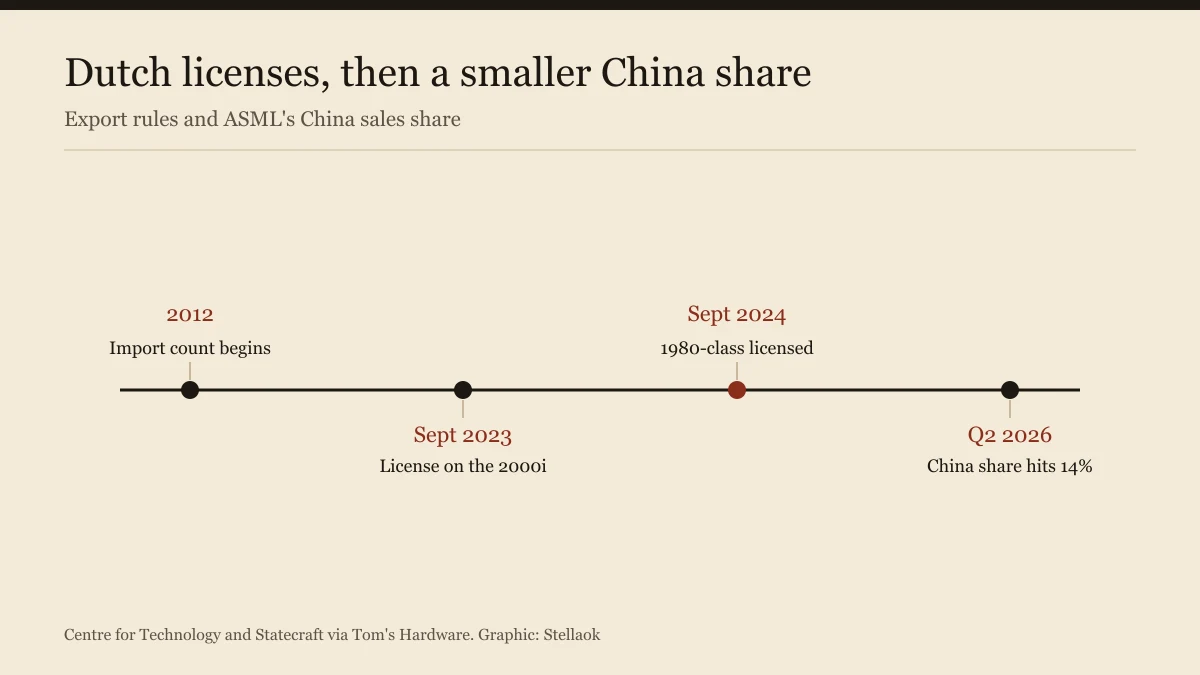
Chinese chipmakers imported 343 immersion DUV lithography scanners from ASML between 2012 and early 2026, according to the Centre for Technology and Statecraft, a Washington group. The count excludes tools that went to multinational fabs inside China. CTS says many of the machines can be used for 7-nanometer-class chips even though China cannot buy ASML's EUV systems.
Tom's Hardware's reading of the CTS report breaks the 343 into models. CTS says 270 are Twinscan NXT:1980-class scanners, with a 38-nanometer resolution, the ones used for multipatterning at 7-nanometer-class nodes. It also counts 22 NXT:2050i tools and six NXT:2000i tools. How many of those advanced machines are actually running is not in the report. Dutch licensing for the NXT:2000i and anything more capable began in September 2023, which pushed buyers toward the less capable 1980-class tool. The Netherlands extended controls to that model in September 2024. Individual exports can still be approved.
Ninety tools in 2024, eighty-nine in 2025
CTS estimates Chinese fabs bought about 90 of the 1980-class scanners in 2024 and 89 in 2025, and spent more than $13 billion over those two years. ASML's published sales cannot reconstruct that unit count. They can check the direction. China was 41% of ASML's net system sales by shipment destination in 2024 and 33% in 2025, then 19% in the first quarter of 2026 and 14% in the second. ASML sold 129 argon-fluoride immersion systems worldwide in 2024 and 131 in 2025. Tom's Hardware says that if the CTS unit counts are right, Chinese buyers took about 70% of that 2024 output and about 68% of the 2025 output. The piece flags those two percentages as dependent on the CTS figures, not as a line in ASML's own tables.
The MATCH Act would go past the Dutch licenses
The MATCH Act, introduced in April, would go further than the Dutch licenses: ban exports of all immersion DUV systems to China, and restrict parts and service for machines already in advanced fabs. Nvidia's buyback authorization is the commercial scale of the chips those scanners are meant to approach. Huang has said chip sales will double next year. A 7-nanometer-class part made without EUV is the gap CTS wants closed. Secondhand 1980-class tools are already on the market, the piece notes, which a new export ban would not vacuum up.
The China share of ASML's sales has already fallen
Fourteen percent in the second quarter of 2026 is the latest destination share ASML has printed. Forty-one percent was 2024. The drop is what ASML had warned about after the licensing tightened. The 343 is a stock of machines accumulated since 2012. The quarterly share is a flow of new sales. AMD's market value and Nvidia's are the scoreboard for the chips those tools are chasing. CTS wants the installed base serviced less freely. ASML's latest quarter already shows fewer new systems landing in China.
Older scanners can still reach a 2018 node
The industry moved to 7-nanometer-class production in 2018 and 2019, which is the node CTS says these older immersion tools can still reach by multipatterning. The 1980-class spec in the report includes a 2.5-nanometer overlay, the alignment tolerance that work needs. Tom's Hardware adds that ASML might still be able to sell the older NXT:1965Ci into China if the parts for that outdated scanner are actually available. The 1980-class name in the piece covers more than one productivity tier, the original Di and a later Fi, even though ASML never shipped a tool under the exact label NXT:1980i. Secondhand 1980-class machines are already listed for sale, so a ban on new exports would leave that stock in place. The MATCH Act is the April proposal that would also limit parts and service. The Dutch rule from September 2024 is the control already on the books, and it still allows a case-by-case license.