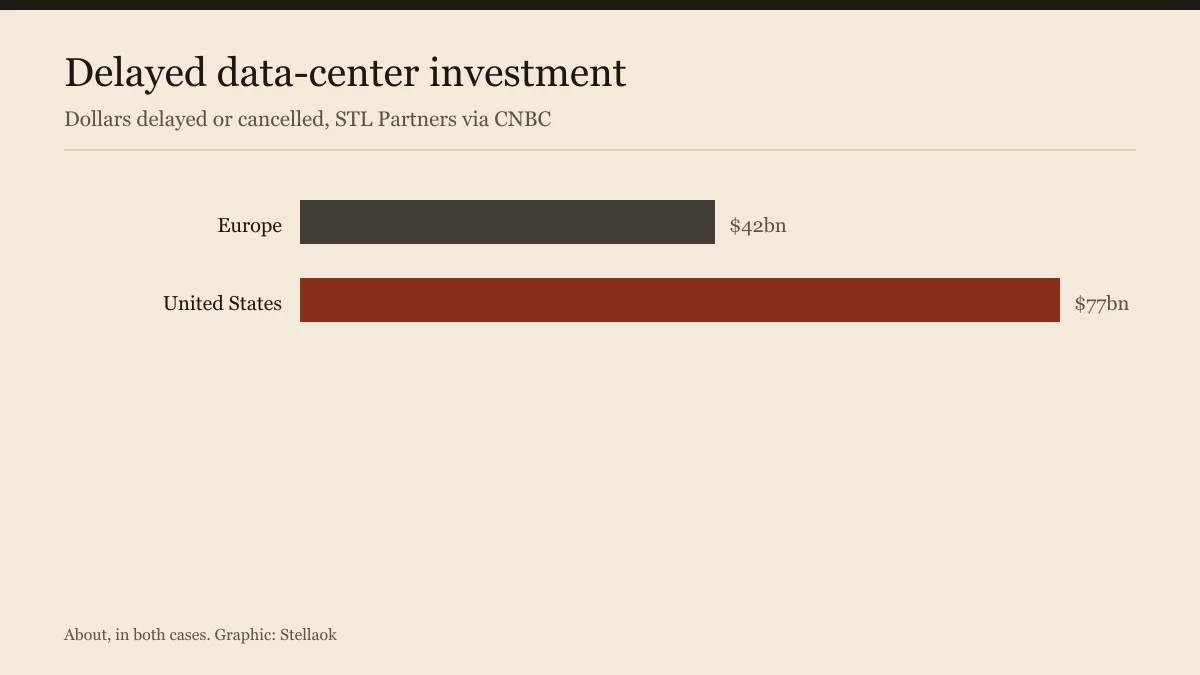
About $42 billion of data-center investment in Europe is stuck in delays or cancellations. The comparable U.S. figure is about $77 billion. Both numbers are from STL Partners, via CNBC.
CNBC's survey of the backlash adds a count that is not a dollar figure. The European Data Center Monitor found more than 70 projects rejected or restricted between January and April 2026, more than in all of 2025. The objections have moved from town halls into courts, regulators, and parliaments. Darmouni, at HEC Paris, told CNBC there is a clearer picture now of how large the build is, and of how widely it is spread. He described the buildings as giant warehouses that use a lot of resources and can hurt the towns around them. Europe's denser population, and the fact that many operators are American companies, is why he thinks the backlash lands harder there than in the U.S.
Scotland stopped, and Denmark cut the queue
Scotland has paused planning approvals for new hyperscale centers after campaigners pointed at Ireland, where power demand produced a moratorium. Denmark, after a surge in applications for grid power, passed an emergency law that can put data centers at the back of that queue. Spain proposed rules this summer requiring centers to take 80% of their electricity from renewables. Projects in the U.K. have stalled after local objections. The Nordics had been the easy site: land, and renewable power. The applications used that up.
U.S. opposition has already blocked $68 billion of projects in a single quarter. Europe's $42 billion is a different geography and a running tally of delays and cancellations, not that one quarter. The complaint is the same list: water, power, prices, and land. There is still no agreed count of permanent jobs, and no standard for what a center is worth per megawatt.
Seoul has been outside the office for 172 days
South Korea named AI data centers one of three national investment projects in June 2026, beside semiconductors and what it calls physical AI. Samsung and SK Hynix sit in that supply chain. In Seoul's Geumcheon district, residents have asked the city to revoke a permit for a center near their homes. As of mid-August the weekday-morning protests had run for 172 days. In July, officials said they would require consent from a majority of residents living within 200 meters of a proposed site, and a three-stage review. In Gwacheon, just south of Seoul, a council member has proposed rules aimed at round-the-clock operation, including fires in backup batteries.
The trades hired to build the American version of these buildings are already in short supply. A European or Korean halt does not free those welders. It strands the capital that was supposed to employ them.
A community can stop a $10 billion plan
Asya Walters of Alvarez & Marsal told CNBC that a community's ability to derail a $10 billion plan is powerful, and that the U.S. has historically been easier to build in. Europe and Asia, she said, run hot and cold by country. Money spent before a permit is a loss if the permit never comes. Most of the capital expenditure arrives after the permit. The pre-permit spend is the part that disappears quietly.
Eulalia Flo of Equinix, one of the largest operators in Europe, said communities want to know what is being built and how the local effects are handled.
Flo sees tightening, Walters sees a stopped project
Flo does not treat the objections as a cap on growth. She does say the policy environment is tightening in some markets. Dominic Ward, chief executive of Verne, told CNBC the industry used to be a black box and is now a layer of the economy that people can point at. There is still no one assigned to watch a million kilometres of the cable these buildings depend on. The fight in the piece is about the building, not the line into it.
Walters's $10 billion example and Flo's "not a structural constraint" are the two readings CNBC leaves side by side. The piece does not say which one the next permit will follow.