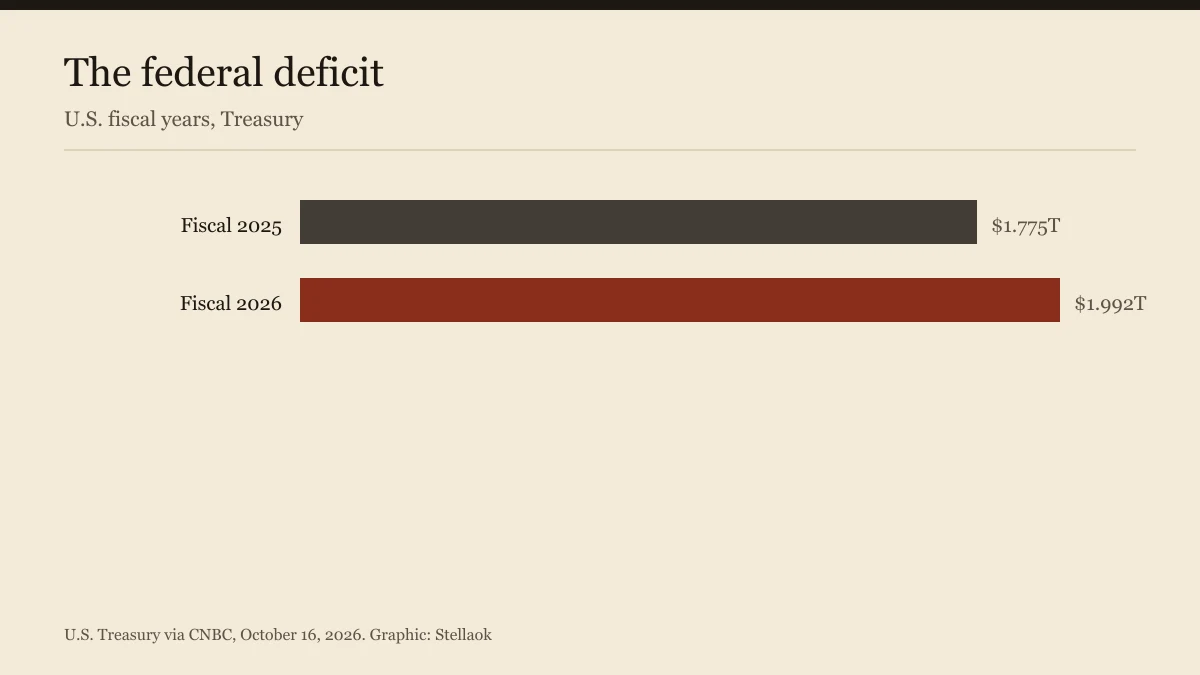
The Treasury Department said Friday that the United States finished fiscal 2026 with a budget deficit of $1.992 trillion. That is about 12 percent higher than the $1.775 trillion deficit in fiscal 2025, and it is the third-largest annual deficit on record, behind 2020 and 2021. The same day, IMF managing director Kristalina Georgieva said growth can ease the debt problem and cannot make the budget adjustment by itself.
CNBC's account of the Treasury release is the source for the year's totals. Fortune's account from the IMF meetings in Bangkok is the source for Georgieva's line: "Growth, of course, helps, but it cannot deliver fast enough the necessary adjustments." She added that the deficit has to come down. The IMF's October growth call, 3.1 percent with the gains concentrated, is a separate release. Friday's comment is about the stock of debt, not that forecast.
Receipts and outlays both set records
A Treasury official told CNBC that fiscal 2026 set records for both money in and money out. Individual income taxes brought in more than $2.8 trillion, up about 7 percent from the year before. Corporate income tax brought in $381 billion, about $70 billion less than in fiscal 2025, which CNBC tied to the tax cuts in last year's One Big Beautiful Bill. Social Security was the largest spending line at nearly $1.7 trillion, up from roughly $1.6 trillion. Medicare was almost $1.1 trillion, against slightly under $1 trillion the year before.
Net interest, the Treasury's interest paid minus the interest it earns, topped $1 trillion, compared with $970 billion in fiscal 2025. Interest on the national public debt was more than $1.3 trillion. The debt itself passed $40 trillion earlier this year. Fortune, using Treasury data, put the figure at $40.3 trillion and called it the largest total in the world. Gross debt was about 126 percent of GDP. Debt held by the public was 100 percent of GDP, which the Committee for a Responsible Federal Budget described as the highest since just after World War II. Fortune put net interest at about 15 percent of federal spending in fiscal 2026 and about 20 percent of revenue.
This is the 25th straight fiscal year in deficit. The last surplus was 2001. Ten-year and 30-year Treasury yields hit 24-year highs last week, which CNBC read as bond traders pricing the debt. CoreWeave's 2031 bond yielded 15.78 percent against a 9.75 percent coupon in Thursday's session. That is one company's credit spread. Friday's number is the federal deficit those spreads sit beside.
Georgieva in Bangkok, and the Treasury's answer
Georgieva spoke during the IMF's annual meetings. The Treasury answered Fortune by attacking the Fund's forecasting record. David Zervos, counselor to Treasury Secretary Scott Bessent, said IMF forecasts were messy before the 2008 crisis and before the 1997 Asian crisis. Bessent's own line, given to CNBC in August and repeated in Fortune's story, is that there is nothing magic about $40 trillion and that the country can grow its way out. He has talked about 3 percent growth, with AI as part of the fuel. In August he also told allies that global growth is how to handle the debt pile.
Fortune, citing the Council on Foreign Relations, said the United States has hit 3 percent calendar-year growth in only five years, the latest being 2019. The same story puts this year's GDP growth estimate at 2.2 percent, after 2 percent in 2025. The Committee for a Responsible Federal Budget has said that by fiscal 2031 the average interest rate on the debt could exceed the economy's growth rate, which is the condition people call a debt spiral. That is the committee's projection, not a Treasury forecast.
Tariffs were the revenue plan. The deficit still rose
President Donald Trump has pitched tariffs as a way to raise revenue and shrink the debt. CNBC noted that the Supreme Court ruled earlier this year that many of the levies he imposed were unconstitutional, and that the White House has kept pressing the policy. The year still closed deeper in the red than the one before it. Fortune's accompanying point is mechanical: if Washington borrows faster than the economy grows, the debt ratio can rise during an expansion. That is the gap Georgieva was talking about when she said growth helps and does not finish the adjustment. Nvidia guided the October quarter to $108 billion, up 89 percent. That is the company-scale version of the AI boom Bessent is counting on. It is not a line in the federal budget.