The International Monetary Fund raised its forecast for world growth in 2026 to 3.1 percent, from the 3 percent it projected in July, and kept 2027 at 3.4 percent. Last year's pace was 3.5 percent. The new outlook was released Tuesday as finance ministers and central bank governors from the fund's 191 members met in Bangkok.
CNBC's account of the World Economic Outlook quotes Silvana Tenreyro, economic counsellor and director of the IMF research department. She told reporters the global economy has been resilient, and that the resilience is reaching its limits. Fortune's writeup of the same outlook has her calling the picture highly uneven.
AI spending carried the first half
The fund said AI-related investment gave the world a demand impulse, so activity in the first half held up better than it had expected through the Middle East war and the trade fights. Markets stayed largely calm, which the IMF said may partly reflect AI-related exuberance. It also called the boom a large, front-loaded demand shock: money is going into semiconductors, data centers, and power generation before broad productivity gains show up. Fortune adds a split inside that demand. The United States and China account for more than three-quarters of net demand for imports of computer chips and other AI-related equipment.
The cushion that got economies through the energy shock is narrowing, the IMF said. Global oil reserves are being drawn down by about 2.7 million barrels a day, near levels that could move prices sharply, and energy constraints could cut into the AI-led momentum. Georgieva has already tied AI to the growth forecast. On Tuesday she called the jobs effect a slow-moving tsunami and put the share of jobs worldwide that could be augmented, downgraded, or eliminated at about 40 percent.
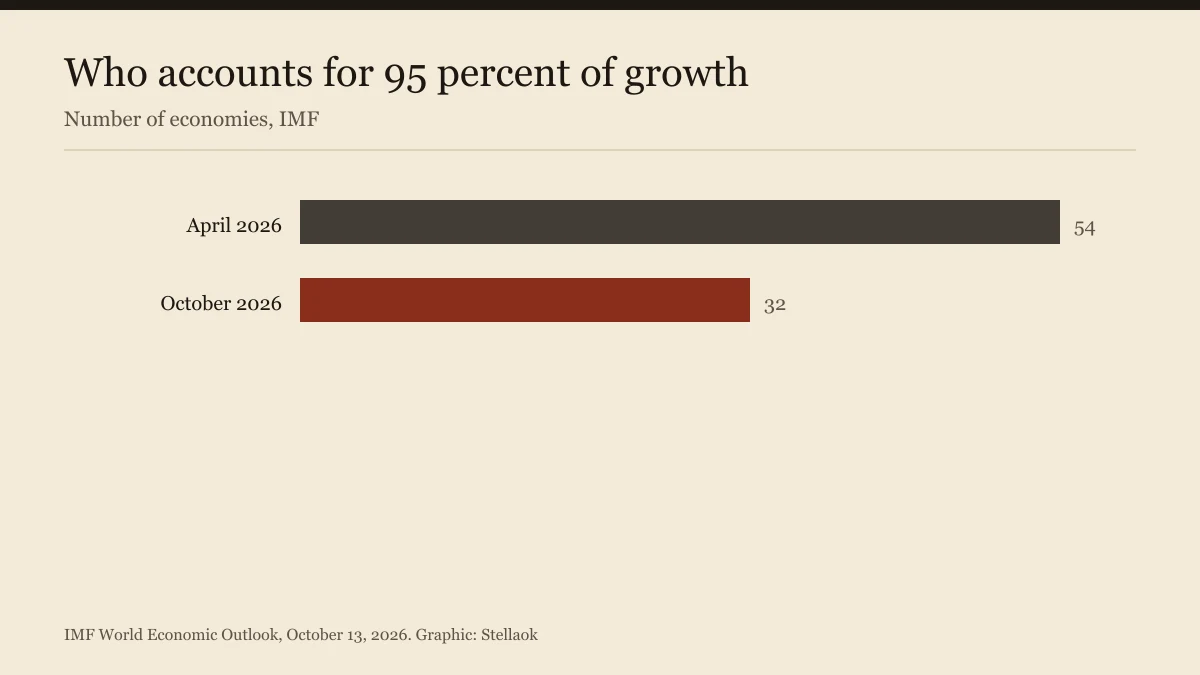
Thirty-two countries now hold 95 percent of the growth
Overall growth is being reallocated, the fund said, according to who is exposed to the war's supply shock and who is selling into AI demand. Thirty-two economies now account for 95 percent of global growth, down from 54 in April.
Taiwan is forecast to grow 10.7 percent this year. South Korea is forecast at 3.3 percent, up from 1.1 percent in 2025, on semiconductor demand. The United States is projected at 2.3 percent in both 2026 and 2027. India, the fastest-growing major economy in the outlook, is at 7.0 percent in both years, upgrades of 0.6 and 0.3 percentage points from July. India raised rates for the first time since 2023, to 5.50 percent. China is at 4.5 percent this year and 4.0 percent in 2027. Fortune puts China's 2025 pace at 5 percent. The euro zone is estimated at 1.1 percent this year. The Middle East and Central Asia are projected to contract 0.3 percent, with Bahrain, Iraq, Kuwait, and Qatar facing double-digit declines before double-digit rebounds in 2027. The World Bank had already lifted its East Asia forecast. The IMF's new map is narrower than a regional average.
The outlook assumes $96 oil and a March reopening
Fortune's version of the outlook rests on a nearly 41 percent rise in oil prices this year, to an average of $96 a barrel, and on shipments through the Strait of Hormuz resuming by March. CNBC has the fund's updated timing: the strait reopens in March 2027 and returns to a pre-war state by October. Gulf crude exports averaged 88 percent of pre-conflict levels in September. Inflation stays at 4.7 percent for the current year. The July projection had put 2027 inflation at 3.9 percent, on an assumption the strait would reopen by mid-July. The new 2027 inflation figure is 4.1 percent.
Fortune's version of the outlook also has advanced economies growing 2.1 percent this year, up from 2.0 percent in 2025, then slowing to 1.9 percent in 2027. Emerging markets and developing economies more exposed to oil and gas costs slow to 3.7 percent this year from 4.5 percent in 2025, then 4.4 percent next year. The 21 euro countries are at 1.1 percent this year and 1.2 percent in 2027 in that account. Fortune puts India's pace last year at 7.7 percent.
A failed AI bet is a 20 percent equity drop
If AI productivity gains fail to materialize, the IMF said U.S. equities could fall 20 percent and global growth could end up 1.1 percent below its baseline by 2028, with Asia 1.7 percent lower. Athanasios Vamvakidis, deputy director of the IMF's Monetary and Capital Markets Department, told reporters an AI-related stock correction is one risk beside rising bond yields and cyber disruptions. Advanced-economy public debt is projected to reach 115 percent of GDP by 2031, from 108 percent in 2025. In emerging and developing economies the projection is 84 percent, from 74 percent.
Tenreyro said monetary policy should stay sufficiently restrictive to get inflation back to target, and that central bank independence matters while governments face financing pressure. The fund's models put the probability that global inflation exceeds 5 percent in 2027 at about 35 percent, up from 30 percent in April.