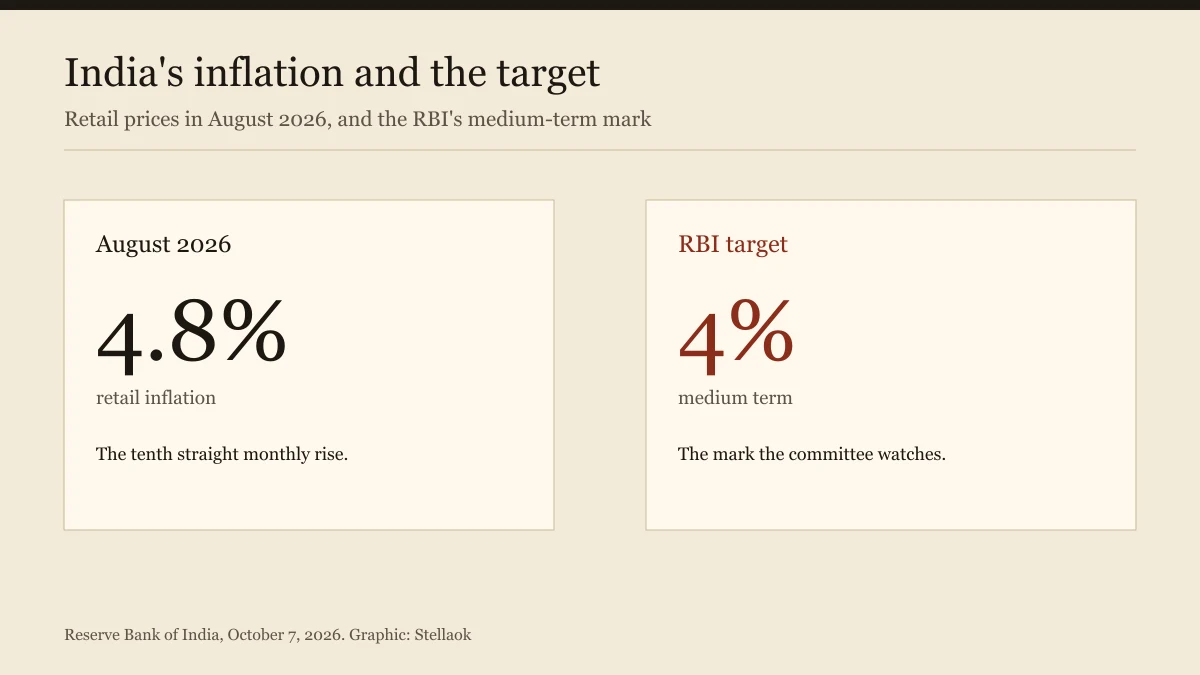
India imports nearly all of its fuel, and the rate move is the bank saying that bill has reached consumer prices. Retail inflation has risen for ten months running. The August 2026 print of 4.8 percent is above the 4 percent target the committee is judged against. Core inflation is expected at 4.4 percent in the year ending March 2027, headline at 5.2 percent. HSBC's Monday note said a hike has to look like it can be repeated. Goldman and HSBC both have December 2026 penciled in for another step. The Nifty's 0.7 percent drop and the 10-year yield at 7.243 percent, up 5 basis points, were the first market marks after Malhotra spoke.
The Reserve Bank of India raised its benchmark repo rate by 25 basis points on Wednesday, October 7, 2026, to 5.50 percent. That is a one-year high, and the first increase since 2023. Economists polled by Reuters had expected the quarter-point move. The prior rate was 5.25 percent.
The hike puts India in the same month as several other central banks. The Fed raised last month and left another move on the table. The Bank of Japan went to a 31-year high. South Korea and the European Central Bank have tightened in the last two months. HSBC wants the Indian step to look repeatable. The December 2026 calls from HSBC and Goldman are that bet written down.
Governor Sanjay Malhotra said growth has held up despite global strain, and that inflation and its outlook are not benign the way they were last year. The monetary policy committee shifted its stance to what he called calibrated tightening. Rate cuts, he said, are off the table in the near term. The next move is another hike or a pause.
CNBC's account of the decision puts retail inflation at 4.8 percent in August 2026, the tenth straight monthly rise, above the medium-term target of 4 percent. The bank expects core inflation of 4.4 percent in the financial year ending March 2027, and headline inflation of 5.2 percent. HSBC and Goldman Sachs expect another increase in December 2026. HSBC wrote on Monday that markets need a hike they can read as credible, including the ability to raise rates again. A move perceived as dovish while inflation is rising would, the bank said, hurt India's appeal to global investors.
The growth forecast went up 40 basis points, to 7.1 percent
The RBI lifted its growth estimate by 40 basis points, to 7.1 percent, citing resilient activity. It also flagged protracted geopolitical tension, trade friction, tighter financial conditions, and high commodity prices as weights on that growth. India is still described as the fastest-growing major economy. The June 2026 quarter expanded 7.8 percent, better than expected, while the United States, China, and Japan cooled under trade conditions, geopolitics, and energy prices. The household oil shock priced in the United States was about $1,700. India's version of that shock is an import bill.
Eighty-five percent of the fuel is imported
India meets nearly 85 percent of its fuel needs with imports, and the Strait of Hormuz was a main route before the war. The World Bank, in a report on Tuesday, October 6, expects growth of 7.1 percent in the year ending March 2027, down from 7.8 percent the year before. The same report said growth held up better than expected and will moderate over the next few quarters. It also said India had its fourth-driest June-to-August period since 1960, with El Niño a risk this year and food prices the channel. Japan lifted rates to a 31-year high as energy prices pushed inflation up.
The bond yield moved 5 basis points
The RBI is not alone in the last two months. The Federal Reserve raised rates last month for the first time in more than three years and indicated another hike could follow. The Bank of Japan moved to a 31-year high. South Korea and the European Central Bank have also raised rates. After the Indian decision, the 10-year government bond yield rose 5 basis points to 7.243 percent. The Nifty 50 fell 0.7 percent.
Malhotra's December question is whether 5.50 percent was the start of a sequence or a single step. HSBC and Goldman have already picked the sequence.