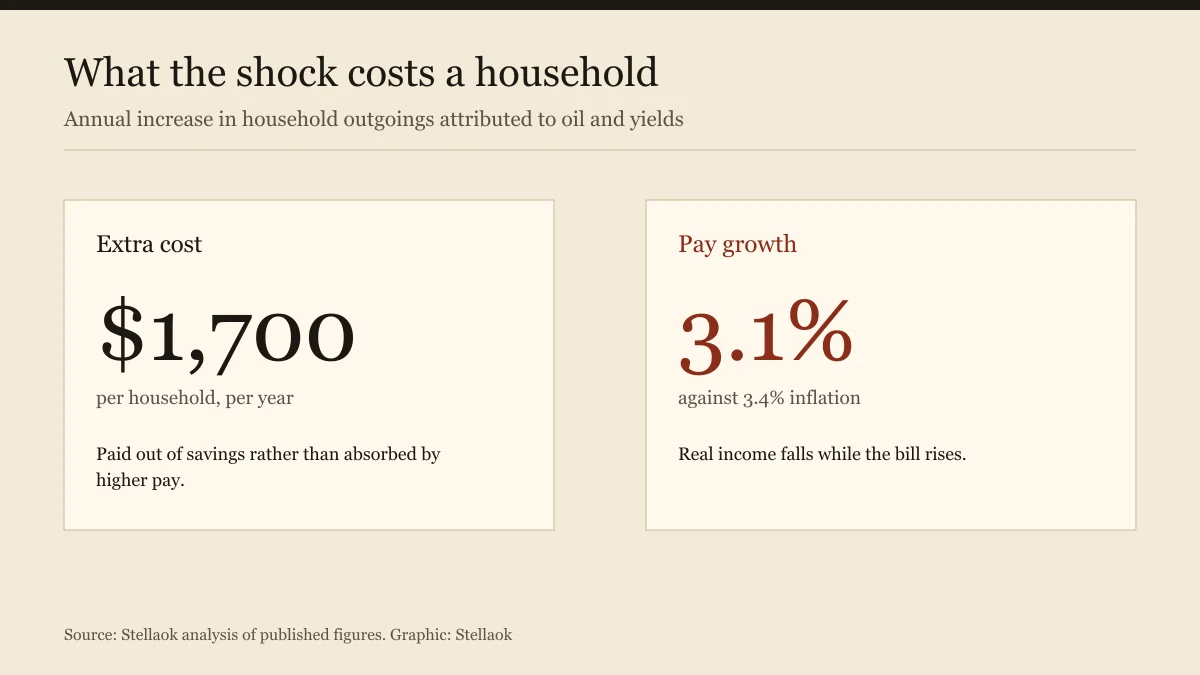
Rising oil prices and higher Treasury yields are lifting energy and borrowing costs for U.S. households, with the combined bill estimated at $1,700 per household. Consumers are dipping further into savings to cover it. Fuel is one channel. Credit is the other. This episode has both.
Crude has climbed with the Iran war, so gasoline and other energy products cost more. Mortgage and other loan rates have moved up with yields, so new borrowing is more expensive. Households are closing the gap from buffers rather than from a matching rise in take-home pay.
Two bills, one kitchen table
The $1,700 figure is an estimate of that combined load. It is not a government rebate. It is not a tax. Nobody gets an invoice with that number on it. They see it in fill-ups, utility bills, and monthly payments that no longer look like last year's.
CNBC Markets ran oil and yields together as a one-two punch. That arithmetic is the reason this is uglier than a pure pump-price scare. You can drive less. You cannot easily refinance cheaper while yields are going up.
Oil shocks and rate shocks usually take turns. Adding the channels is how the household math gets to $1,700. Families who heat with oil, commute, and still have a floating-rate or a new-purchase loan are paying on both lines at once. Families who rebuilt a cash buffer after earlier inflation scares are now drawing on it.
Retailers will see the squeeze as trade-down and thinner checking balances before they see a recession headline. Auto dealers and mortgage brokers will see it as fewer applications. Paying an estimated $1,700 out of savings is not a stable equilibrium. Either oil and yields ease, or spending cuts.
2022 split the story. This week adds it up.
The closest recent rhyme is 2022, when energy spiked while the Fed was already raising rates. Even then, the household conversation often split into two files: pump prices, and mortgages. This week's reporting stitches them into one bill.
Treasury yields set the reference for mortgages, auto loans, and much of consumer credit. When yields rise, new borrowing gets more expensive even if the central bank did not move that morning. When oil rises because of a war, the energy line moves on tanker risk and on the crack that turns crude into diesel and gasoline.
Savings jumped during the pandemic, then eroded as inflation ate the buffer. Drawing more heavily on what is left is the adjustment Americans have used before. It works until balances hit a floor. It is not a raise.
Container-ship fuel that more than doubled this year is the traded-goods cousin of the same energy shock. Import prices do not care that your mortgage also reset. U.S. gas slipping with Europe might take a little pressure off heating in some regions. It does not pay the $1,700.
Factory-town labor stories such as Brampton will compete with this at the kitchen table. Job risk and a higher cost stack at the same time is how consumer caution hardens. Do not wait for a perfect macro label. The savings drawdown is already the label.
Savings are doing the work wages aren't
Retail gasoline and diesel, plus the next auction-driven yield move, are separate inputs to the same household total. A drop in only one channel still leaves the other half of the $1,700 story intact.
Credit-card delinquencies and the mix in retail sales will show whether the estimated bill is becoming a spending cut. Auto and mortgage application volumes will show whether the credit half is freezing big-ticket demand. Those series are more useful than another speech about resilience.
People who locked a mortgage in 2020 and 2021 are not in the same boat as people shopping a rate this month. The $1,700 estimate averages them. If you are in the second group, the yield half of the stack is not theoretical. If you are in the first group, the oil half still is. Either way the savings line is doing work wages are not.
The next Fed decision and any ceasefire-or-escalation headline on Iran will reprice the two channels at once. Households cannot wait for either. They are already paying, and they are already using savings to do it. That valve works until it does not. Plan as if the $1,700 is real until oil and yields both reverse, not just until one of them has a good week.