Meta says 200 million small business owners are already on its platform. On Tuesday it pointed a new agent at them.
Muse for Small Business is the product. CNBC's Investing Club note and a same-day news story agree on the shape. The agent connects to professional Facebook and Instagram accounts, to Meta ad accounts, and to tools those owners already pay for. The first story names Zoom, Intuit's QuickBooks, and Salesforce's Slack. The second adds Asana, Box, and Canva. Pricing matches the consumer Muse app: free up to a usage limit, subscription after that.
A billion users at 3 percent is $10.8 billion, and that is a sketch
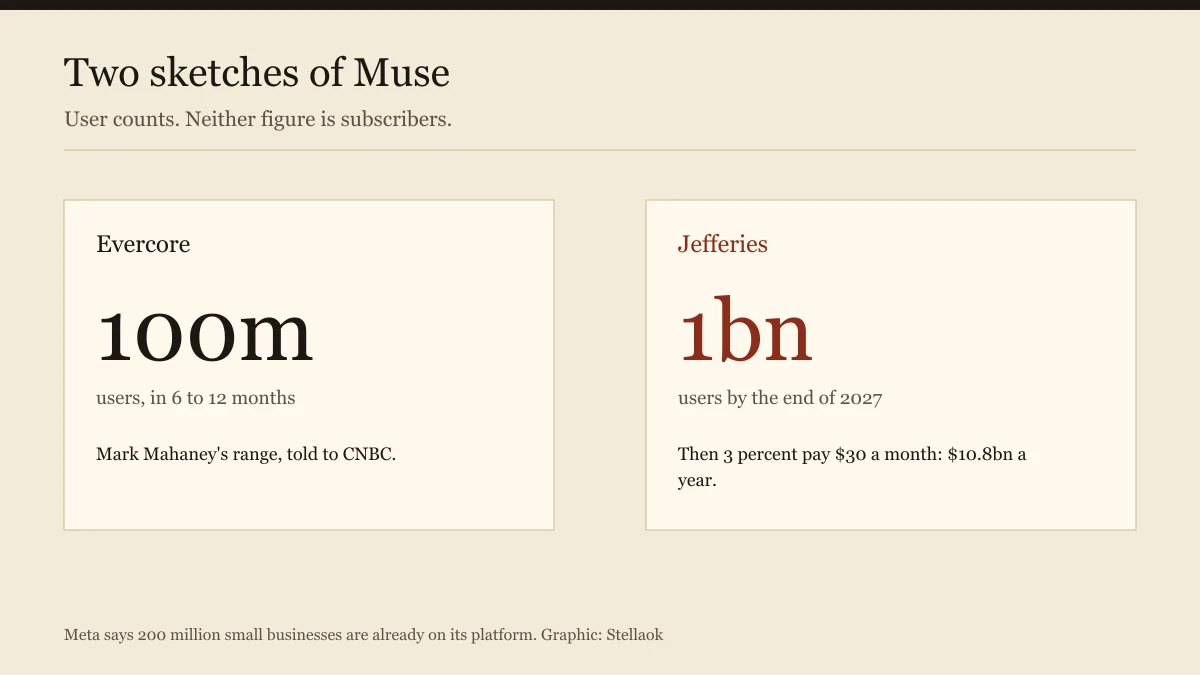
Jefferies, in a note last week cited by the Investing Club, ran one scenario. Muse reaches 1 billion users by the end of 2027. Three percent pay. Average revenue is $30 a month. One billion times 0.03 is 30 million subscribers. Thirty million times $30 is $900 million a month, times 12 is $10.8 billion a year. Business customers, Jefferies said, would sit on top of that.
That arithmetic is not a forecast Meta has endorsed. It is what 3 percent and $30 have to do at once. Evercore's Mark Mahaney told CNBC he expects Muse to reach 100 million users in six to 12 months. One hundred million is a tenth of the billion in the Jefferies sketch. The near-term user number and the 2027 subscription story are not the same bet.
Muse's consumer app launched on Sept. 8 and reached the top of Apple's App Store, ahead of ChatGPT. Tuesday's version is the attempt to charge the installed base Meta already has, rather than win a new one.
The stock move and the multiple are not the same claim
The two CNBC pieces do not agree on September's share move. The Investing Club note says the stock surged 26% in September. The news story says it is up 25%, and that it sold off over the past two sessions. Treat those as two readings of the same month, not as one official print.
What the Investing Club does state cleanly is the multiple: 14.6 times 2029 earnings-per-share estimates, via FactSet. Jim Cramer, on Tuesday's Morning Meeting, said enterprise companies get higher multiples than the consumer multiple Meta has worn. A 2029 earnings figure is three years out. The 14.6 only becomes an enterprise multiple if small businesses actually pay.
Monday's setup is the org chart for that hope. Meta announced an enterprise platform to be run by CJ Desai, who left the CEO job at MongoDB. It is meant to hold the consumer Muse agent, a business agent, and a coding tool. The company's own line for the small-business agent is "Give Muse a goal, like running your business or finding new customers, and it gets it done." President and Vice Chairman Dina Powell McCormick told Jim Cramer the point is that owners spend time on the business "not worrying about the back-office work."
Two hundred million accounts is distribution, not revenue
"Small businesses have been growing on our apps for nearly two decades," Meta said. "They told us they're short on hours, not ideas." Zuckerberg, at Meta Connect last week, called Muse the "centerpiece" of the AI strategy. Alexandr Wang's group, hired out of Scale AI, started shipping Muse Spark models in April.
None of those sentences is a subscription count. The free tier can absorb a lot of the 200 million before a single invoice goes out. OpenAI's own spending plan still shows a $278 billion hole, which is the rival cost structure this product is supposed to compete with. Data-centre hiring is already the physical bill for that race. Anthropic, meanwhile, is the lab that has actually filed to list.
The test Meta set for itself is narrower than the Jefferies table. Owners have to use Muse on cash, inventory, and customer messages, then cross the free limit. Until that conversion exists, $10.8 billion is 30 million people paying $360 a year, written down before any of them have been asked.