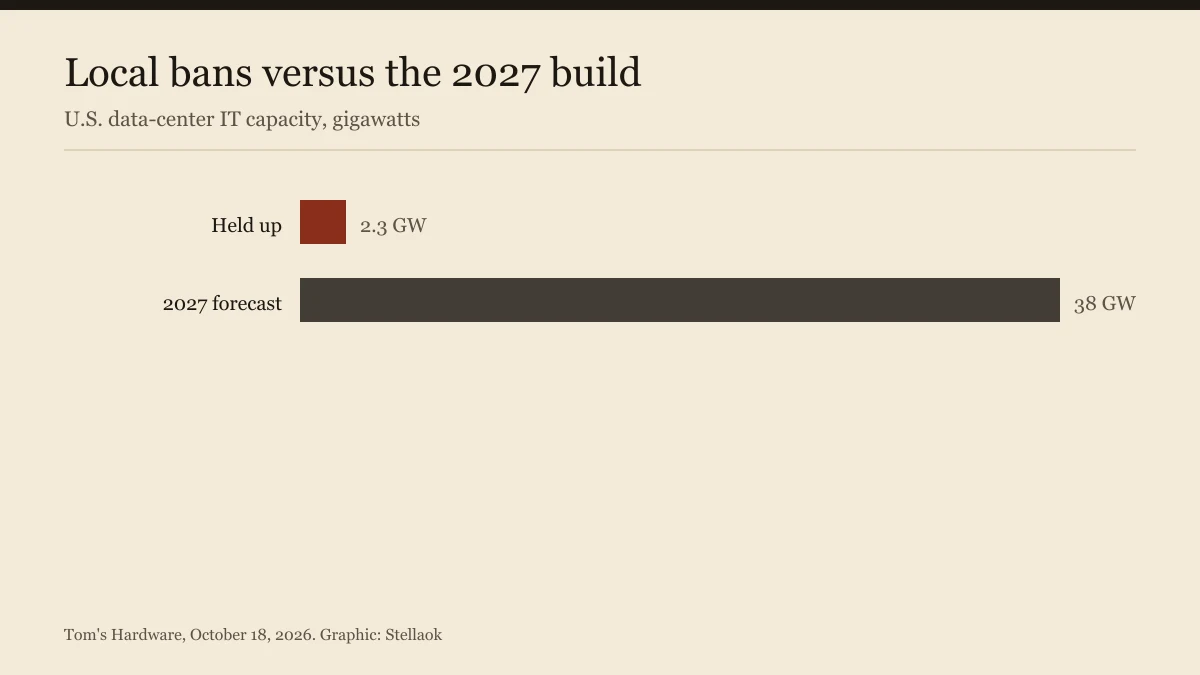
More than 300 local bans on data centers have delayed three U.S. projects, 2.3 gigawatts of IT capacity. The same forecast still has 38 gigawatts coming online in 2027, more than double the 2026 figure, and Tom's Hardware says that forecast has barely moved in the past 12 months.
Tom's Hardware's readout of the report is the source for the split. Of the 38 gigawatts, 22 are under vertical construction and 16 are mostly financed, with site work underway. The enacted local moratoriums cover about 20 gigawatts of that map. The slice they have actually pushed back is the 2.3. Nvidia guided the October quarter to $108 billion, up 89 percent. That is the chip order book these buildings are being financed to fill. CoreWeave's 2031 bond yielded 15.78 percent on Thursday, October 15. The borrower is one customer for this capacity. The gigawatts are the buildings.
A pause delays a project only if it hits the parcel in time
The firm defines a moratorium as a temporary legal pause, almost always a freeze on new applications. It tracks more than 400 local instruments across 17 states. The enacted set, as of September, includes a few permanent zoning bans. Four states acted in under two months this summer: New York, Texas, Pennsylvania, and Oregon. The firm tested each active restriction against thousands of project records. A short pause can expire before the next application is even due, and a lawsuit or a late transformer can set the date with no help from zoning. The three delayed projects are the cases where the pause arrived in time and applied to the use. The other instruments did not.
A ban does not revoke a permit that is already issued. A short pause can expire before the next application is due. Lawsuits and equipment lead times may already set the date. The delivery slips only if the rule reaches that parcel, is in force, overlaps the schedule, and covers the use in a way the project cannot route around. ASML's third quarter reached $13.06 billion. The scanners are a separate shortage from the local zoning fight, and they do not move because a township stops taking applications.
Michigan has 45 pauses and almost none of the pipeline
Michigan has 45 enacted moratoriums and, in the firm's count, effectively zero pipeline exposure. A Google campus there sits on industrial land already zoned for data processing. SpaceX's planned data center in Brownsville, Texas, is on land the city removed from its limits, so the city's pause does not reach it. One pause that did bite: a Pennsylvania township adopted one before NorthPoint filed for its special exception.
Texas is outside the 2.3 gigawatt count
The 2.3 gigawatt tally leaves out a statewide halt. Texas Governor Greg Abbott told the Texas Commission on Environmental Quality to issue no data-center permits, whether or not a project is in the ERCOT queue. The law firm Bracewell expects that pause to last until ERCOT finishes a review in mid-December.
The authors would worry about a state rule that also blocks off-grid power
The Economist's Archie Hall, after a trip through Michigan and Ohio, called the local bans "much more bark than bite" for now, and said the larger risk is that newer projects change address rather than die. The report's conclusion is that moratoriums would have to be materially more widespread and more restrictive before they delay the national buildout. On the firm's podcast last month, author Jeremie Eliahou Ontiveros said the firm would worry about a strict state-level moratorium that also blocked off-grid projects, and he named Texas as the example. New York Governor Kathy Hochul, like Abbott, found ways around her legislature.