ASML reported third-quarter 2026 revenue of $13.06 billion, or €11.66 billion, up 55 percent from a year earlier and 25 percent from the previous quarter. Gross margin reached 57.5 percent, from 51.6 percent a year earlier. Operating income was $5.79 billion. Net income was $5.56 billion, and that figure includes about $570 million from revaluing the company's stake in Mistral AI.
Tom's Hardware's account of the results and CNBC's earnings writeup both have customers trying to lock tools years ahead. Chief executive Christophe Fouquet said leading-edge customers now think demand for their own chips will outpace supply through at least 2028, so they are speeding up new fabs and planning expansion past 2028.
The quarter was 121 lithography systems
ASML sold 121 lithography systems in the quarter, 113 of them new and eight refurbished, up from 91 in the second quarter. Seventeen EUV systems brought in $4.59 billion. DUV tools, including 45 argon-fluoride immersion scanners, plus i-line tools, brought in $4.82 billion. Of equipment revenue, 54 percent came from logic chipmakers and 46 percent from memory. The installed-base business, upgrades and service, was $3.68 billion, about $450 million above the company's guidance. GlobalFoundries will make TSMC interposers under a $2 billion deal. Those packages still need the scanners ASML sells.
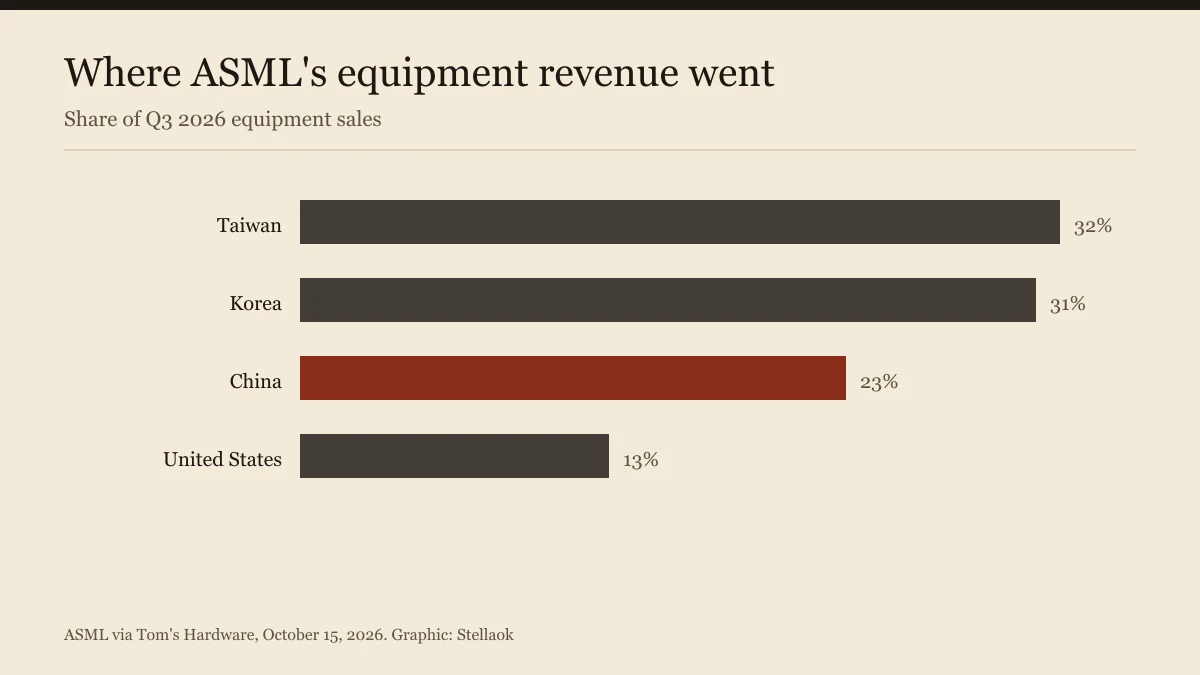
Taiwan and South Korea were 63 percent of equipment sales
Taiwan was 32 percent of equipment sales. South Korea was 31 percent. China was 23 percent. The United States was 13 percent. The rest of Asia was 1 percent. Taiwan and South Korea together were 63 percent. A Washington count put 343 immersion DUV tools in China. ASML's own split this quarter still has China as the third-largest equipment market, behind the two countries buying the most advanced tools. Micron's last reported quarter was the profit spike. Memory makers were 46 percent of ASML's equipment revenue in this quarter, and the company expects memory-related equipment sales to rise about 75 percent for the year.
Orders are being placed for 2028, 2029, and 2030
Fouquet said the company is increasingly taking orders for 2028, and that customers are asking about 2029 and 2030. Fourth-quarter revenue is guided at $15.9 billion to $17.0 billion, with gross margin around 57 percent. Full-year revenue is guided at $49.3 billion to $50.4 billion, up about 36 percent. EUV revenue for the year is expected to rise more than 45 percent.
Low-NA EUV output is planned at 65 systems this year
ASML plans to build about 65 low-NA EUV systems in 2026, up from 44 scanners shipped in 2025. Immersion DUV production is expected to stay near last year's level, after the company had expected those shipments to fall. It has said it wants to lift low-NA EUV and immersion DUV capacity by 30 percent in 2027, and it has talked about another 30 percent in 2028. On the 2026 EUV target, that path is about 85 low-NA systems in 2027 and about 110 in 2028, if both increases happen. Chief financial officer Roger Dassen said the company now expects even that output will not meet customer demand in 2027 and 2028, and that it is looking at 2028 capacity beyond the extra 30 percent. It has not published a revised target.
Intel has already exposed more than one million wafers on High-NA tools and plans to use High-NA EUV on its 14A process in 2028. Samsung plans High-NA high-volume manufacturing in 2028 for DRAM, and for logic later. ASML said that DRAM step could bring more High-NA orders from memory makers, and it has not given shipment targets for those tools. TSMC plans to use High-NA scanners in 2030 and 2031. The company recognized revenue from one High-NA EUV system in the second quarter. ASML says availability across the installed High-NA fleet is approaching 90 percent. The Twinscan NXE:3800F, scheduled for early 2027, processes up to 260 wafers an hour, against 230 for the NXE:3800E. ASML puts the difference at about 21,600 extra EUV exposures a month per tool, without more cleanroom space. Three of the new tools in one fab, the company says, are 90 extra exposures an hour. It also described a critical-layer immersion DUV system at 330 wafers an hour. Upgrade packages for EUV and DUV tools already in the field raise throughput without a new scanner. Dassen said talks with major customers on value-based pricing are finished. The higher prices do not show up in 2026. They start during 2027, and the full effect is in 2028 and after, on new tools rather than the backlog.