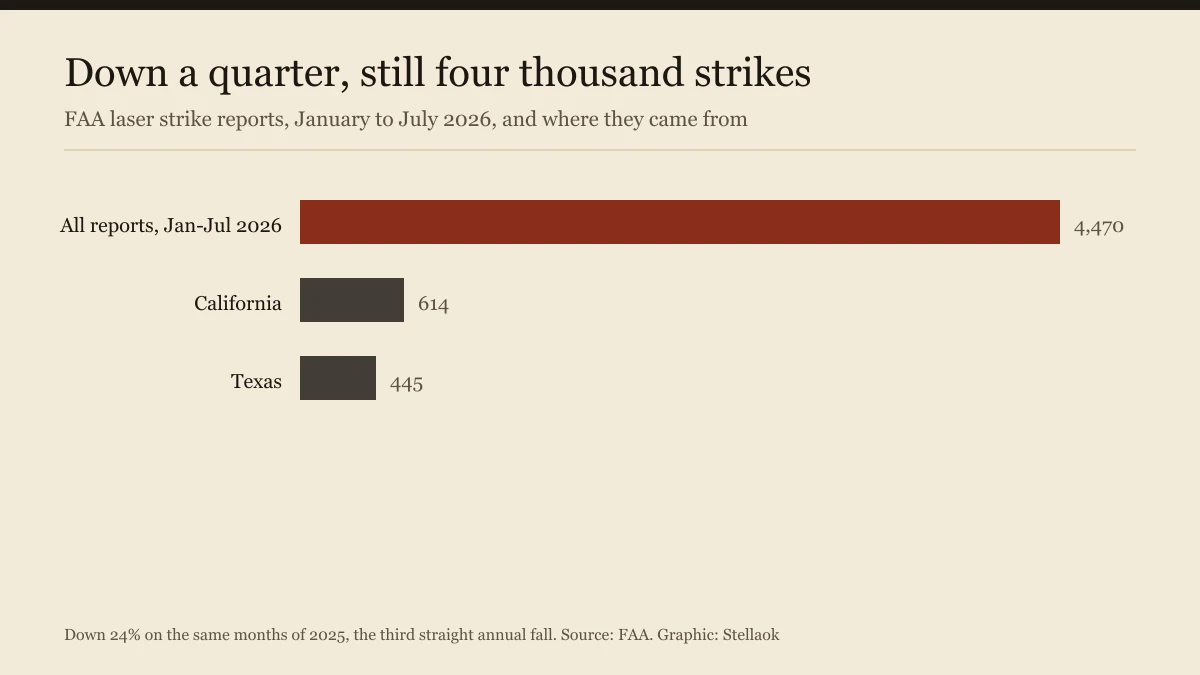
On Thursday the Federal Aviation Administration put out its 2026 midyear count of laser strikes on aircraft. Pilots reported 4,470 incidents from January through July, 24 percent below the same stretch in 2025, the third straight year of declines. The agency still called that total "still too high."
California accounted for 614 of those reports. Texas logged 445. Rank the states by population and those two were always going to sit near the top. Rank them by person, and New Mexico and Hawaii are the ones that look ugly.
4,470 reports is a decline, not a pass
Four thousand-plus incidents before August is not a leftover. Spread across seven months, cockpit laser reports are still a daily U.S. event. The FAA refused to treat the drop as a win, which is the most honest sentence in the bulletin.
Engadget first reported the midyear tally next to that "still too high" line. January through July is the cleanest comparison the agency offered. Full-year totals will be higher. They always are, because the rest of the calendar still has night flying and people on the ground with a line of sight to arrivals.
Pointing a laser at a plane is a federal crime. The bulletin repeats that every cycle, because the people holding the pointer still treat the beam as a joke. "Shining a laser at an aircraft poses a serious safety threat and is a federal crime," the FAA wrote. Flash-blind a crew on short final and you do not get to argue you were aiming at the landing lights.
Congress made the offense a federal crime in 2012 after a decade of rising reports. Cheap green pointers then flooded online shops, and the FAA's public counts became one of the few ways anyone could see a ground-to-air hazard that never shows up on radar. Local police have used those tallies to chase backyard beams after the fact. A flash lasts a second. The airplane is moving. The person with the pointer is often already inside.
California's pile versus Hawaii's rate
Raw counts flatter big states. California's 614 and Texas's 445 mostly track traffic: more flights, more people, more chances. Per capita, New Mexico and Hawaii led, which is the ranking crews who fly those arrivals should actually care about.
Smaller states under busy corridors can look calm in a table until you divide. Hawaii puts a lot of metal over a small population. New Mexico sits under routes that make a backyard laser more than a statistic. The FAA named those two as the worst on a per-person basis. It did not, in the account that circulated, publish the formula behind that ranking.
- January, July 2026 U.S. reports: 4,470
- Change versus the same months in 2025: down 24 percent
- California: 614
- Texas: 445
- Highest per capita: New Mexico and Hawaii
That list is the entire hard dataset. Do not invent a historical peak the bulletin did not give. What we have is three years of declines, a still-ugly midyear pile, and no official cause.
What a midyear tally cannot tell you
Cockpit illumination is worst on approach, when the airplane is slow, low, and configured to land. En route flashes are ugly. They are less likely to put a hull on a neighborhood. These counts get published because they proxy a risk concentrated in the last few minutes of a flight, over the same suburbs every night.
No driver was named. Better enforcement, fewer pointers in circulation, or simple noise in the reporting system could all move a number. None of those explanations is in the release. Three years of declines is harder to wave off as a blip. It is still not a causal story.
Other machines that share public space with people on the ground have a cousin of this problem. Waymo's Singapore robotaxi plan is a 2028 commercial bet that still has to survive careless humans at street level. A laser at a 737 is the aviation edition: the vehicle cannot dodge, and the person with the toy is not in the cockpit.
If you fly, the practical move is simple. Report the beam. Do not assume the person on the ground knows it is a felony. Kitchen gadgets that watch food, like Tovala's scan-to-cook oven, get to fail as a slightly burnt dinner. A cockpit flash does not.
Consumer hardware elsewhere on this site, including Valve's Steam Frame work on streaming versus standalone, is about convenience. This story is about whether 4,470 reports before August is an improvement you can feel. It is not, until the full-year number keeps falling and prosecutors treat the next backyard beam as the crime the statute already describes.
The next hard figure is the 2026 annual total, after December's reports close. If the 24 percent gap versus 2025 dies in the holiday banks, this midyear drop was weather. If it holds, the FAA will still be right to refuse a celebration. Four thousand-plus strikes is a trend line. It is not success.