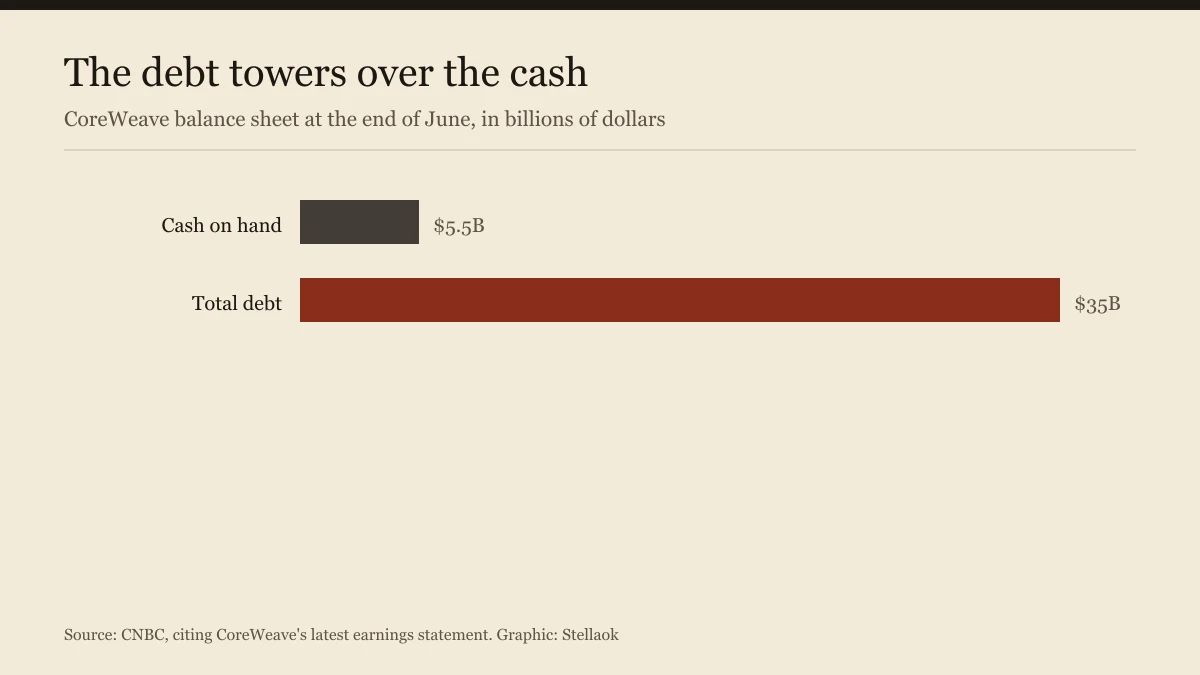
CoreWeave reports quarterly results on Tuesday with a question hanging over the numbers: can a company carrying $35 billion of debt keep borrowing cheaply enough to grow? The AI cloud provider ends June with $5.5 billion in cash against that debt load, and the credit market has spent the past month repricing the risk.
What the credit market is saying
Yields on some CoreWeave bonds maturing in 2031 have jumped above 16%. The spread on its five-year credit default swaps, effectively insurance against default, soared above 1,240 basis points, up 50% in the past month. The trigger was a brutal stretch for neocloud stocks, whose prices have been cut in half, culminating in drops last Thursday that helped push the Nasdaq to its steepest slump in 19 months. The Fed has raised rates once already since 2023, and local bans have held up gigawatts of planned data center capacity, so the capital and the politics around the buildout are tightening at the same time.
CEO Mike Intrator has tried to talk the market down, writing on LinkedIn that CoreWeave does "not anticipate any impact to existing customer commitments or associated backlog" from the shifts in Washington, where Democrats won governor's races in five states last week and voters rejected data center measures in 40 of 41 ballot questions nationwide.
The balance sheet in detail
The company's own filings sketch the pressure. CoreWeave owed $1.3 billion at a 15% interest rate on a facility due March 2028, and had $3.2 billion of obligations on an August 2030 facility at 11%, per its latest earnings statement. Morningstar analyst Luke Yang thinks bankruptcy is unlikely and existing contracts are funded, but growth over the next five years needs new capital, and "if they want to issue money through equities, the stock price is not working in their favor." What he wants from Tuesday's call is how management plans to close the financing gap.
Nebius, which reports Thursday and is expected to show sixfold revenue growth to about $908 million, sits in the same boat; CoreWeave's consensus expects about 160% growth to $3.55 billion. Neither the appetite for new listings nor the valuations support the alternatives: Nscale and SB Energy filed IPO paperwork in September without updated prospectuses since, and Australian neocloud Firmus scrapped its listing plans last month.
The doom cycle and the counterexamples
Paul Meeks, head of technology research at Freedom Capital Markets, named the fear plainly on CNBC: "it's a self-fulfilling prophecy, a doom cycle, where if the creditors are worried about CoreWeave paying back their debts, then of course they have to borrow going forward to fund their AI infrastructure build at exorbitant rates." His bull case runs through execution: CoreWeave generated $5 billion of revenue in 2025, and he models $42 billion by 2028 with an EBITDA margin near 70%. If that path looks credible, the debt questions quiet down.
One smaller peer bought itself relief. IREN said about 48% of its backlog is tied to Microsoft, a concentration risk in its own right, but its AI cloud revenue more than doubled from the prior quarter and the stock jumped 20% on Friday. Co-CEO Daniel Roberts told CNBC that "capital markets have become more selective in the last few weeks, and the questions have undoubtedly moved from how big the contract is to whether it can be delivered, financed, and run at a profit." He carries $10 billion of debt himself. Yields on government paper have been reading fiscal risk all year; this week the same question moves to corporate paper with servers behind it.
Source: CNBC