China's goods surplus reached $1.04 trillion in the first ten months of the year, customs data showed on Tuesday, clearing the trillion-dollar mark with two months left in the calendar. The full-year record stands at $1.2 trillion, set in 2025, the first year the surplus crossed $1 trillion at all.
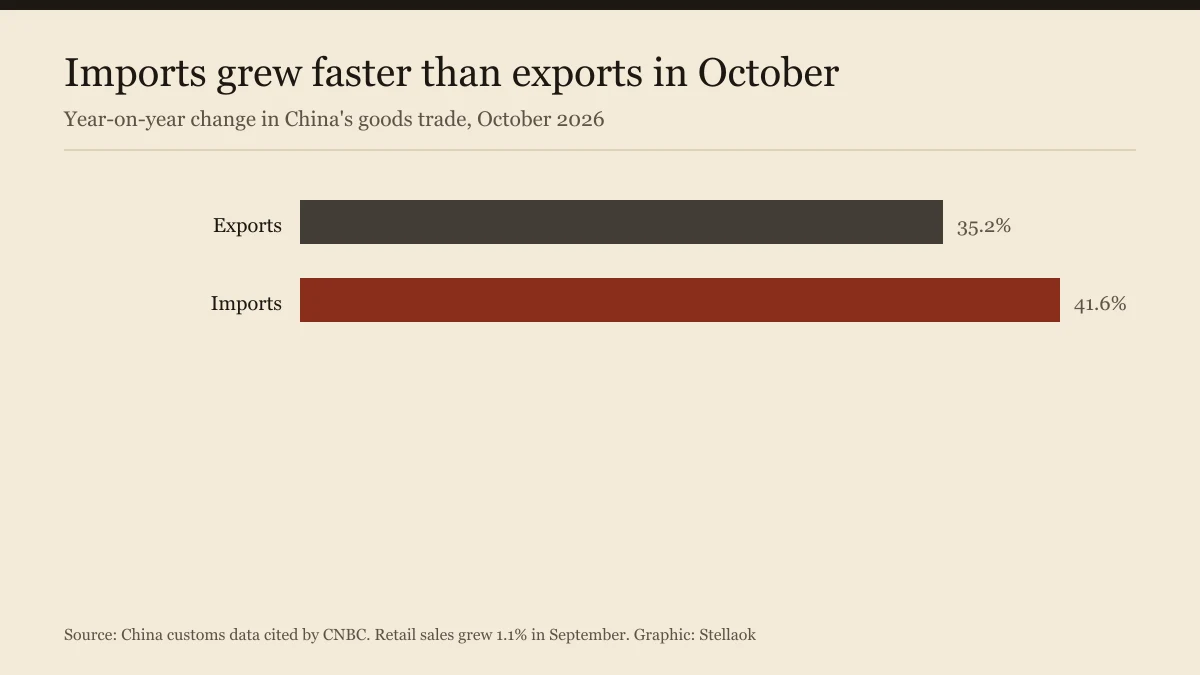
October's numbers were strong on both sides of the ledger. Exports rose 35.2% from a year earlier, ahead of a Reuters poll forecast of 33.5% and just below September's 36.3%. Imports rose 41.6%, the fastest since May 2021 and far above the 32% analysts expected. The surge in imports is why the monthly surplus growth slowed to a six-month low, which is the one piece of the release that reads as balance.
The AI trade is doing the work
Imports of high-tech products rose 72% by value, according to CNBC's calculations from the official figures. Crude oil imports rose about 41%, liquefied natural gas about 50% and coal about 60%. Tianchen Xu of the Economist Intelligence Unit told CNBC that growth was driven by tech goods, critical minerals such as copper, and energy. "Imports were still dominated by AI trade," he said.
The export side is the same story told outward. Global demand for Chinese-made AI hardware is holding up an economy where households are not spending: retail sales grew 1.1% in September, and the government is relying on moderate stimulus to hit a growth target of 4.5% to 5%. That imbalance is exactly what trading partners keep raising, and what the IMF has repeatedly asked Beijing to fix by shifting growth toward consumption.
The risk embedded in that dependence is straightforward. US data center construction is running at an $85 billion annual pace, and any slowdown in that buildout hits Chinese exporters' margins directly. Capital Economics estimates exports fell 2% month on month in seasonally adjusted terms, and Citi Research expects export growth to slow to 8% in 2027 as base effects fade.
Where the surplus lands
Shipments to the United States rose 32.9% by value while imports from the US rose nearly 35%, leaving a $32.7 billion surplus. The year-to-date increase in US-bound cargo is 12.1%, helped by a low base: shipments fell 20% last year when tariffs jumped. Europe is the wider gap. Exports to the EU grew 24.4% while imports fell more than 4%, widening the surplus to $33.4 billion.
Brussels has an answer ready. From December 1 it caps imports of Chinese hybrid vehicles at 350,000 a year, which is above the roughly 300,000 hybrids China sent to Europe last year and well below the 800,000-unit annualized pace of the past three months, according to Brad Setser of the Council on Foreign Relations. "Europe still is a long way from a coherent trade and industrial policy with respect to autos," he said.
Tariffs have already changed the composition of trade rather than the direction. Washington's 50% levy on a list of Canadian goods is the same instrument applied to a smaller partner, and the result there has been rerouting rather than reduced volumes.
Two dates set the next test
The US-China truce agreed in September was extended by two months to January, alongside waivers on some critical minerals and special port fees on each other's vessels. Presidents Xi Jinping and Donald Trump are due to meet at the APEC summit in Shenzhen next week, their third meeting this year, and the truce's expiry is the clock behind it.
Beijing's own numbers will be read against that meeting, and so will the market's appetite for the assets behind them: a listed data center trust is down 16% since May while the physical build continues. The surplus is now large enough that any partner negotiating with China arrives with a domestic industry to protect, and the December 1 auto cap gives Europe a deadline it can point to. The APEC meeting is where the next number gets set.
Source: CNBC