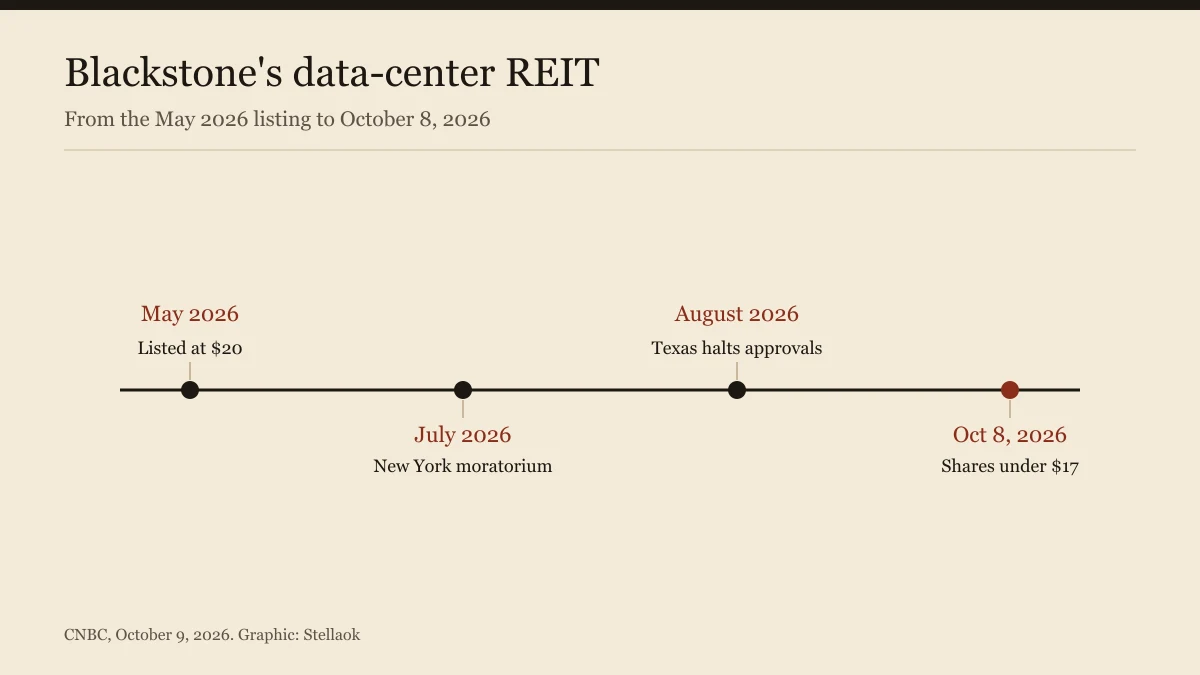
Blackstone sold 87.5 million shares of its Digital Infrastructure Trust at $20 apiece in a mid-May 2026 debut on the New York Stock Exchange. The shares closed under $17 on Thursday, October 8, down roughly 16 percent from that sale. Chief executive Nick Pell has called the REIT the lowest-risk way to own data centers, because it aims at buildings already running in mature markets such as Northern Virginia and Dallas, picked from what he says is a $300 billion pool.
CNBC's piece on the pitch sets that debut against two older data-center landlords. Equinix and Digital Realty, both REITs, have seen their shares stall in the months since the Blackstone fund listed. The broader REIT group did better early in 2026 than it usually does when rates and bond yields are rising, then sold off from August. On the company's latest earnings call, Pell described a total market he expects to pass $1 trillion over the next several years. Welders and pipefitters are the labor sitting under that build: postings on data-center sites are up 164 percent.
Blue Owl is weighing a fund of up to $6.5 billion
Blue Owl already runs a private digital-infrastructure fund. CNBC says it is considering a public REIT valued as high as $6.5 billion that would roll existing centers into the new vehicle. The firm says it owns more than 130 data centers in 32 markets, representing over $18 billion in assets. It declined to comment. Co-chief executive Marc Lipschultz, in a LinkedIn post, called the projects some of the strongest long-term opportunities in decades, and said the contracts are written so the owner is made whole if a tenant leaves early. Blackstone's listed trust, by contrast, has yet to put its capital into buildings.
Brookfield Asset Management took a different route in July, listing its data-center services firm Csquare on the same exchange. Those shares are down close to 16 percent since the debut, a separate listing with a similar first-months result.
New York halted approvals in July, Texas in August
Gallup found that 70 percent of Americans oppose a data center in their own area. A New York Times and Siena poll this fall found roughly two-thirds opposed, in both parties. New York became the first state to pause new hyperscale approvals, in July. Texas followed in August. Governor Greg Abbott, who a year earlier had called the state the AI epicenter, ordered the halt after he had already asked for a grid-connection audit. Local opposition blocked $68 billion of data-center projects in the second quarter. The risk for a fund is whether politics slows a project already baked into the return math.
Oracle wants room to delay payment until 2028
Oracle's stock fell 4 percent in late September after the company sent a force majeure notice tied to Project Jupiter, a New Mexico campus in the Stargate buildout that Blue Owl is developing. Oracle is seeking to delay payment if the site misses a 2028 operating date, citing regulatory hurdles and local opposition, and it says the project remains on track. An Australian data-center company backed by Nvidia and Blackstone pulled a planned listing after investor interest came in light. That same Thursday, a batch of AI stocks fell on a report that an OpenAI revenue forecast sat close to $20 billion under a prior projection.
Patrick Datz, digital-risk lead at the insurance brokerage IMA, and Rachel Nixon, the firm's data-center practice co-lead, still call the held-out projects a safe bet. Datz said the centers offered to investors are usually vetted and underwritten by $3 billion to $5 billion of insurance, and that carriers in that market play it safe. Nixon's worry is uptime: a contract that promises availability creates a second problem the moment the building goes dark. Sabur Mollah, a finance professor at Gettysburg College, listed the other side in one breath. Long leases with large technology tenants can throw off rent. The same buildings depend on power, a short list of tenants, and a valuation that enthusiasm can stretch.
Kalshi puts the 2027 count above 5,100
Traders on Kalshi were assigning a 75 percent chance that planned or operating U.S. data centers would top 5,100 before 2027, up from roughly 4,700 now. That contract was at 60 percent two weeks earlier. Retail money is still a thin slice of the listed Blackstone trust: about 94 percent of the shares sit with institutions. Securities and Exchange Commission chair Paul Atkins put out proposals last week to let a wider set of individuals into private funds, including fee structures that have lived with hedge funds.
Andrew Tarver, president of Altic Private Markets at InvestCloud, describes the plumbing under those private funds as a post office. It was built for a small number of large checks, with redemption windows, and 2026 already produced a fight between private-credit managers and shareholders who wanted out. Jake Falcon, chief executive of Falcon Wealth Advisors, draws the line at the exchange listing. A public REIT can be sold. A private fund should be bought only if the buyer can say which goal in an existing portfolio it serves.