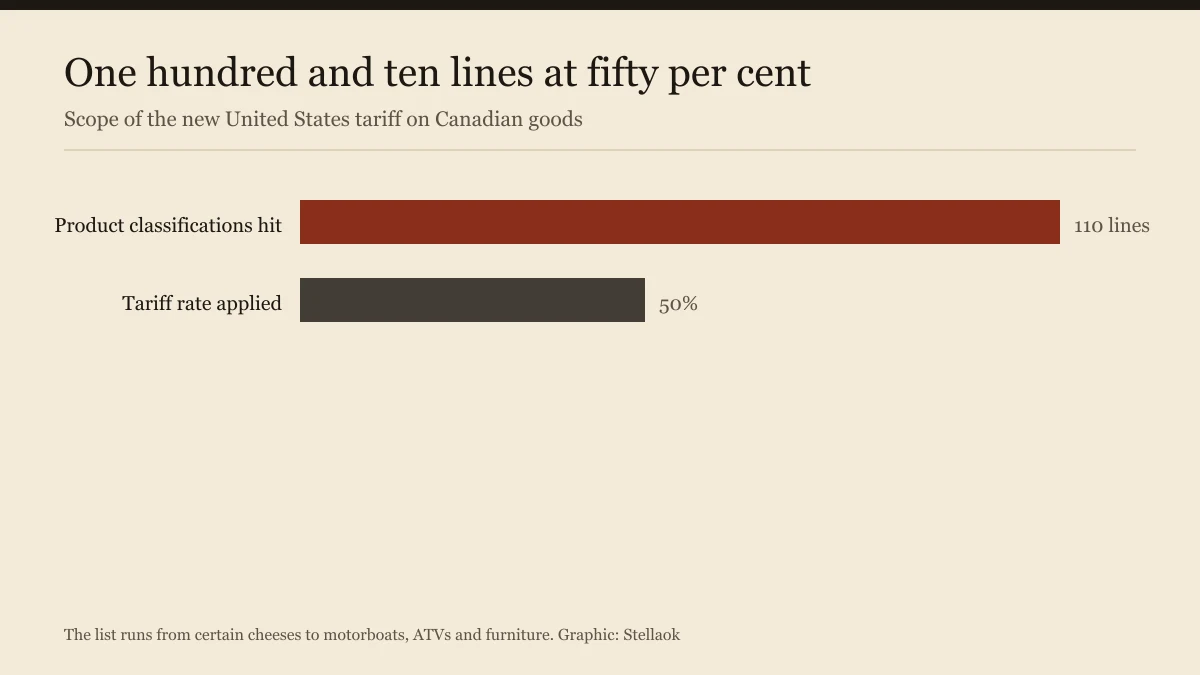
Just after midnight Tuesday, a new round of U.S. tariffs on Canadian goods took effect. One hundred and ten products now face 50 percent levies, a list that runs from certain cheeses to motorboats and ATVs, plus furniture.
The duties are the latest step in President Donald Trump's tariff campaign against Canadian shipments. They landed as Washington also lifted some other tariffs. Trade specialists said that pairing shows concern about prices paid by U.S. households.
A 50 percent rate is large enough to reroute an order book
Importers either raise U.S. shelf prices, swallow margin, or switch to a non-Canadian supplier. Canadian plants that sell those 110 classifications into the United States lose price competitiveness on the day the rate hits, not on a future review date.
Dairy exporters sit in the first ring. Boat plants and furniture shops do too, and so do ATV factories. U.S. dealers and grocers that relied on those Canadian lines are in the second. The simultaneous rollback of some other tariffs does not offset the 50 percent hit on this list. Firms in the affected lines cannot average their way out with a neighbour's relief.
Goods that hit household budgets more visibly appear to have been treated differently from the 110 lines that just took the new rate. That is the specialists' read of the split package: some levies removed because pass-through was too obvious, a fresh wall where the administration still wants leverage.
Officials in Washington have not framed the package as a pause. Some tariffs came off. A 50 percent charge went up on a defined set of Canadian goods.
CBC News Money first reported the 110-product list and the midnight-Tuesday start, along with the reading that the parallel removals show attention to U.S. consumer pass-through. Importers see the new rate on those classifications from the Tuesday effective hour.
Preferential trade was supposed to be the baseline
Canada and the United States already have a preferential architecture: NAFTA, then the Canada-United States-Mexico Agreement, known in Canada as CUSMA. Tariff fights in this relationship are not supposed to be the everyday setting. They have become a recurring overlay, from metals in the first Trump term to a wider second-term campaign that treats duties as a negotiating instrument.
Household inflation in the United States, which peaked in 2022 and then cooled, remains the political constraint on how far a tariff program can go before voters notice it in grocery aisles and showrooms. That is why the split package is being read as a cost-of-living hedge as well as a bilateral shot.
Canada's goods trade is still overwhelmingly U.S.-facing. A list of 110 products is not the entire export book. The rate is high enough that it is not a rounding error either. Prior fights often concentrated on metals or lumber, sometimes autos. This list mixes food with recreational vehicles and household goods, categories where the consumer sees a price tag.
Carney's insistence that Canada will choose its own partners is the diplomatic soundtrack to the same week. A Toronto summit selling Canada as a safe place to invest has to talk around a 50 percent wall on 110 lines. Unifor's fight over Brampton is what happens when auto-sector plants already feel product and trade risk at the same time.
After midnight, the next move is a list, not a speech
Watch the next customs notice for whether the 110 lines are amended, expanded, or given exclusions. Exclusion processes, when they exist, become the real policy for companies that can afford lawyers.
U.S. retail prices on those household and recreational goods in the following weeks will test the specialists' consumer story against the new 50 percent, not only against the tariffs that were lifted.
Ottawa's toolkit is talk, a challenge under the trade agreement, and a retaliatory list. None of those tools change the rate that applied at midnight. A mirror duty on politically sensitive U.S. goods would widen the fight. A legal challenge without tariffs would keep it in a slower channel.
CUSMA review politics will get harder to square with a preferential partner story while a running tariff campaign is still adding walls.
Importers who handle the 110 lines need a classification check against the new rate from Tuesday's effective hour, then a sourcing decision: pay, pass through, or switch origin. Canadian exporters in the named categories should assume the U.S. shelf is now a 50 percent problem until an exclusion lands. Midnight Tuesday was the operational date. The next operational date will be whichever side publishes the next list.