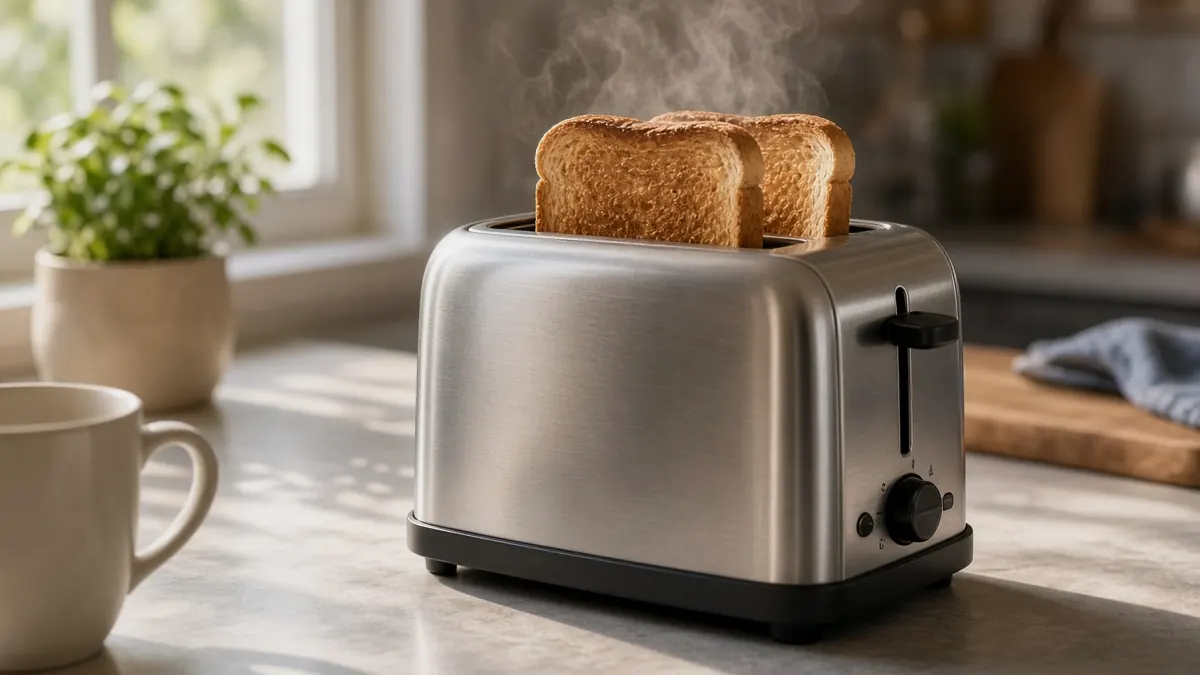
Breville's Eye Q toaster uses an optical sensor to decide when a slice is done, instead of leaning only on a timer. Most slot machines still cook by time and temperature. That works until you switch breads, or the first slice is frozen and the second is not.
The pitch is that a sensor can see browning and stop at the shade you asked for. CNET's review says the machine will impress people who care a lot about toast and have the budget for a splurge. For everyone else, it is probably too expensive.
Timers fail the moment you change bread
A numbered dial is a compromise that got worse as grocery bread got weirder. Thick sourdough, thin sandwich loaves, gluten-free mixes, leftover bagels, and frozen waffles do not brown on the same clock. Time only knows how long the coils ran. Temperature only knows how hot the slot got. Neither one can see the surface.
Breville is arguing that looking at the slice is the missing loop. An optic asks how dark, not how long. In theory, frozen bread and a thinner loaf can stop at the same visual target even if they took different amounts of time to get there. That is a real engineering idea. It is also a lot of machinery for a food people scrape when they miss.
Toasters survived the air-fryer years because a slot is still faster when all you wanted was bread. The early 2020s filled counters with boxes that toast among other jobs: toaster ovens, air fryers, smart ovens with presets. A dedicated toaster remained because it does one thing without a preheat speech. Eye Q is Breville betting that one thing can still command a premium if it looks smarter than last year's chrome.
Other brands have already tried to take the guesswork out of browning, with sensors, algorithms, and prices that made a basic toaster look like a relic. The category's problem has never been a shortage of ideas. It has been convincing people that toast is worth a splurge. Breville does not win by being the default at a big-box endcap. It wins when the cheap version has annoyed you long enough.
A sensor toaster on a counter full of air fryers
Air fryers and toaster ovens crowded the same few inches of tile. They toast, among other things, and they justify their footprint with leftover pizza. A dedicated toaster has to be better at bread than those machines are at their side hustle. Eye Q's answer is the optic. The review's answer is: only if you were going to buy a fancy toaster anyway.
There is no street price in the source material, and inventing one would be cheating. The useful fact is the verdict. Too pricey for most households. Dazzling if you have a padded budget and you actually care. That is how most of Breville's catalog works. You are not shopping against a cheap slot toaster on features. You are shopping against your own patience.
Compare the control loops, not the chrome:
- Timer: elapsed time. Fails on frozen versus fresh, thick versus thin.
- Temperature: heat in the slot. Same heat, different breads, uneven slices.
- Optical sensor (Eye Q): visible browning. Costs more. Still a dedicated toaster on a crowded counter.
A slice of toast is often the quiet part of a meal, which is why these machines remain in kitchens that already own three other heating boxes. Convenience over a pan is not the question. Locking in a preferred doneness is. Time and temperature cannot see the bread. Breville is arguing that looking at it is worth the extra money. I do not think it is, unless toast is a hobby.
Sensor cooking elsewhere in the kitchen is a fair cousin, not a reason to copy the purchase. Tovala's scan-to-cook oven at least ties the sensor to a meal you were going to pay for anyway. Eye Q ties it to bread you can already brown, badly, in a machine you own.
Spend this money only if toast is the point
Skip Eye Q if your air fryer already toasts. Skip it if you eat two kinds of bread and you have learned the dial. Skip it if a slightly uneven slice is not a crisis. Buy it only if you will use the sensor every morning and you already live in Breville's price band.
Holiday kitchen pricing is when premium small appliances either become gifts or sit. Copycats will show up if the optic trick photographs well. They always do. Sales mix will say whether Breville treats this as a halo product or as a machine it actually expects to sell.
If you wanted a gadget that has to work in the physical world, this site is full of them, from Waymo's long Singapore robotaxi ramp to Valve arguing through Steam Frame's streaming-versus-standalone split. Toast is a smaller version of the same test: does the sensor survive contact with messy reality, or does it win a review and then live in a cabinet?
After a month of mixed loaves is the real review. Grocery white, bakery sourdough, frozen leftover ends, the bagel that is already a day old. A sensor that only looks clever on supermarket sandwich bread is a demo. Until those tests pile up, treat Eye Q as a luxury for people who already decided toast was worth a project.