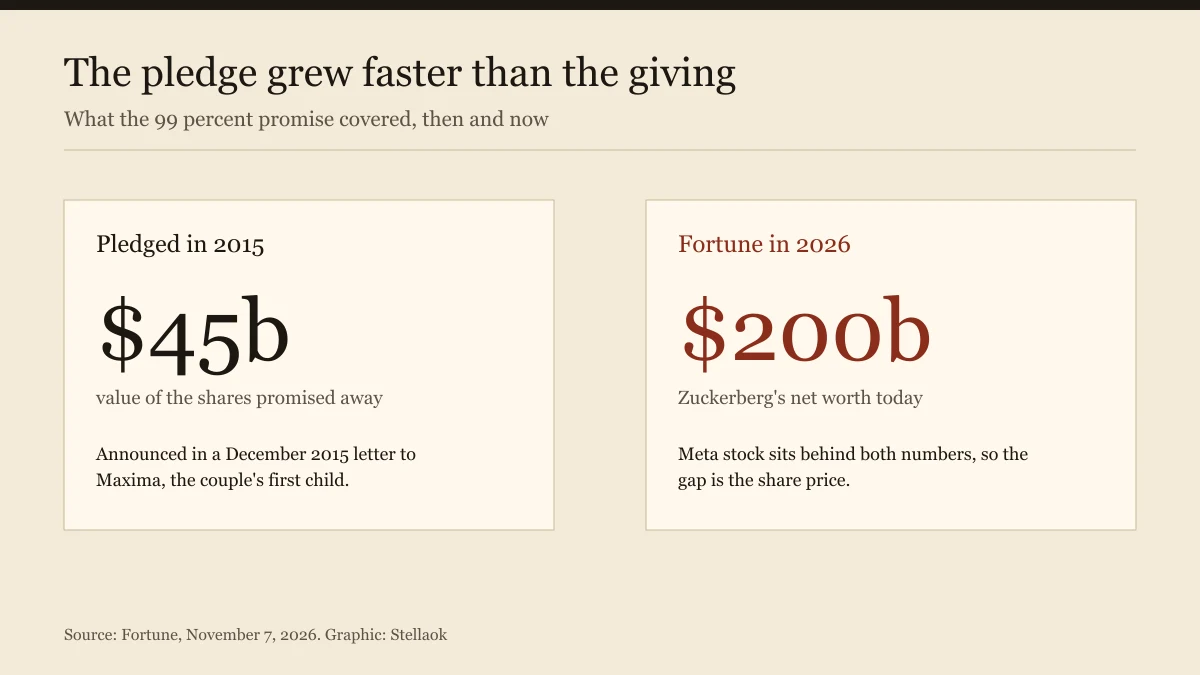
When Mark Zuckerberg and Priscilla Chan pledged in December 2015 to give away 99 percent of their Facebook shares, the stake was worth about $45 billion. Eleven years later his fortune has passed $200 billion, and their three daughters are still not slated to inherit most of it.
The couple made the commitment in an open letter to their first child, Maxima, published days after her birth. The letter introduced the Chan Zuckerberg Initiative and framed the gift as an obligation rather than a bequest: "Our society has an obligation to invest now to improve the lives of all those coming into this world, not just those already here."
They join a short list of American fortunes where the children will not receive the bulk of the balance sheet. Bill Gates, Warren Buffett and Michael Bloomberg have all made similar arrangements. The comparison matters because the amounts are not comparable to a normal estate: an estimated $124 trillion is expected to pass to younger generations as baby boomers hand down their portfolios, and the largest fortunes are opting out of that transfer.
What the pledge actually commits
The commitment is to give away 99 percent of the Meta shares during the couple's lifetimes, which means the money has to move while they are alive rather than at death. Zuckerberg still holds roughly 13 percent of Meta, enough for majority voting control of the company, so the pledge does not touch his grip on the business.
It also does not require him to sell quickly. Meta's stock is the engine of the fortune, and its value moves with the market rather than with the pledge. The same volatility showed up across tech last week, when three trillion dollars left the market a day after the best rally in 44 years. A pledge denominated in shares is worth whatever those shares are worth on the day the money is given.
The philanthropy itself has changed shape. The Chan Zuckerberg Initiative began with housing affordability in California and criminal justice reform, and has since shifted its core funding toward AI-enabled biomedical research. That shift follows the couple's stated interests rather than a conventional foundation's mandate, and it is the main argument for the structure they chose.
An LLC, not a foundation
CZI is a limited liability company, not a private foundation. That distinction is boring until it is not: an LLC can invest in for-profit companies, fund policy advocacy and time its spending without the annual payout rules that govern foundations. It gives the couple control over when the money moves and what counts as a gift.
Gates took the other route. The Gates Foundation, a traditional philanthropy, plans to close in 2045 after spending down roughly $200 billion. Gates has cited Zuckerberg as a model, telling Fortune last year that the Meta chief executive "is committed to give over 90% of his wealth away and he's off to a very good start."
Both approaches produce large sums and very different paper trails. A foundation files public returns and must distribute a minimum each year. An LLC discloses what it chooses to disclose, which is why the size of CZI's actual spending is harder to audit than the pledge that created it.
The tax vote in the background
California voters are counting ballots on Proposition 40, a one-time 5 percent levy on the net worth of the state's billionaires. It was trailing 55 percent to 45 percent as of November 6. A countermeasure, Proposition 42, which would nullify the tax and bar new wealth taxes in the state, was leading with about 54 percent support.
Zuckerberg had told Meta's board he was weighing a move out of California over the measure, and the company responded by creating a new class of stock he could sell to cover a potential bill. That is a governance decision shaped around one shareholder's tax exposure, and it is the kind of arrangement that invites questions from other holders.
The pledge and the tax fight are separate stories that keep touching. A fortune large enough to fund a $200 billion philanthropic project is also large enough to be a tax base, and the same shares sit behind both. Meta's own regulatory history shows how closely the company and its controlling shareholder are read together, as with the $25 billion fine over how the company handled a data disclosure. The daughters will inherit a smaller share of the money than the headline suggests. They will inherit the name on the building either way.