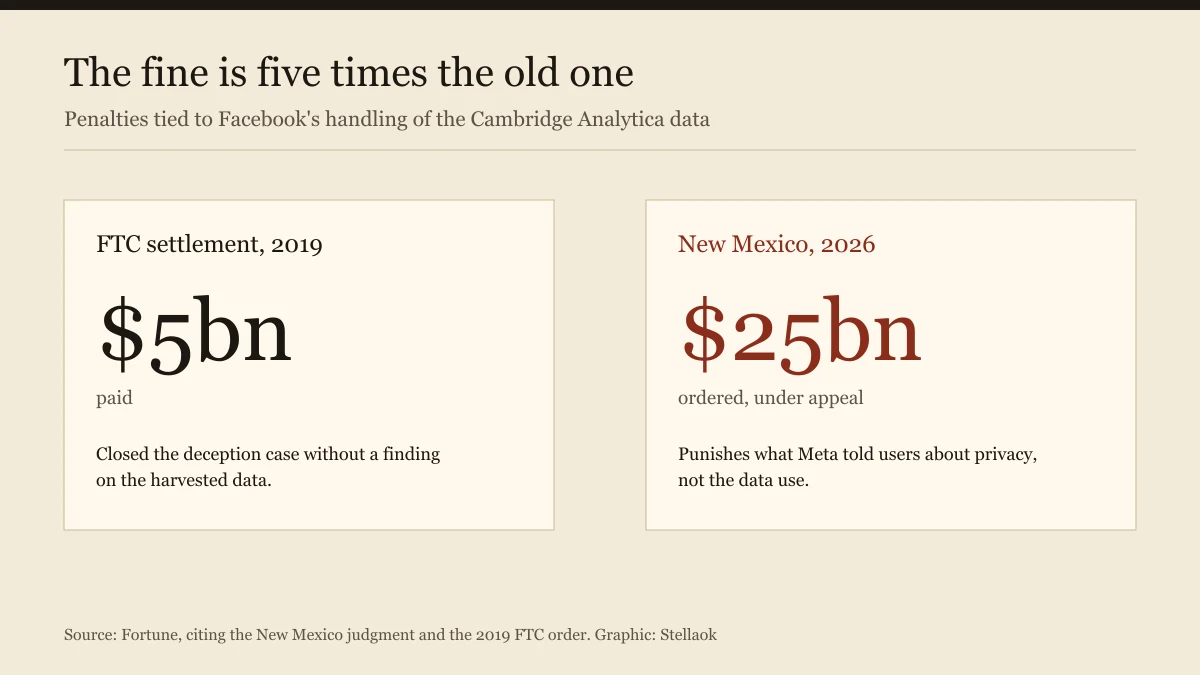
A New Mexico judge ordered Meta to pay $25 billion over Cambridge Analytica, one of the largest data privacy penalties in American history. The judgment, reported by Fortune, punishes the company for statements it made about its privacy practices and its response to the scandal rather than for the harvesting of the data itself, and Meta has said it will appeal.
The distinction is the story. Cambridge Analytica used Facebook user data without permission to build psychological profiles of voters. The court did not rule on what that did. It ruled that Facebook told users and regulators things about its data handling that were not true, knew its own checks on app developers were inadequate, could not enforce deletion of data it had handed out, and failed to tell users about thousands of applications tied to misuse.
The fine is about the cover-up
Twenty-five billion dollars is five times the $5 billion the Federal Trade Commission extracted in 2019, and the increase is not because the underlying conduct got worse. It is because the later case could point at a decade of statements that turned out to be false.
That is how privacy enforcement works in the United States. There is no federal statute that sets a price for using someone's data badly, so regulators charge what they can prove, which is usually deception. The fine measures the lie, not the harm, and the two are not the same size.
Rohit Chopra made this point in 2019 when he dissented from the FTC settlement as a commissioner. He argued the agency had failed to account for Facebook's unjust enrichment and that the company's real exposure was far larger than the $5 billion it paid. Seven years later the New Mexico judgment suggests he had the direction right.
Four hundred and fifty-nine million inside seventeen billion
The number worth reading twice is smaller. In August 2026, on the eve of a child-safety trial in Oakland, Meta settled with a bipartisan group of state attorneys general for about $17 billion. The deal covered 47 states, the District of Columbia and two territories, and folded into it was $459.3 million allocated to Cambridge Analytica claims held by those states.
Divide the two figures and Cambridge Analytica is about 2.7 percent of a settlement whose subject was teenagers and social media. A decade-old scandal about election data was cleared as a line item inside a case about something else.
The language does more than the money. The states agreed to release Meta "fully, finally, and forever" from claims "whether known or unknown, whether accrued or unaccrued." Unknown claims are the ones nobody has found yet. A state that took the payment gave up the right to sue over conduct it had not yet discovered, which is a strange thing for an attorney general to sell and a very good thing for a company to buy.
Why the Senate never got the files
Part of the reason the harms were never tested is that the evidence was hard to obtain. The Senate Intelligence Committee's report on Russian interference said it could not get the corporate communications of Cambridge Analytica or its parent SCL Group, because UK authorities had already seized them. The UK Information Commissioner's Office told the scholar whose research helped expose the scandal that committee staff made initial inquiries but never filed a formal request, so no information was shared.
The British investigation had its own subject. It examined the referendum on EU membership, not the American election, which left the US side of the operation documented mostly by journalism and by a whistleblower's account. A 2020 documentary, People You May Know, raised questions about a Cambridge Analytica-linked app marketed to American churches, and the New Mexico evidence revived them without resolving them.
What is left to litigate
New Mexico opted out of the multistate settlement and went to trial, which is why it produced a judgment rather than a cheque. Attorney General Raúl Torrez said after the ruling that the state was just getting started, and the case shows that a single state willing to litigate can win against a company this size.
The open question is what Facebook gained. The judge found that the company could not police how apps used the data it gave them, which means the value of the misuse accrued to the app developers and to whoever bought their profiles. Nobody has put a number on that, and the releases now covering 47 states make it harder to try.
Meta's response to the ruling was that the case seeks to impose a tax on speech to enforce new rules for what people can say online. That framing is about the First Amendment and not about whether the company's statements about data handling were accurate, which is the question the judge actually answered.
The pattern is familiar from other settlements this year. Meta's small-business AI tool started with 200 million owners on the same premise that scale settles questions of consent, and a federal judge described a Flock camera search as mass surveillance in a ruling that also turned on what the company told the public. The difference this time is the size of the cheque, and the fact that it was written for the explanation rather than the act.