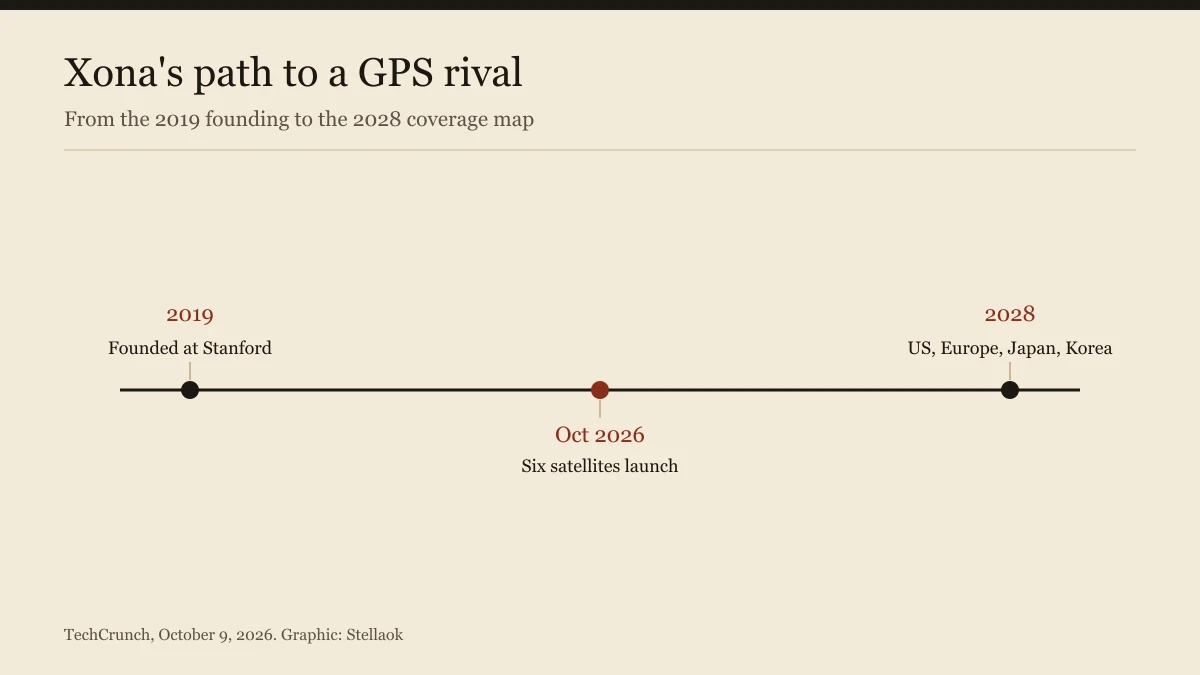
A SpaceX rocket is scheduled, in October of 2026, to launch six satellites for Xona Space Systems, a startup selling precision navigation and timing as a commercial alternative to GPS. Four of the satellites resemble a prototype the company flew last year and ride on a platform from Aerospace Labs. The other two were built entirely at Xona's headquarters in Burlingame, California. Those two are the pattern for Pulsar, the 258-satellite constellation the company intends to operate.
TechCrunch's visit to the company records the bet chief executive Brian Manning says he first resisted. He and four other engineers met in Stanford's aerospace graduate program. The company dates to 2019. Tyler Reid, now chief technology officer, wrote a PhD thesis on using low-Earth orbit to improve navigation, then worked on self-driving cars at Ford, where he concluded a service like Pulsar would be required if those cars were going to leave the test track. Manning's first reaction, over what he calls pizza and beer, was that replacing GPS was a foolish product. GPS is free. His revision is that the market is the hardware: billions of devices sold every year, none of them given away. A Falcon 9 carried Google's AI chips to orbit on Thursday. Xona's six are a different payload on the same class of rocket.
Existing receivers are supposed to hear it
The technical claim Manning walked through is twofold. The satellites keep time without atomic clocks on board, using their closeness to Earth and a steady link to ground clocks. The signal is meant to be picked up by GPS receivers already in the field. A software change is what Xona says a receiver needs, and that patch is also how it expects to clear the rules on broadcasting a navigation signal. Government systems from the United States, Europe, China, and Russia remain the free layer. Manning's pitch is that those signals are easy to jam and too coarse, on their own, for farm robots and self-driving cars.
Centimeters, and a pass overhead eight times a day
Pulsar is specified at centimeter-level position, against the meter-level figure Manning uses for GPS. He says the signal is strong enough to be read inside buildings and on city streets, and strong enough, in his view, to raise the cost of jamming and spoofing. Beta testing starts once the new satellites are overhead at mid-latitudes, about eight times a day. Ian Gough, chief executive of TimeBeat, which sells electronic timing, says the pilot lets his engineers check and correct clocks on devices around the world. The coverage map Xona is selling for 2028 is the United States, Europe, Japan, and South Korea.
The round is just over $300 million
Xona has raised just over $300 million from venture investors since 2019, including $20 million from the U.S. Space Force. The government money sits next to a commercial service. Manning's case for the Space Force check is the same one he gives customers: jamming and spoofing of satellite navigation have become ordinary in conflicts, and a second signal is a product whether or not the buyer wears a uniform. SpaceX is buying 14 megahertz of spectrum for Starlink Mobile. Navigation is the other satellite service private money is trying to sell beside connectivity.
The safety bar he named is a landing airliner
From the Burlingame office, which looks onto the approaches at San Francisco International, Manning points at landing airliners and calls civil aviation the safety standard he wants Pulsar to help a car meet. Hands off the wheel, he said, should feel as settled as sitting back on an airliner.