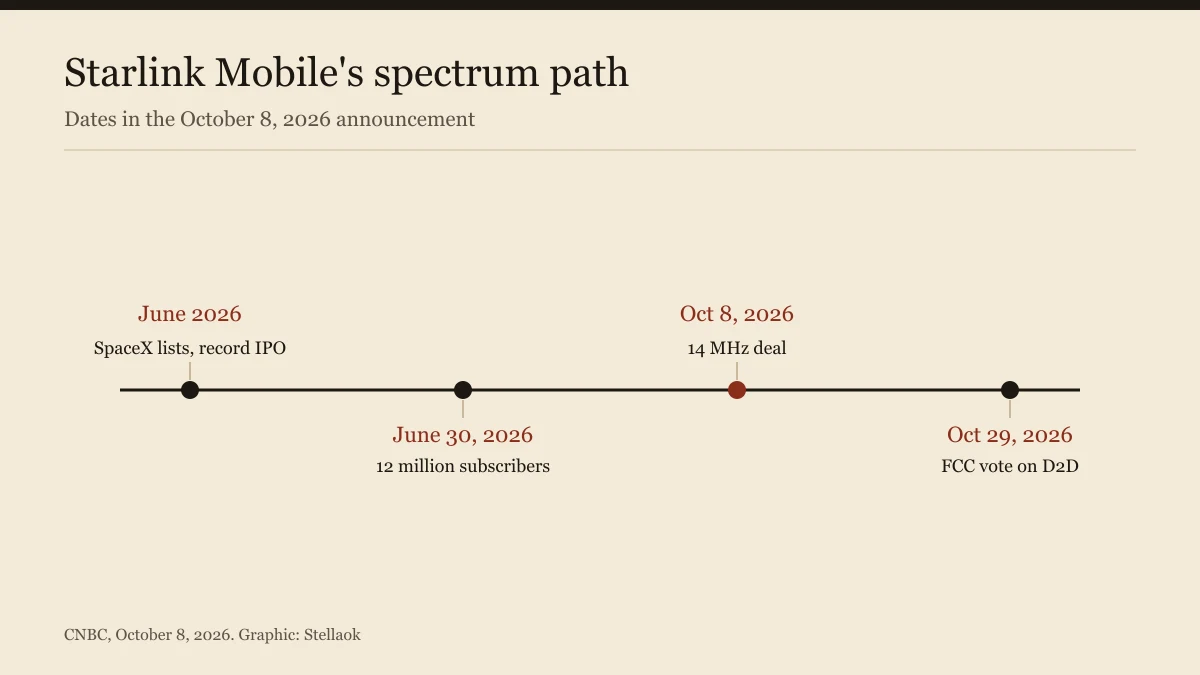
The carrier joint venture last week is the context for the share drop. Three national networks said they would work together on satellite coverage for places they do not serve well, and they left Starlink out. T-Mobile had already stopped putting Starlink's name on T-Satellite ads. Farrar's caution is that 14 megahertz will not punch through city buildings by itself. SpaceX's own statement treats the band as the missing piece for a phone service. Those two sentences can both be true: the license is low-band spectrum the company did not have, and it is not a tower network.
SpaceX did not answer CNBC on when the new service would start if regulators approve it. If the license clears, the company says the spectrum lets it combine satellite coverage with ground towers once those towers exist. The stock rose about 2.5 percent in extended trading after falling 4 percent in the regular session. Farrar's point about urban buildings is the limit on a 14-megahertz holding: phones indoors still need a tower, and SpaceX has not said it has built that network.
SpaceX agreed on Thursday, October 8, 2026, to buy a nationwide spectrum portfolio from Grain Management, a digital-infrastructure firm. The package is a license for up to 14 megahertz of paired spectrum in the 800 MHz band. It still needs the Federal Communications Commission. SpaceX said the low-band airwaves close a technical gap on the way to making Starlink Mobile a major U.S. mobile carrier. Elon Musk called it a very big deal on X. Shares of AT&T, Verizon, and T-Mobile fell in extended trading.
CNBC's account sets the purchase against a joint venture the three carriers announced last week, aimed at expanding coverage in underserved areas by satellite and direct-to-device service. Starlink was not in that venture. T-Mobile has also taken Starlink's name off its T-Satellite promotions. Tim Farrar of TMF Associates said the deal adds fuel to the fight, and that 14 megahertz is still a limited slice. Reliable coverage inside city buildings, he said, would require SpaceX to put towers on the ground. India's ministry told Starlink this week that it is in the same queue as two other satellite licensees. The U.S. move is a purchase, not a permission slip.
The FCC votes on October 29, 2026
A day before the Grain announcement, the FCC said it would vote on a proposal to auction 25 megahertz of what it called prime spectrum for satellite-to-phone service. The same meeting, October 29, 2026, is also set to take public comment on making another 482 megahertz available for supplemental coverage from space, and on updating the rules for direct-to-device service in licensed bands. CNBC says both proposals could help SpaceX and Amazon, which is building a satellite network of its own. The 14 megahertz SpaceX wants to buy is a private deal. The 25 and the 482 are auctions and rulemakings that have not happened.
Twelve million subscribers was the June 30 count
SpaceX went public in June 2026 in a record IPO and is valued at over $2 trillion. Starlink is described as its cash cow and its only profitable segment so far. The service was in 205 countries with 12 million subscribers as of June 30, according to the second-quarter report. Connectivity produced $1.66 billion of operating income in that quarter on $4.29 billion of revenue. More than 11,000 satellites are in orbit. Deutsche Bank, which recommends the stock, estimated this week that subscribers reached 13.5 million at the end of September, including 4.1 million in the United States. Huang has said chip sales will double next year. Starlink's subscriber count is the other growth line Musk is selling, and it is the one that already throws off profit.
Starship is the rocket plan, and it is losing money
The rocket side is being slowed on purpose. SpaceX cut its planned launch cadence for next year and wants Starship reliable and fully reusable so it can stop leaning on Falcon. It is also building a cloud business and talks about orbital data centers. Those space and AI units are losing money. A Falcon 9 has already put Google's AI chips in orbit. The spectrum filing is the phone business, not the rocket.
Fourteen megahertz is what Grain is selling, if the FCC agrees. October 29 is when the commission takes up the wider airwaves. The carrier stocks moved the night of the announcement, before either vote.