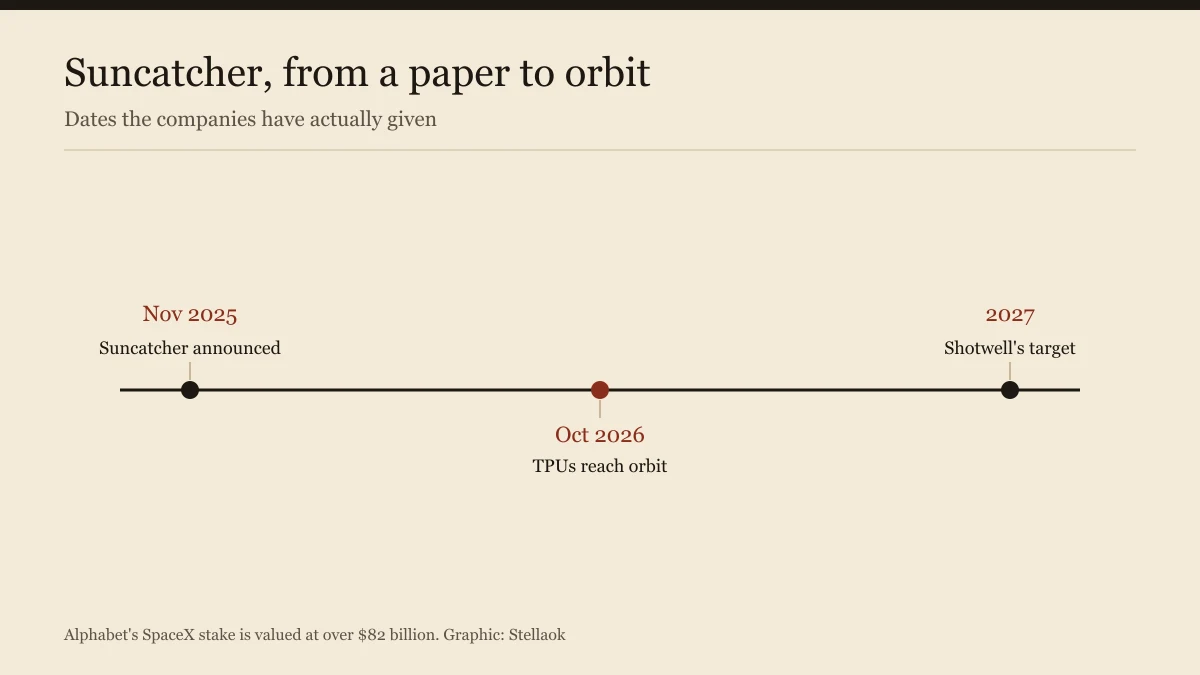
Alphabet put its own AI chips in orbit on Thursday, October 1, 2026. A SpaceX Falcon 9 lifted them from Vandenberg, on a window that opened at 11:15 a.m. Pacific. Every payload on the rocket was deployed by 1 p.m. local time.
CNBC's account of the flight identifies the ride as the uncrewed Transporter-18 mission. Among the Planet Labs satellites was a solar-powered prototype carrying Google tensor processing units. Travis Beals, senior director of Project Suncatcher, wrote afterward that the team had confirmed contact and that the satellite was operating as expected. He called the pass the first step in a research effort into whether orbit could host machine-learning infrastructure at scale.
November 2025 was the paper, Thursday was the radio check
Google disclosed Suncatcher in November 2025 and described it as a moonshot: reliable, solar-powered computing that could run continuously in space. The tensor processors have already run AI workloads in a facility at the University of California, Davis. Alphabet has also said it does not yet know how those chips will behave in low Earth orbit. Thursday's flight, from Vandenberg Air Force Base in Santa Barbara County, was the first time the company put them there. Liftoff was uneventful. Alphabet's stake in SpaceX, which listed in a record IPO in June, is currently valued at over $82 billion. The two companies compete in AI models and still flew this hardware on the same morning.
SpaceX has sold orbit as the way around the fight over data centers on the ground, using the phrase "infinite real estate." Local opposition blocked $68 billion of data-center projects in one quarter. Thursday's hardware is a solar-powered prototype on a Planet Labs satellite, and the published result is Beals's radio check. Alphabet wants that design to run continuously on sunlight, then to tie separate constellations together so a larger training job can stay overhead.
The company's year is 2027
Alphabet says satellites in low Earth orbit can reach near-constant sunlight and generate up to eight times as much solar power as the same hardware on Earth. That multiple is the company's own ceiling, printed beside a machine that has flown once. Elon Musk said earlier this year that training in space would be the cheapest option, and that this would be true within two years, or three at the latest. Gwynne Shotwell, SpaceX's chief operating officer, was more specific at a September event: the company will deploy "supercompute in space" in 2027. One speaker gave a window measured in years. The other gave a calendar year. SpaceX's own swarm would be built in Redmond, Washington, carrying GPUs and solar arrays the company plans to produce with Tesla.
Cathie Wood's revenue call moved a SpaceX share proxy, not a launch schedule. Shotwell's 2027 is an operating claim, separate from any public-market target. SpaceX has also said it will build its own orbital data centers, distinct from hauling someone else's chips on a rideshare. Those satellites would be developed in Redmond, with graphics processors on board and with solar arrays planned together with Tesla. Google's TPUs on Transporter-18 are a passenger. The Redmond swarm would be SpaceX's own machine.
Industry specialists quoted by CNBC put four practical barriers next to both projects. Launch capacity is still tight, and a ride up is still expensive. The hardware needs a cooling system. The chips have to survive extreme temperatures and radiation. Debris sharing those orbits can end a constellation that looked fine at the moment of deployment. Alphabet's own post, cited by CNBC, separates the radio check from the workload: the company has run the processors at Davis, and it has said the conditions of low Earth orbit are the test still in front of the chips. Contact with the satellite answers a different question than a benchmark.
A crew left Florida the same day, booked for six months
The same Thursday, SpaceX started a crewed run to the International Space Station from Florida's Space Coast. CNBC counts that liftoff as the second major launch of the day, after the Vandenberg rideshare. NASA's crew is booked for six months. That flight has a duration, a destination, and a job the company has flown before. Suncatcher's published result is the contact Beals reported: the satellite was operating as expected.