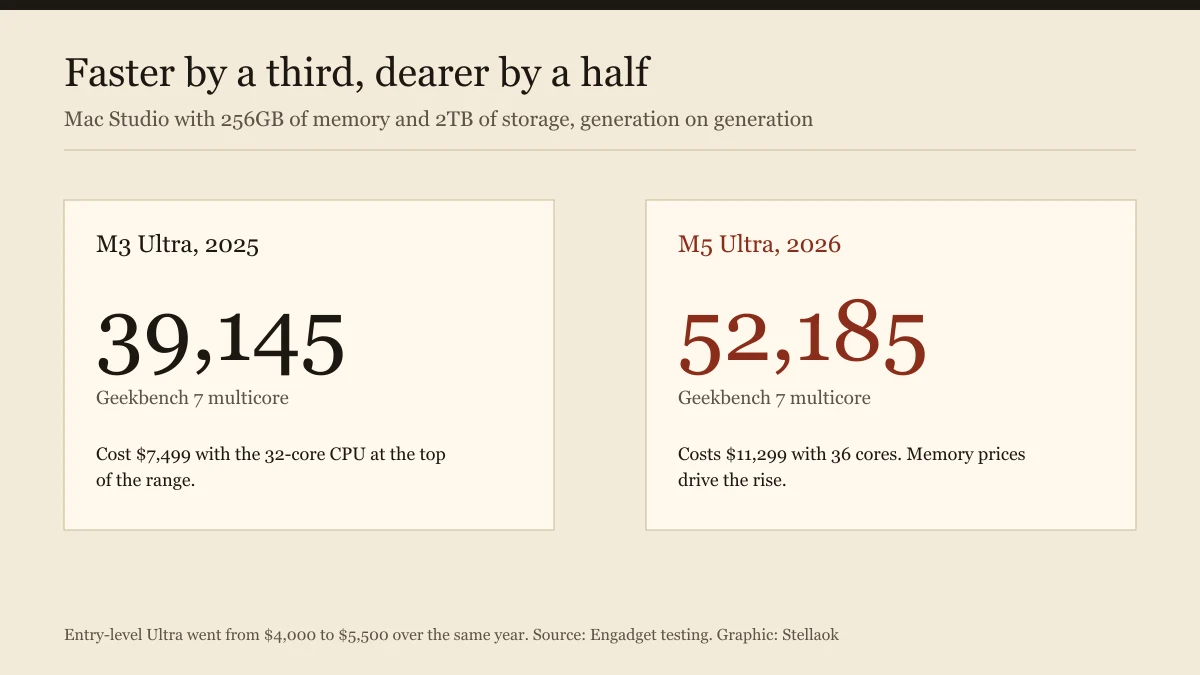
Apple's most powerful desktop started shipping today, and the most useful way to read it is as a pair of percentages. Engadget's Geekbench 7 multicore run put the M5 Ultra Mac Studio at 52,185 against 39,145 for last year's M3 Ultra, a gain of 33%. A comparable M3 Ultra configuration cost $7,499. The M5 Ultra version of the same build costs $11,299, a gain of 51%.
Both numbers come from testing the same storage and memory capacities, which is what makes the comparison worth anything. The Verge's early testing landed in the same territory, around 30% faster in single-core and multicore CPU work against a similarly configured M3 Ultra it still had on hand.
Where the extra money went, and it was not silicon
Engadget's review is direct about the cause. Memory prices have climbed through the year, and the Mac Studio is the Apple product most exposed because its whole proposition is unified memory at capacities nothing else offers. The M5 Max model moved from a $2,000 base to $2,500. The M5 Ultra moved from $4,000 to $5,500.
That is a $1,500 increase on the entry Ultra configuration before Apple's own margins are considered, and it explains why the performance-per-dollar comparison goes the wrong way this generation. A 33% score improvement against a 51% price increase is a worse deal in the narrow sense, and the buyers who need 256GB or 512GB of unified memory do not have an alternative to compare against.
The wider component market is under the same pressure. Micron has been answering Samsung with 512GB DDR5-9200 modules at the high end while, further down the market, Fairphone has said memory now accounts for 60% of its materials cost. Apple pricing a desktop at $11,299 and a phone maker restructuring its bill of materials are the same story at two scales.
What the chip actually is
The M5 Ultra is two M5 Max dies joined together, which is the same approach as previous Ultra parts. It brings up to 36 CPU cores, 80 GPU cores and a 32-core neural engine. Only the CPU count moved, from 32 cores on the M3 Ultra, with GPU and neural core counts unchanged.
Unified memory currently ships in 96GB and 256GB configurations, with 512GB arriving next month. Entry pricing is $5,499 for 30 CPU cores, 64 GPU cores, 96GB and 1TB of storage. The Verge's review unit, at 36 cores, 256GB and 4TB, reached $12,299.
The chassis has not changed since 2022. It is still 3.7 inches tall and 7.7 inches square, and still stackable. Ports are unchanged too: a fast memory card slot and two Thunderbolt 5 ports on the front of the Ultra model, four more Thunderbolt 5 at the back with two USB-A, HDMI 2.1, 10Gb Ethernet and a headphone jack. Thunderbolt 5 runs to 120Gbps, though accessories that can use it remain expensive.
Storage is where both reviewers ran out of superlatives. Engadget measured 14GB/s write and 11GB/s read, close to double the previous generation and about as fast as PCIe 5.0 can go. Apple initially claimed PCIe 6.0 and withdrew it.
The comparison that actually decides the purchase
It is not the M3 Ultra. It is the M5 Max sitting one tier below in the same enclosure.
Engadget's measurements put single-core CPU performance identical between the two, multicore and GPU work 20 to 30% apart, and Geekbench AI results only about 10% apart. The top M5 Max configuration with 2TB of storage costs $5,899, a little over half the Ultra's price, and does not deliver anything close to half the performance deficit those numbers imply. Engadget's verdict, at 8.9 out of 10, is that the Ultra premium only makes sense for a narrow group.
The group is identifiable. It is people constrained by memory capacity rather than compute: local model work at sizes that will not fit in 128GB, and visual effects timelines that need everything resident at once. Engadget exported a nine-minute 4K timeline built mostly from 8K H.256 footage in one minute 13 seconds, against more than eight minutes on an M3 Pro MacBook. It sustained eight 8K 30fps ProRes streams on a 4K timeline with 4K monitoring, though not on an 8K timeline, and four 7K RAW streams with heavy colour correction running together.
The Verge's Premiere test, a 4K export producing a 1.7GB MP4, finished in about 40 seconds.
Both reviewers noted that Apple is selling this generation on AI, and neither has finished testing that claim. The Verge's writer is explicit that a handful of days was enough to run standard benchmarks and not enough to find the machine's limits, and has gone looking for local model workloads to try. Apple's own framing of the M5 Ultra as a monumental step for AI remains, for now, a marketing line with synthetic scores attached. The Geekbench AI gap of roughly 10% over the M5 Max is the one measured data point, and it argues against the Ultra rather than for it.